



TL;DR:
- The US Senate Banking Committee advanced the vote on its own version of the legislative proposal this past June 10, 2026.
- The House of Representatives already approved a previous version of this bill focused on digital assets during the 2025 legislative period.
- Stablecoin reserves issued in the market require full backing in dollars or Treasury bonds for each equivalent unit in circulation.
The chairman of the US Senate Banking Committee, Tim Scott, renewed his support for the CLARITY Act on June 11, 2026, through a public statement that associates Crypto Rules with the global hegemony of the dollar.
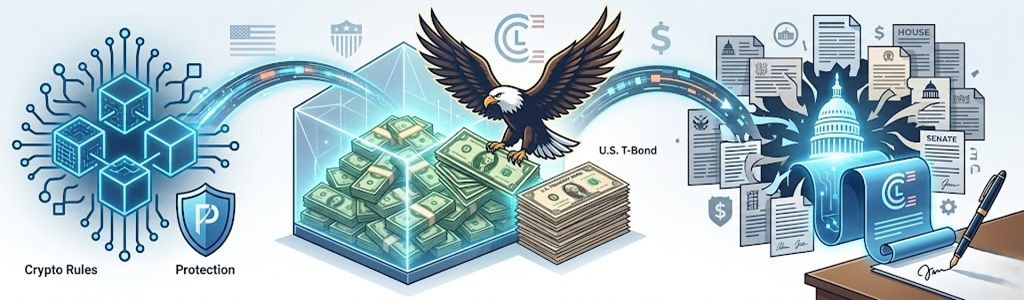
The proposal seeks to establish definitive guidelines for the issuance of stablecoins within US territory. Lawmakers on the advanced legislative committee consider that a clear regulatory framework for digital assets is strategic for protecting end users and ensuring the competitiveness of the American banking system.

The link between stablecoins and traditional debt instruments of the centralized American state constitutes the main argument of the Republican parliamentarian. Industry data suggests that tokens backed by fiat currencies generate constant demand for physical currency and public securities. Based on statements gathered by Fox Business, the senator from South Carolina detailed that stablecoins require dollars or Treasury bonds to back every cent issued, a condition presented as an advantage for maintaining the greenback’s status as an international reserve currency.
Legislative progress and the bill reconciliation process
The technical path of the proposal includes various administrative phases within the United States Congress before its eventual final ratification. The House of Representatives gave the green light to an initial version of the CLARITY Act during the year 2025. On the other hand, the Senate Banking Committee did the same by approving its own version of the regulatory text on June 10, 2026.
Official documentation indicates that the project now requires a vote on the full floor of the nation’s Senate. Subsequently, both houses of Congress must initiate a reconciliation process to unify the divergent regulatory criteria before sending the final statute to the Executive Branch for the president’s signature.
Congressman Scott also connected these regulations with the labor sector and the finances of middle-income families in the United States. According to his stance on the television panel, blockchain-based services operate uninterruptedly and lower transaction costs for households with tight budgets.
The analytical framework of the parliamentary committee further linked the deployment of distributed ledger technologies with the development of artificial intelligence in the corporate environment. According to the legislative committee’s schedule, June 11, 2026, marked the first in a series of hearings dedicated to evaluating energy consumption, water operating costs, and the financial impact that AI infrastructure and digital mining exert on local consumers.
Lawmakers’ projections aim to prevent corporations under China’s influence from taking the leadership role in the design of these key technological systems.


Be the first to comment