



In July 2025, the House and the Senate Banking Committee passed the Digital Asset Market Clarity (CLARITY) Act with a 294-to-134 margin. But even though the bill reached the home stretch, the hardest few miles were still pending.
It’s July 2026 now, a year later, and the bill is still stalled on the Senate floor.
The Act’s documents, however, were not lying on the desk under a paperweight during this one year. Rather, the Act was the subject of numerous amendments and debates that are still shaping and altering the bill to date.
But this has resulted in the window of approval getting smaller day by day due to the Senate’s full legislative calendar.

Six months of the CLARITY Act rising the rollercoaster
Along with introducing disclosure and registration requirements for crypto firms, the bill aims to establish a permanent legal framework that would make it more difficult for future administrations to undo the current pro-crypto regulatory stance.
With these agendas, the CLARITY Act is on course for a possible Senate floor vote the week of the 3rd of August. However, any additional procedural hold-ups might cause the 180-day implementation period to be postponed.
As of now, the bill has gone through more than 100 proposed amendments, stretching the draft from 278 pages in January to now 616 pages in July.
Supporters vs. critics
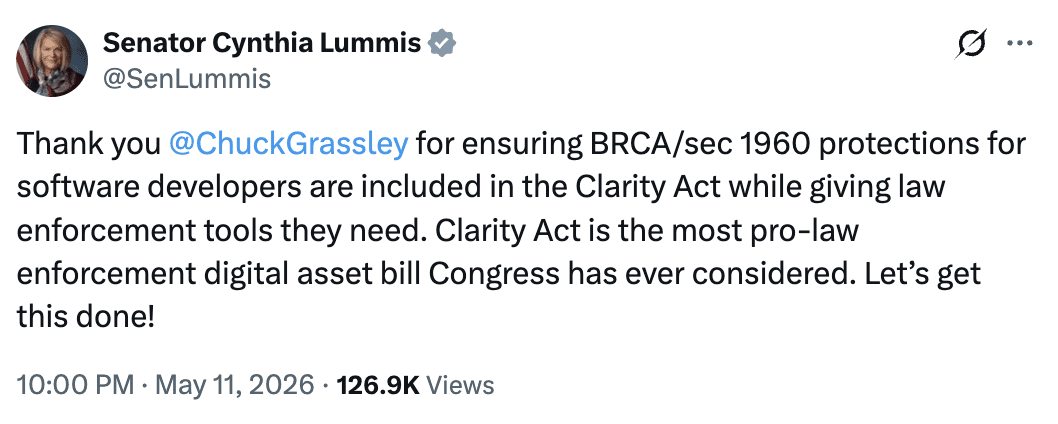
One of the most vocal supporters was Senator Cynthia Lummis, who said,
However, Senator Elizabeth Warren was undoubtedly one of the most outspoken opponents of the legislation. She emphasized that if the CLARITY Act does not curb Trump’s “corruption” in the sector, it is unnecessary.
After much back and forth, a revised draft was presented that included ethics rules that prohibited senior officials, the president, vice president, and their spouses from issuing or sponsoring digital assets for compensation while they were in office.
Additionally, the Bank Policy Institute (BPI) has criticized the draft, claiming that it still lacks safeguards against illicit finance and stablecoin yield restrictions.
This was significant since, in a recent email sent to AMBCrypto, Reeve Collins, co-founder of Tether, and Maksym Sakharov, CEO and co-founder of WeFi, discussed the significance of stablecoins and said,
Stablecoins are becoming more important because they match how people and businesses already expect digital value to move: continuously, across markets, and without waiting for traditional settlement windows.
Have the approval odds changed?
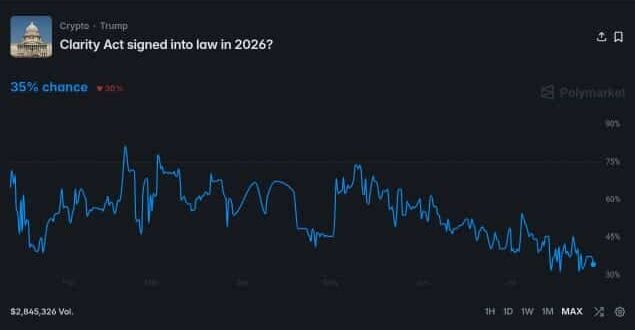
Looking at Polymarket’s approval odds, we can see that despite their strong start, the odds had fallen to 35%, a 30% decrease that indicated waning investor confidence.
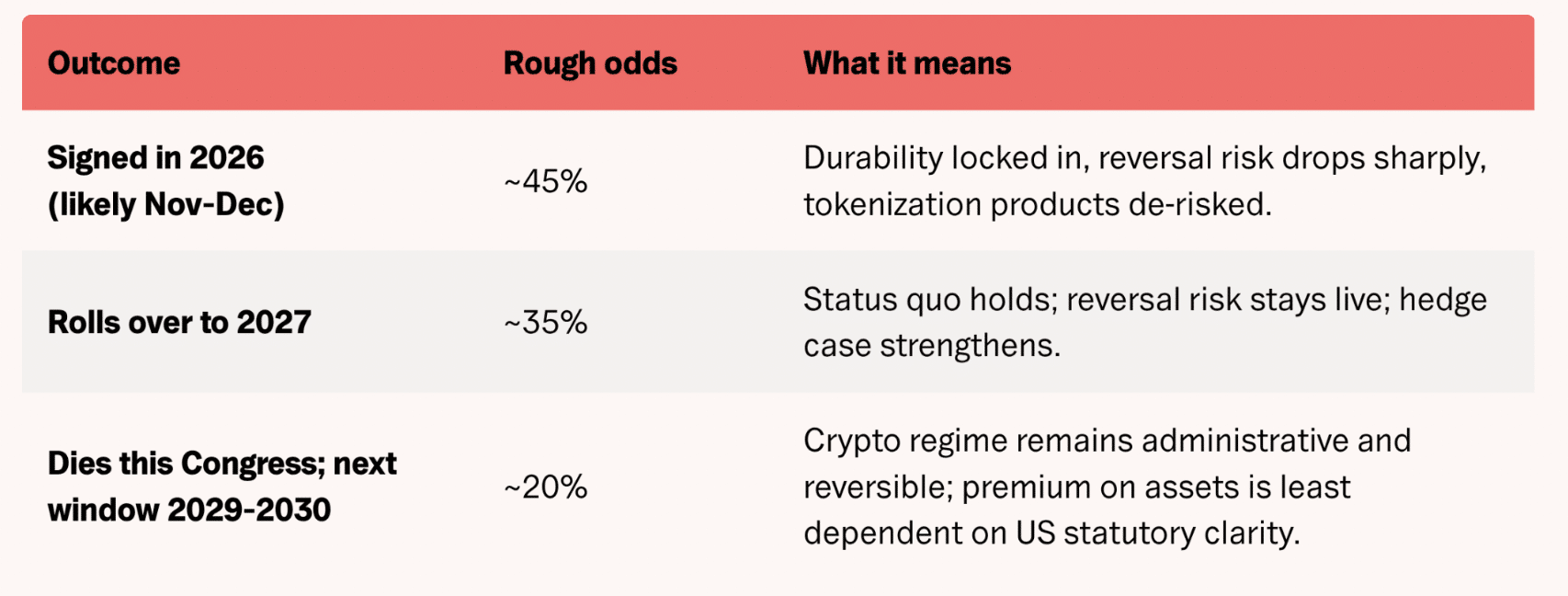
This means that the post-election lame-duck period (November–December 2026) is the most likely time frame for passage, though a postponement into 2027 is still possible.
With so much uncertainty, all eyes are now on the institutional giants. Companies like BlackRock, Fidelity, Franklin Templeton, Goldman Sachs, and SoFi have already urged Congress to approve the bill during the past week.
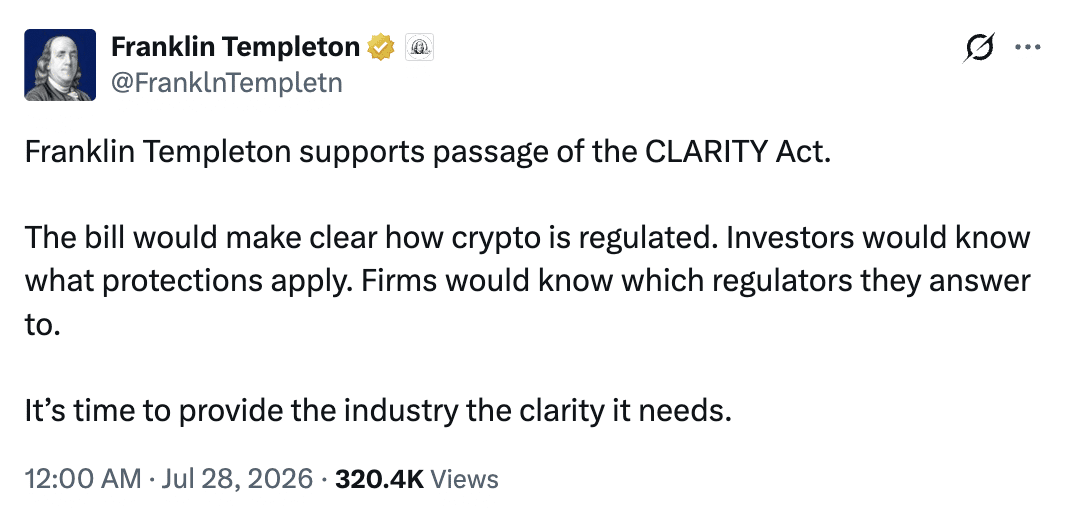
Although it’s unclear if this lobbying will result in Senate votes, institutional involvement has surely altered the discourse around crypto legislation.
The litmus test
Amidst these blockers, the latest draft of the CLARITY Act indicates that talks have progressed to a more advanced stage, and conflicting Senate proposals are now combined into a single framework.
With this, the argument has now shifted from how to implement a crypto framework to whether the United States needs one.
Meanwhile, with President Trump also stating that he would “not sign other bills” until the SAVE America Act was passed by Republicans in Congress, many people are assuming that Trump might be using the CLARITY Act as leverage in larger talks.
All in all, things are still unfolding. But if the CLARITY Act is passed, it will finally fill the gaps left by the GENIUS Act.
Final Summary
- After one year of negotiations, the CLARITY Act still seems to have a bleak chance of passing.
- But there is hope that the bill could be approved by the end of the year now that it has the support of institutional giants.





Be the first to comment