



The CLARITY crypto market structure bill could see a markup in the US Senate Banking Committee as early as next week, according to Kara Calvert, the vice president of US policy at crypto exchange Coinbase.
“My prediction is that we have a markup next week,” Calvert told the audience at the Consensus 2026 crypto industry conference in Miami, Florida.
She said that the bill needs at least 60 votes to pass in the Senate and that the CLARITY bill needs bipartisan support to become law. She said:
“That means you need Democrats. You need a bipartisan bill, and we have all been working really hard to make sure that bipartisanship holds. I think the big question is, how do these votes shape up over the next few days?”

Kara Calvert, pictured on the left, provides an update on the CLARITY market structure bill. Source: Consensus 2026

A HarrisX survey on Thursday revealed that there is strong, broad-based and consistent demand for clear federal rules. A 70% majority of voters say the US should already have passed clear cryptocurrency legislation, and 62% say it is important that the US set the global rules for digital finance.
The CLARITY bill stalled in January after Coinbase withdrew its support for the legislation, citing several concerns, including a lack of legal protections for open source software developers, a prohibition on stablecoin yield, and decentralized finance (DeFi) regulations.
Related: US senator says crypto market structure vote may happen by August
Coherent tax policy remains a barrier to institutional adoption
A lack of coherent tax policies is the main “barrier” to institutional crypto adoption, Calvert said, adding that tax reform is a bigger issue for institutions than market structure legislation.
Many of these institutions just want to buy and hold cryptocurrencies or trade digital assets, but are burdened by tax compliance and reporting requirements, she said.
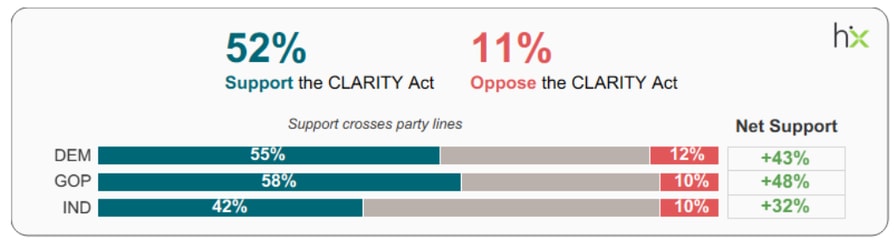
A HarrisX poll shows there is broad bipartisan support for passage of the CLARITY Act. Source: HarrisX
Tax reporting requirements under the current regulations mean the Internal Revenue Service (IRS) forces crypto exchanges to document every crypto transaction using 1099-DA forms, she added.
“We’re sending out millions of 1099-DA’s for things like $1 transactions — that makes zero sense,” Calvert said.
She added that she “hopes” tax reform legislation can advance through Congress in 2026, citing several crypto tax proposals submitted by US lawmakers, including the Digital Asset PARITY Act, introduced by Representatives Max Miller and Steven Horsford in March.
“I think that we will see action in the Senate. I think we will see legislation, probably in the next month or two, in the House,” she said.



Be the first to comment