


TLDR
- Warren said the CLARITY Act could weaken crypto illicit finance controls.
- Lummis said the CLARITY Act has more than 16 illicit finance safeguards.
- Section 201 applies BSA and AML rules to digital commodity firms.
- Section 303 gives Treasury power over certain digital asset money laundering risks.
- Trump’s crypto income and ethics concerns have slowed CLARITY Act talks.
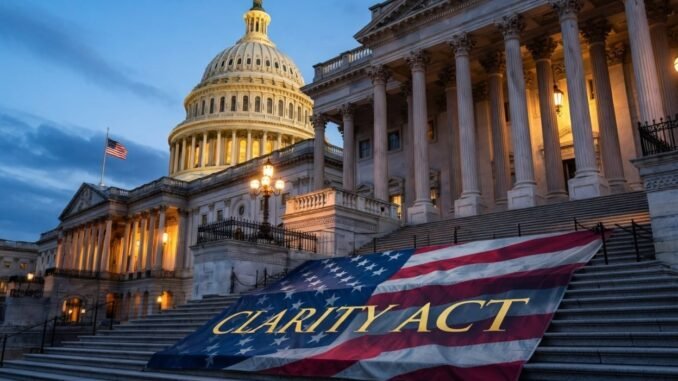
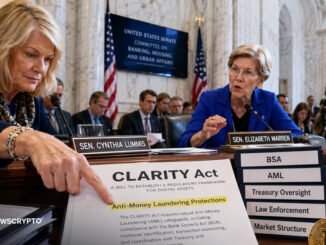
Senators Elizabeth Warren and Cynthia Lummis clashed over whether the CLARITY Act would strengthen or weaken crypto illicit finance controls, after reports linked Iran-connected wallets to billions of dollars in crypto flows.
Warren said adversaries use crypto to move large sums and argued that the current version of the CLARITY Act would worsen the problem. Lummis rejected that claim and said the bill includes more than 16 safeguards tied to anti-money laundering rules, sanctions, and temporary holds on suspect transactions.
The exchange comes as the CLARITY Act faces pressure in Washington, with prediction market odds for passage this year falling below 40% amid ethics disputes and concern over President Donald Trump’s crypto business ties.
Warren Says CLARITY Act Could Create Loopholes
Warren criticized the bill after reports described crypto transactions linked to wallets controlled by Iran’s central bank. The report said investigators traced some funds backward to the $1.5 billion Bybit hack allegedly carried out by North Korean hackers.

Warren wrote,
“More evidence that our adversaries exploit crypto to move billions.” She added that the CLARITY Act, “as it’s currently written, would make this problem worse.”
She said Congress should strengthen illicit finance standards instead of creating new loopholes. Her comments reflect a long-running concern among some lawmakers that crypto platforms can help sanctioned actors move funds outside traditional banking channels.
The reported activity involved CoinEx, a crypto exchange founded in 2017. Blockchain intelligence firm TRM Labs said wallets with identifiable Iran links moved more than $3.84 billion through CoinEx since 2019.

CoinEx Denies Government Relationship
CoinEx founder Haipo Yang acknowledged that Iranians had widely used the exchange, according to the report. However, he said CoinEx does not have a relationship with the Iranian government.
The exchange said it uses transaction monitoring, screens high-risk users, and began steps to distance itself from the Iranian market. These steps included blocking new users with Iranian IP addresses.
A CoinEx spokesperson said the exchange would conduct an internal review of transactions linking funds to the Bybit hack. The review has not been completed, and the report does not prove that CoinEx knowingly aided sanctioned entities.
The case has added attention to how offshore exchanges monitor funds tied to hacks, sanctions, and state-linked actors. It also sharpened debate over whether U.S. crypto rules should expand market access before adding stronger enforcement tools.
Lummis Defends CLARITY Act Safeguards
Lummis pushed back against Warren’s criticism and said the bill does not create loopholes. She wrote, “The Clarity Act has 16+ illicit finance safeguards, not loopholes.”
She cited Section 201, which applies Bank Secrecy Act and anti-money laundering rules to digital commodity brokers, dealers, and exchanges. The section also covers exchanges registered, or required to register, under the law that allow direct customer access.
— Senator Cynthia Lummis (@SenLummis) July 1, 2026
Lummis also pointed to Section 303, which gives the Treasury authority to act against foreign jurisdictions, institutions, or transaction classes tied to digital asset money laundering concerns.
She cited Section 305, which allows temporary holds for certain digital asset transactions involving stablecoin issuers and digital asset service providers. Lummis added, “If you don’t like crypto, then say it, but stop these baseless attacks.”
Trump Crypto Income Adds Political Pressure
The debate comes as Trump’s crypto income has become another obstacle for the CLARITY Act. His 2025 financial disclosure showed more than $1.4 billion in crypto-related assets and income.
Critics have argued that Trump’s crypto holdings create conflicts while his administration supports digital asset legislation. Ty Cobb, a former White House lawyer, described Trump’s financial filings as “the greatest onslaught of corruption in the history of mankind.”
The White House has denied conflict claims and said Trump and his family have not engaged in conflicts of interest. However, Democrats continue to push for ethics language that could restrict senior officials from holding certain crypto business interests.
Polymarket odds now show the CLARITY Act’s chance of becoming law this year below 40%. The bill remains a major crypto market structure proposal, but illicit finance rules, ethics language, and election-year politics continue to slow its path.




Be the first to comment