

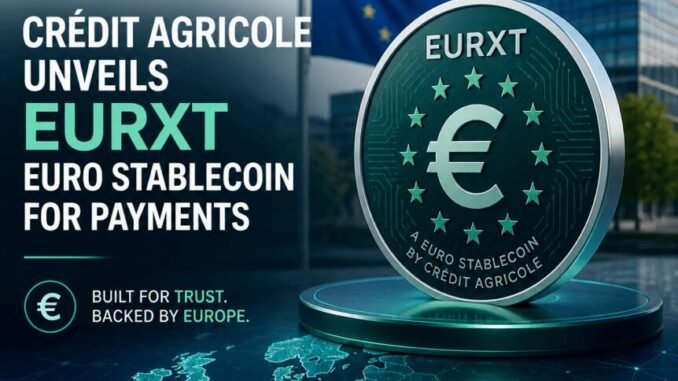

Crédit Agricole has entered Europe’s regulated stablecoin race with the launch of EURO eXchange Token (EURXT), a euro-backed token issued via its asset servicing arm, Crédit Agricole Caisse d’Epargne Investor Services (CACEIS). The bank says the rollout is intended to accelerate its broader move into tokenized finance, with the stablecoin initially aimed at institutional investors and corporate clients.
According to CACEIS’s announcement, the first subscription has already been used to purchase shares in a tokenized Amundi Money Market Fund. EURXT is issued as an electronic money token (EMT) on the Ethereum blockchain, designed to maintain a 1:1 peg to the euro.
Key takeaways
- Crédit Agricole’s CACEIS has launched EURXT, a euro-pegged electronic money token issued on Ethereum and targeted first at institutions and corporates.
- The stablecoin is structured with no stated hard cap on supply; issuance is expected to scale with demand through its smart contract system.
- EURXT is backed by euro reserves held by CACEIS Bank, with initial figures showing roughly 20.02 million EURXT in circulation matched by about the same amount in reserves.
- The launch is positioned as MiCA-compliant, following CACEIS’s June 2025 MiCA crypto-asset service provider (CASP) authorization in France.
- The move reflects intensifying competition between traditional financial institutions and crypto-native firms to deliver regulated stablecoin rails for tokenized assets.
EURO eXchange Token goes live via CACEIS
CACEIS said it launched EURXT on Wednesday, alongside its first reported subscription into a tokenized product: shares in a tokenized Amundi Money Market Fund. The integration is notable because money market funds are commonly used by investors seeking short-duration yield—suggesting EURXT is being introduced as a settlement and value-holding tool for tokenized investment workflows rather than a standalone retail payment token.
EURXT is issued on Ethereum as an EMT and pegged 1:1 to the euro. In the project’s material, the token is explicitly designed to track the euro value, with the expectation that redemption and issuance mechanics are governed by the issuer’s reserve structure and smart contract logic.

No hard cap on supply, demand-driven issuance
The EURXT white paper indicates there is no hard cap on issuance. Instead, the token supply can expand as demand grows through the token’s smart contract system.
As the white paper states: “As of the date of the white paper, there is no limit on the issuance of EURXT. The number of EURXT in circulation will depend on market demand.”
This approach matters for investors and integrators because it implies that liquidity and availability should track real-world demand for EURXT rather than being limited by an upfront fixed supply. For tokenization platforms and asset managers, that can reduce operational friction when onboarding flows require euro-backed stable settlement at scale.
At launch, the project website shows 20.02 million EURXT tokens in circulation. That circulation figure is matched by approximately 20.02 million euros in reserves held by CACEIS Bank, according to the same public dashboard.
MiCA compliance and regulator authorization in France
CACEIS frames EURXT as compliant with the EU’s Markets in Crypto-Assets (MiCA) framework, which covers crypto-asset issuers and related services across the bloc. The launch follows CACEIS’s earlier licensing milestone: CACEIS Bank secured a MiCA crypto-asset service provider (CASP) authorization from French regulators in June 2025.
While the token’s launch is presented as authorized under the French regulatory process, Cointelegraph reported it could not find the EMT approval entry on the European Securities and Markets Authority (ESMA) register at the time of writing, noting the register appeared last updated on June 26. A CACEIS spokesperson told Cointelegraph that the French banking regulator—Autorité de Contrôle Prudentiel et de Résolution (ACPR)—has authorized CACEIS Bank to issue EURXT, and that ESMA’s public register had not yet been updated to reflect the approval.
For market participants, this distinction underscores a practical point: even when an EMT is authorized to operate, the public registry status may lag behind. Builders and compliance teams typically rely on both regulator confirmations and authoritative registries, so watching for the ESMA update can be important for audit readiness and onboarding checks.
Tokenized finance momentum: banks move closer to stablecoin rails
EURXT’s launch adds to a growing wave of stablecoin and tokenization initiatives from traditional finance players in Europe. The story also fits into a wider trend: major banks and asset-service firms are increasingly exploring blockchain-based settlement for institutional use cases, with stablecoins positioned as a core primitive for moving value and interacting with tokenized funds.
Cointelegraph previously noted that HSBC and BNP Paribas—Europe’s two largest banks by assets—joined the Canton Foundation last September to accelerate tokenization of institutional real-world assets. EURXT extends that direction by putting a regulated euro-backed token into an ecosystem intended for real trading and investment flows, rather than limiting experimentation to internal pilots.
At the same time, the competitive landscape remains active across both Europe and the US. In Europe, Cointelegraph coverage referenced other MiCA-compliant stablecoin developments from firms such as AllUnity and Quantoz Payments, which continues rolling out euro-denominated stablecoins. In the US, Cointelegraph reported that Open USD (OUSD) has attracted more than 140 participant companies, including Visa, Mastercard, Coinbase, and Ripple, building a dollar-pegged token model where participants can mint at no cost and keep earnings from reserves.
These parallel tracks highlight a key tension in the market: regulated, issuer-backed euro stablecoins like EURXT are expanding through traditional banking rails, while crypto-linked ecosystems continue to scale alternative stablecoin issuance and distribution models. The difference matters for investors evaluating custody, compliance workflows, settlement speed, and how easily tokenized products can integrate with stablecoin liquidity.
Next, market watchers should focus on two practical questions: whether EURXT’s supply growth remains smooth as demand increases (given the no hard cap design), and how quickly ESMA updates its register to reflect CACEIS’s EMT authorization. Those details can influence onboarding timelines for institutional platforms and compliance teams looking to integrate euro-backed token settlement into tokenized financial products.



Be the first to comment