



Software-payment wallets are spending sooner and receiving repeat funding, according to Chainalysis, offering evidence of recurring use without establishing how independently AI agents make purchasing decisions.
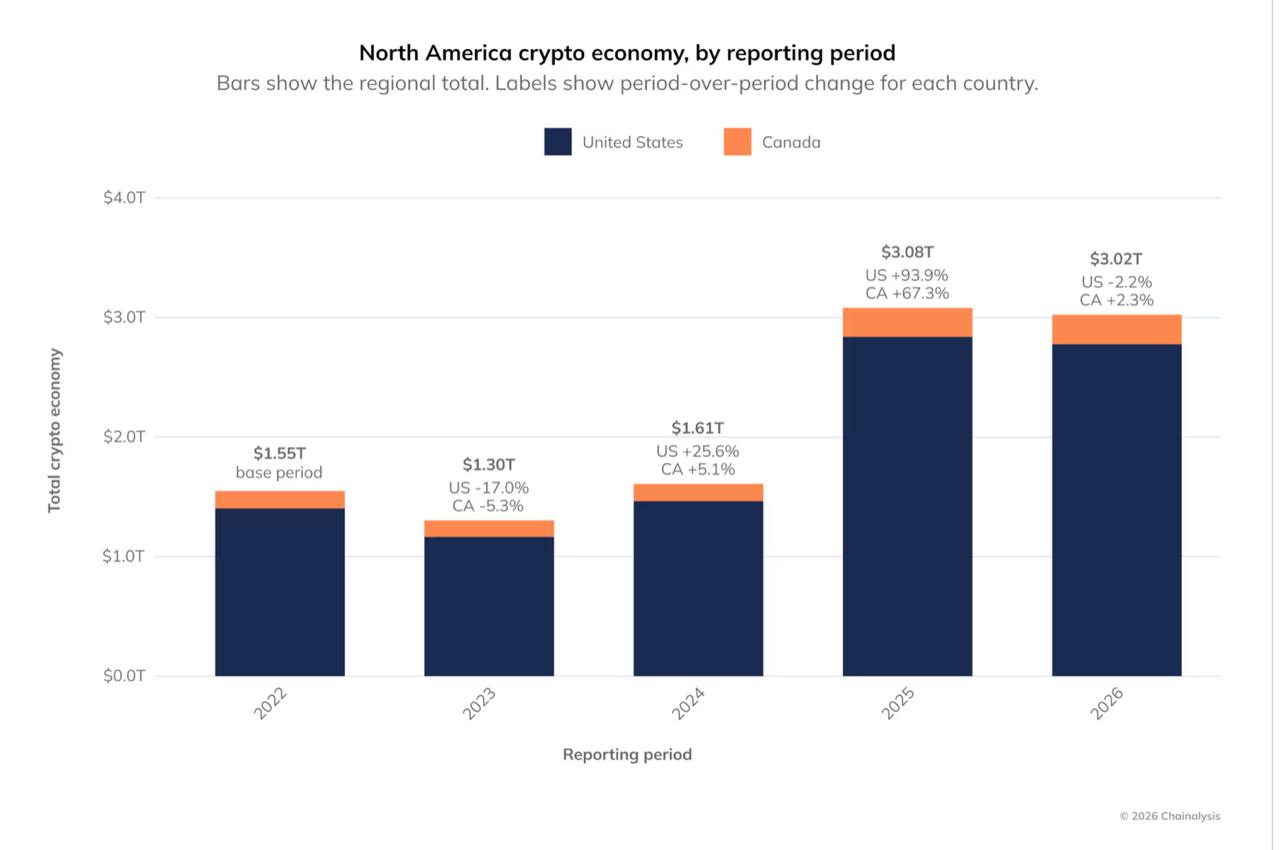
The findings appear in the North America chapter of its 2026 Geography of Crypto Report. The region received an estimated $3.02 trillion in onchain value during the 12 months ending July 1, 2026, down 1.9% from the previous period. That total measures received crypto value—not revenue from AI services or consumer spending.
The agent-payment analysis examines a narrower activity: software using x402 to pay for online resources. Its relevance lies in whether those payments serve repeatable tasks, rather than how large a regional crypto total looks.
How software pays for a single request
Coinbase introduced x402 in May 2025 as an open standard for stablecoin payments over HTTP, the protocol used for web requests. It uses the HTTP 402 “Payment Required” response to tell an application what a resource costs and how to pay.
A hypothetical research assistant might need a fresh dataset to complete a report. Instead of stopping at a subscription page, its software could request the data, receive payment instructions and authorise a purchase within a budget set by its operator.
- Request: The application asks a service for a resource.
- Price: The service responds with payment requirements.
- Payment: The application retries with a signed payment payload.
- Delivery: Payment is verified and settled, and the service returns the resource.
This can support pay-per-use access without requiring a person to enter card details at each purchase. It does not remove the need for records, spending permissions or a way to handle a service that delivers unusable results.
Coinbase explicitly describes x402 as usable by people, ordinary scripts and AI agents. A payment made through the protocol is therefore not, by itself, evidence that an AI model selected the service or decided the purchase was worthwhile.
Repeat funding is useful evidence – with a restricted sample
Chainalysis reports more than 138 million x402 transactions on Base by the end of its main reporting period. A separate payment-size analysis extends through September 2026 and finds that more than 87% fell between one-hundredth of a cent and 10 cents. Those observation periods should not be treated as interchangeable.
The researchers also examined wallets that paid on at least two separate days. Within that selected group, the share receiving another deposit within 30 days rose from 70.6% for the Q3 2025 cohort to 89.3% for Q2 2026. Separately, the median funding-to-first-payment interval fell from 73 days in late 2025 to 18 minutes in Q3 2026.
The repeat-funding result describes wallets already showing recurring activity. It is not a retention rate for everyone who tried x402, and it does not reveal how many one-time users abandoned it.
Faster activation is consistent with wallets being prepared for immediate use. But several explanations remain possible: a scheduled script, an application’s automatic setup or an agent acting within delegated permissions could produce similar transaction patterns. The blockchain record alone cannot distinguish those cases.
What the figures establish: Selected wallets receive repeat funding, and newer wallets begin paying sooner. Establishing autonomous commercial demand also requires information about the payer, the service purchased and whether the activity represents production use.
A small payment still needs a spending decision
For a business, approving every tiny request manually would defeat much of the purpose of automation. Giving software unrestricted access to a funded wallet creates the opposite problem: a mistaken task, repeated request or malicious service could consume the balance.
A practical deployment therefore needs decisions before the purchase. The operator can specify a total budget, a maximum price per request and approved recipients. It also needs a stopping rule when the task fails or produces repeated charges without useful output. These are operating controls, not evidence that every x402 application already implements them.
For example, an assistant buying financial data could be allowed to spend a fixed amount with two approved providers. A request exceeding that allowance would require human approval. Such a setup delegates routine payments while keeping the financial decision bounded.
Other ecosystems are developing comparable controls. The XRP Ledger integration for payments in XRP and RLUSD describes policy-controlled signing that lets an agent request authorisation without reading the raw private key. The owner still sets the permitted assets, recipients and spending limits.
That integration also illustrates why payment counts require context. Its reported activity does not separate testing from production, and the newer payment package remains in beta. Available software and a transaction total answer different questions from sustained use by independent customers.
Payment infrastructure does not guarantee a market for the service
Stablecoin settlement can make a small purchase programmable, but a successful transaction is only part of the commercial exchange. The buyer still needs accurate data, reliable computing or another useful result. Paying automatically cannot establish that the resource was worth buying.
Providers also have choices beyond charging separately for every request. Subscriptions, prepaid balances and aggregated billing can already support automated consumption. An x402 implementation must offer a reason to choose per-request settlement—for example, occasional access across multiple providers without maintaining a separate funded account at each one.
Earlier findings that onchain activity declined much less than crypto market value show why usage deserves examination apart from token prices. For software payments, that examination must go further than counting transfers: repeat customers, independent service providers, payment value and delivery outcomes would help establish whether a working market is developing.
The current wallet evidence supports a narrower finding: some recurring users are replenishing balances and beginning to spend more quickly. It does not yet tell readers how much of that activity comes from autonomous agents, how profitable the services are or whether customers would continue paying without incentives.
This article is provided for informational purposes only and does not constitute financial, legal or investment advice. Chainalysis’s figures reflect its methodology and observation periods and do not represent all cryptocurrency activity.

Alex is Editor-in-Chief of Coindoo and co-founder of Millennial Media Group, with nearly a decade of experience covering financial markets – crypto first, then everything else.
It started in 2016 with Bitcoin. Like most people at the time, he didn’t fully understand it – so he kept digging. Blockchain, tokenomics, the projects, the cycles. That curiosity never stopped, and eventually pulled him into traditional markets too: equities, commodities, macro. Not because he left crypto behind, but because you can’t properly understand one without the other.
What drives him is straightforward: he wants to know why something is happening, not just that it’s happening. Most market coverage stops at the headline – price up, price down, here’s a chart. Alex finds that kind of reporting actively unhelpful. If you walk away from an article without understanding the mechanism behind the move, what did you actually learn?
He holds a degree in Tourism from New Bulgarian University – not the most obvious path into financial markets, but markets have a way of pulling in people who are simply too curious to stay out. He has authored over 200 in-depth analyses and more than 10,000 articles across crypto and traditional finance. He still thinks every day in markets teaches him something new. That’s probably why he hasn’t stopped.


Be the first to comment