




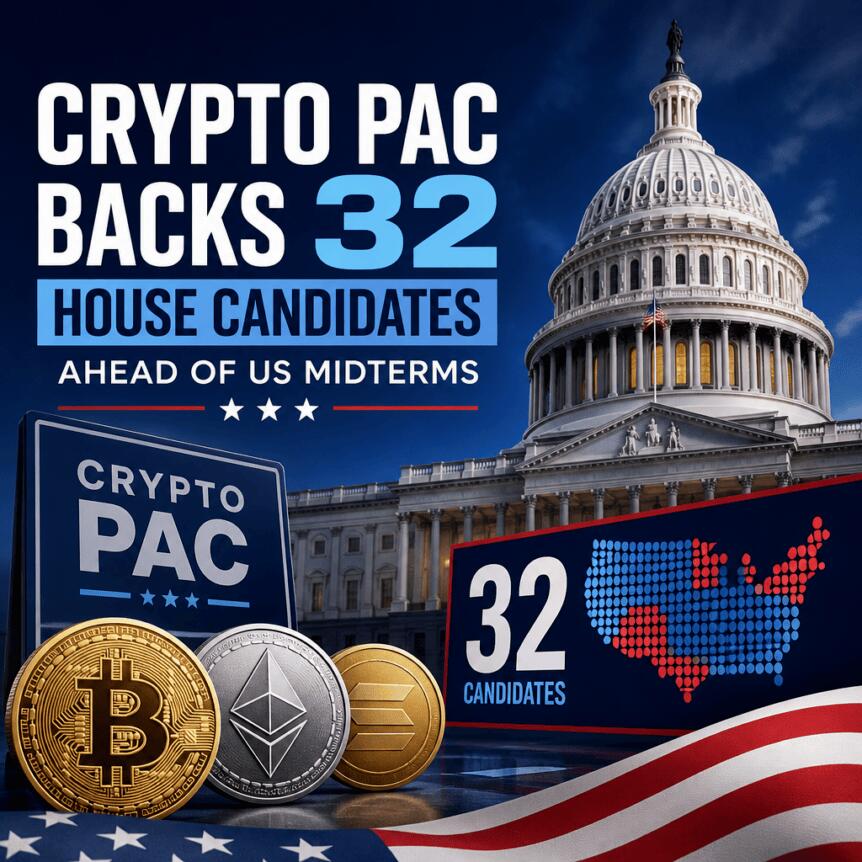
Fairshake, the influential crypto-backed political action committee (PAC) funded by supporters including Coinbase, Ripple Labs, and Andreessen Horowitz, has outlined its early spending plans for the 2026 U.S. midterm elections. The group says it will initially allocate a combined $6 million to six House candidates, selected from a broader slate of 32 House contenders it plans to back ahead of the vote.
In a Monday update, Fairshake stated it will support 19 Republican and 13 Democratic incumbents in 2026 House races. The PAC also signaled it expects to spend heavily as the campaign season ramps up, with earlier reporting from Cointelegraph noting the group is expected to spend more than $100 million on ads for House and Senate candidates in 2026, including at least $30 million in Ohio’s Senate race.

Key takeaways
- $6 million in initial spending is earmarked for six House candidates out of Fairshake’s broader 32-person House slate.
- Fairshake’s 2026 House backing plan favors incumbents, with 19 Republicans and 13 Democrats included.
- Fairshake framed its strategy as issue-based, saying it backs pro-crypto candidates across both major parties.
- All 32 candidates cited by Fairshake supported the Digital Asset Market Clarity Act, a bill that failed to clear a key Senate vote.
- Public reporting earlier indicated Fairshake has accumulated significant cash reserves and already invested heavily in previous ad spending leading up to the midterms.
A targeted early push for House incumbents
Fairshake’s announcement focuses on a limited set of candidates at the start of the cycle. The PAC said it will spend a combined $6 million ahead of the 2026 midterms on six House of Representatives races, with each candidate receiving $1 million in spending.
Among the Democrats named in Fairshake’s list are Oregon Representative Janelle Bynum, California Representative Derek Tran, and Nevada Representative Steven Horsford. On the Republican side, the PAC pointed to Arkansas Representative French Hill, Michigan Representative Bill Huizenga, and Wisconsin Representative Bryan Steil.
The decision to highlight incumbents is notable given that Fairshake’s broader political approach has consistently linked spending to legislative alignment on digital-asset policy. By concentrating early funds on lawmakers it already expects to have a role in the next Congress, the PAC may be seeking to lock in momentum while campaign attention is still forming.
“Pro-crypto” backing spans both parties
Fairshake spokesperson Geoff Vetter described the organization as issue-driven rather than ideologically bound to one party. Speaking to the PAC’s stance, Vetter said: “Fairshake has always been and always will be an issue-focused organization.” He added that Fairshake “backs pro-crypto candidates who support American innovation in both parties.”
The slate itself—19 Republicans and 13 Democrats—reflects that message. For investors and crypto-industry stakeholders, the practical impact is that Fairshake’s political strategy is designed to influence outcomes across the political spectrum rather than solely trying to shape one party’s platform. That could increase the likelihood that crypto-friendly lawmakers—regardless of party control—remain in positions to steer the next round of policy debates.
How the Digital Asset Market Clarity Act fits into the strategy
Fairshake tied its political support to legislative action: the PAC said all 32 candidates it plans to back voted to advance the Digital Asset Market Clarity Act. The bill, described as one that would establish clearer roles for U.S. financial agencies overseeing digital assets, had been widely expected to bring more structure to the sector’s regulatory environment.
However, the legislation failed to pass a crucial Senate vote, leaving the bill’s future uncertain heading into the midterms. According to the article coverage cited by Cointelegraph, many polls suggested Democrats were favored to win control of both chambers in 2027, which would influence how any successor legislation could be drafted and scheduled.
That uncertainty may help explain Fairshake’s urgency in building political support now. If a major standalone bill stalls in the Senate, PACs that prioritize regulatory clarity often shift toward reinforcing a broader coalition—essentially trying to ensure that whichever party leads after the election has lawmakers prepared to advance digital-asset oversight proposals.
Cash on hand and prior spending remain central to the midterms
Fairshake’s capacity to influence races also depends on its financial position and how much it has already committed to political messaging. In August, Vetter said the PAC had $122 million cash on hand ahead of the midterms as part of a plan to “help build the largest pro-crypto caucus in American history.”
Separately, Public Citizen reported that Fairshake had spent $82 million on ads opposing or backing candidates as of June, according to the coverage referenced in this report. Public Citizen estimated that less than half of the $189 million it calculated came from advocacy groups and companies aligned with the crypto industry.
Those figures underline why Fairshake’s decisions matter well beyond individual races. Large, sustained spending can shape voter perceptions during short windows when campaigns attempt to define candidates’ records—especially on issues that are complex or unfamiliar to many voters. And because digital-asset regulation has frequently been a moving target in Washington, political messaging can function as a proxy for regulatory expectations during election season.
Earlier Cointelegraph reporting also highlighted that Fairshake is expected to spend more than $100 million on ads across House and Senate races in 2026, with a major component earmarked for Ohio’s Senate contest—at least $30 million—to back Republican Jon Husted over Democrat Sherrod Brown.
What to watch next
Fairshake’s first-round spending decisions put pressure on other political actors to clarify where they stand on digital-asset oversight—particularly as the Digital Asset Market Clarity Act remains stalled in the Senate. As the midterms approach, the key question is whether Fairshake can translate legislative alignment into durable electoral outcomes, and whether any new regulatory proposals emerge once the next Congress is formed.
This article was originally published as Crypto PAC Backs 32 House Candidates Ahead of US Midterms on Crypto Breaking News – your trusted source for crypto news, Bitcoin news, and blockchain updates.



Be the first to comment