



Crypto spot trading volume has fallen to its lowest level since October 2023, underscoring how sharply market participation has cooled during the latest downturn.
According to CryptoQuant’s latest market review, centralized exchange spot volume dropped to $679 billion in April 2026. That marks the weakest monthly reading in more than two and a half years and signals a market where fewer traders are adding risk while prices remain under pressure.
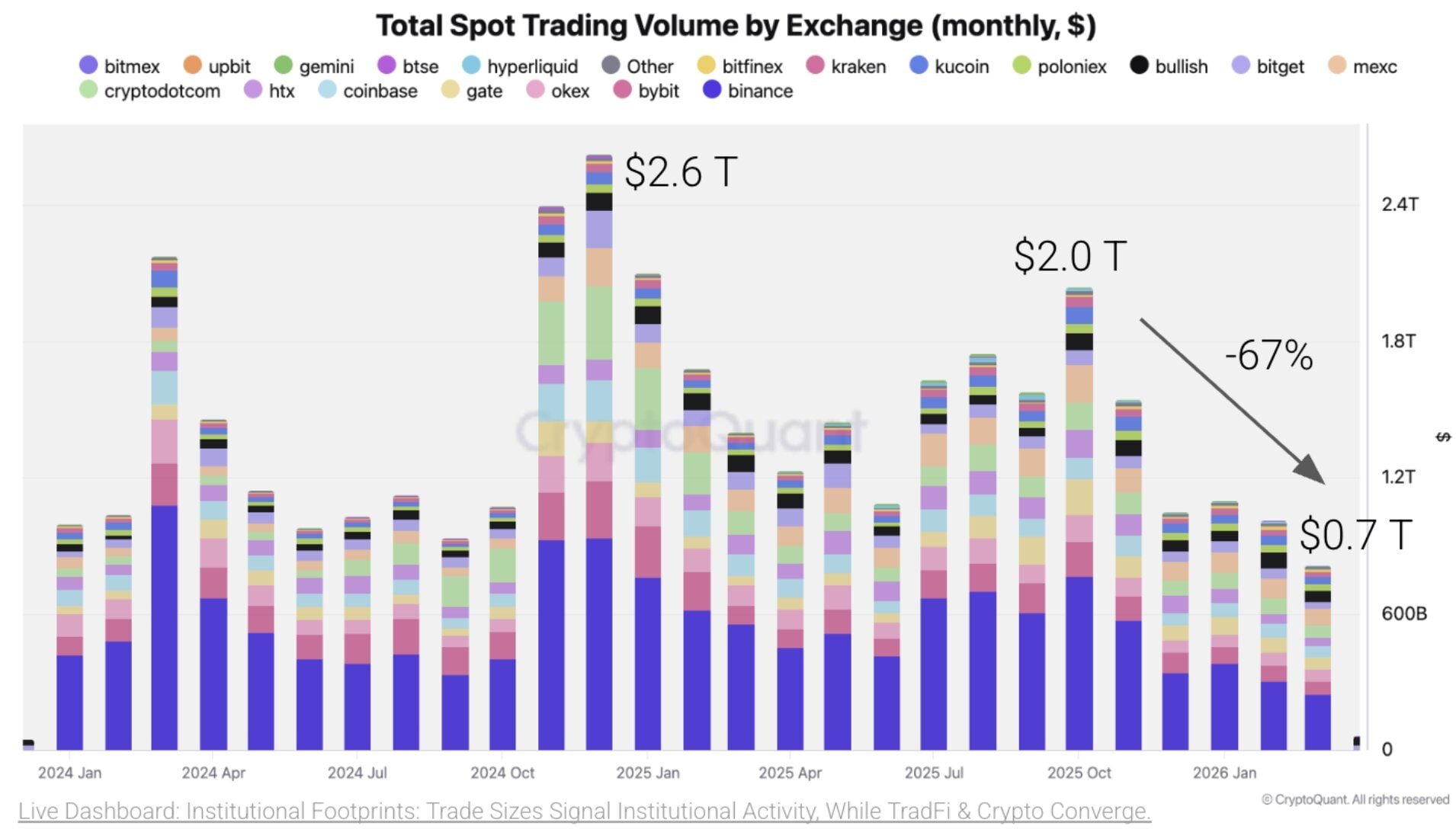
The decline comes at a difficult moment for risk assets. U.S. equities recently suffered a roughly $1.7 trillion stock-market wipeout after stronger jobs data fueled rate fears and triggered a brutal selloff across AI and semiconductor stocks. Crypto is now dealing with the same liquidity problem from a different angle: fewer spot buyers, weaker flows, and more sensitivity to large sell orders.
CryptoQuant also noted that liquidity is becoming more concentrated across a smaller group of exchanges. Binance, Bybit, Gate and Crypto.com have carried the largest cumulative spot volumes this year, while perpetual futures activity has weakened alongside softer prices and lower leverage appetite.
Thin Liquidity Makes Every Selloff Harder To Absorb
Lower spot volume matters because it changes how the market handles pressure.
When spot activity is strong, large orders can move through deeper books without causing extreme price impact. When spot liquidity dries up, the same exchange inflow, whale sale or ETF redemption can push prices much further because fewer buyers are waiting underneath.
That is why the latest weakness feels more fragile than a normal pullback. The market is not only repricing Bitcoin, Ethereum and altcoins. It is testing whether enough real spot demand exists to absorb supply after months of institutional inflows, older holder distribution and heavy leverage.
That supply-demand question has already become a central Bitcoin debate. CryptoQuant CEO Ki Young Ju recently argued that Bitcoin could have traded much lower if Michael Saylor’s Strategy and spot ETF buyers had not absorbed 1.24 million BTC sold by older whales over the past two years. The spot-volume drop makes that argument more important because absorption becomes harder when fewer market participants are active.
Weak Volume Matches Weak Sentiment
The volume slowdown also lines up with a visible sentiment reset. Search interest, social activity and trader confidence have all cooled as prices move lower and liquidity thins.
That has pushed “crypto is dead” talk back into the market conversation, with bearish social chatter reaching its highest level since February. Historically, extreme pessimism can become a contrarian signal when sellers are exhausted. The problem is that sentiment alone does not create a bottom. The market still needs buyers, volume and liquidity to return.
Very low spot volume can mean two different things. It can mark exhaustion, where sellers are running out of force and sidelined capital is waiting for a cleaner entry. It can also mean a fragile market where even modest selling pushes prices sharply lower because depth has disappeared.
Liquidity Is The Real Market Test
The current market is no longer being driven only by headlines or technical levels. Liquidity has become the main story.
Spot volume at its lowest level since October 2023 means rallies may struggle unless real buying returns. It also means breakdowns can become sharper when derivatives liquidations, ETF outflows and whale transfers hit at the same time.
For Bitcoin and the wider crypto market, the next recovery needs more than a short squeeze. It needs spot participation to rebuild across major exchanges, ETF flows to stabilize, and buyers willing to absorb supply without relying only on leverage. Until that happens, low volume will remain one of the clearest signs that the market’s problem is not just sentiment. It is liquidity.


Be the first to comment