



- Wrench attacks jumped 33.3% globally, with exposure surging 11.8-fold to $124.1 million.
- Home invasions rose from 1 to 20 cases, overtaking kidnapping as the leading tactic.
- France recorded 33 of 52 global incidents, driven partly by leaked personal data.
Wrench attacks against cryptocurrency holders didn’t just get more frequent in the first half of 2026 — they changed shape.
According to CertiK’s newly released Intel3D: H1 2026 Wrench Attacks Report, the defining story of the period isn’t the rising incident count on its own, but a sharp pivot in how attackers operate: away from opportunistic robbery and toward coordinated home invasions built on leaked personal data.
Home Invasions Overtake Kidnapping
CertiK verified 52 wrench attacks against cryptocurrency holders worldwide in the first half of 2026, a 33.3% increase from 39 in H1 2025.
Sponsored

Crypto Prediction Markets
18+ · Gambling involves risk. Play responsibly.
Recorded financial exposure — covering ransom demands, transferred funds, and frozen assets — jumped to roughly $124.1 million, up 11.8-fold from $10.5 million a year earlier.
Yet, the report’s central finding is a tactical shift: home invasions rose from a single publicly reported case in H1 2025 to 20 in H1 2026, now accounting for about 41% of all verified incidents. Kidnapping, still a significant tactic, rose more modestly, from 12 to 16 cases.
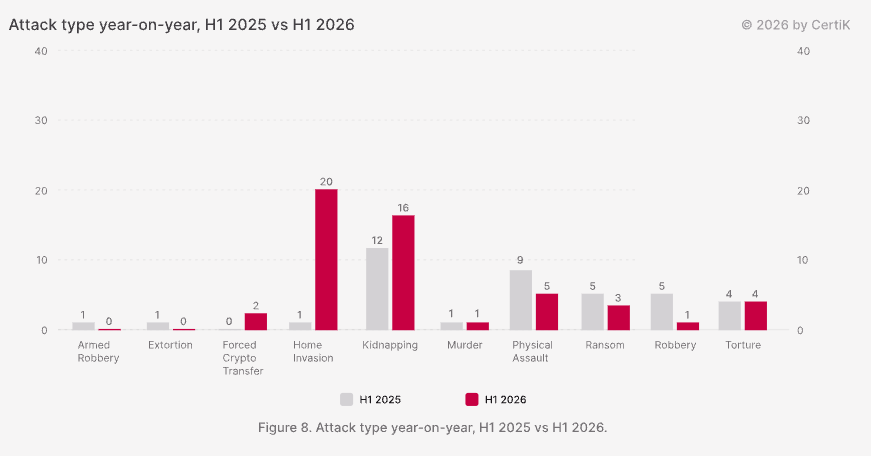
CertiK links the shift to improved wallet security. As multisig setups, hardware wallets, and cold storage have made remote hacking harder, attackers have moved toward the person holding the keys.
A home invasion attacks a victim’s entire security perimeter at once — residence, family, device access, and psychological composure — in a way a remote hack cannot.
Europe accounted for 39 of the 52 incidents (75%), with France alone recording 33 — 63.5% of the global total. The US recorded 4 incidents; Sweden and the UK recorded 2 each.
Data is the new Attack Surface
A major focus of the report is how targets are identified. CertiK highlights a growing “data supply chain” of leaked databases, tax records, exchange data, and social media activity used to build detailed profiles before physical contact.
Specific cases cited include a French tax administration employee allegedly selling investor data to criminal networks, and an extortion attempt Kraken disclosed involving malicious insiders in its client-support environment.
The report reframes personal data exposure — not just wallet security — as a physical safety risk.
Threat Is Organized, Not Opportunistic
CertiK report describes a layered criminal model behind many attacks: organizers who source victim data and coordinate logistics, local recruiters, and ground-level operators — often young men recruited through messaging apps, some themselves coerced into participating.
French authorities have made roughly 200 arrests since January tied to crypto-linked kidnapping and extortion, with several dozen of those arrested identified as minors.
CertiK attributes France’s crypto-related crime concentration to its visible crypto ecosystem combined with recent data breaches at institutions like France Travail and ANTS, which may have expanded the pool of identifiable targets.
Security Recommendations for Crypto Users and Companies
For individuals and families, CertiK recommends reducing exposure by removing wallet addresses, portfolio screenshots, home details, travel plans, and other public signals of wealth.
It advises separating wallets, securing long-term holdings through multisig or MPC systems, adding withdrawal controls, and keeping recovery materials away from signing devices.
Families should also prepare emergency procedures, strengthen home security, and avoid carrying sensitive wallet access on everyday devices.
For founders and high-profile holders, the report recommends assessing personal risks, eliminating single-person control over treasuries and critical systems, and verifying meetings, travel, and public appearances.
It also advises reviewing past online content for leaked personal information and creating a response plan with legal, security, and custody partners.
CertiK also highlights the need to reduce human points of failure through multi-party controls, limited data exposure, and stronger insider monitoring for institutions and wallet providers.
Wallet providers should build in safeguards such as emergency freezes, spending limits, safer recovery options, and privacy-focused defaults.
Why This Matters
The shift toward home invasions shows that as on-chain security improves, attackers are targeting the physical safety of holders instead. This reframes personal data protection as a security issue with direct physical consequences for the crypto community.
Dive into DailyCoin’s popular crypto news today:
Glassnode Investigates Customer Data Exposure, Warns of Phishing Risks
Prediction Markets Lift Rate-Hike Odds, XRP Rally Faces Risk
DailyCoin’s Vibe Check: Which way are you leaning towards after reading this article?






Be the first to comment