


Disclaimer: The below article is sponsored, and the views in it do not represent those of ZyCrypto. Readers should conduct independent research before taking any actions related to the project mentioned in this piece. This article should not be regarded as investment advice.
Didi Hamann said the most dangerous opponent in football is the team with nothing to lose — not because they are better, but because they have already made peace with losing. That frees them to play without the weight that better-resourced sides carry into every decision.
His approach across a career spanning Bayern Munich, Liverpool, and two Champions League finals was built on the same logic in reverse: stay calibrated. The score does not change how you play. The situation does not change the process. Your position on the pitch does not entitle you to do things you would not normally do.
The trading panel arrived at the same place from a different direction. When a framework is built before the market opens, pressure stops being a variable and starts being information.
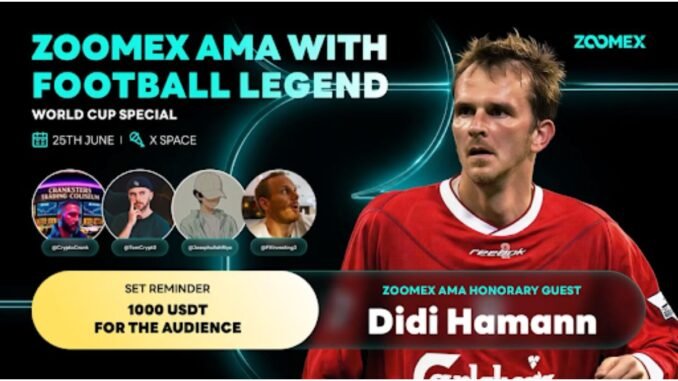
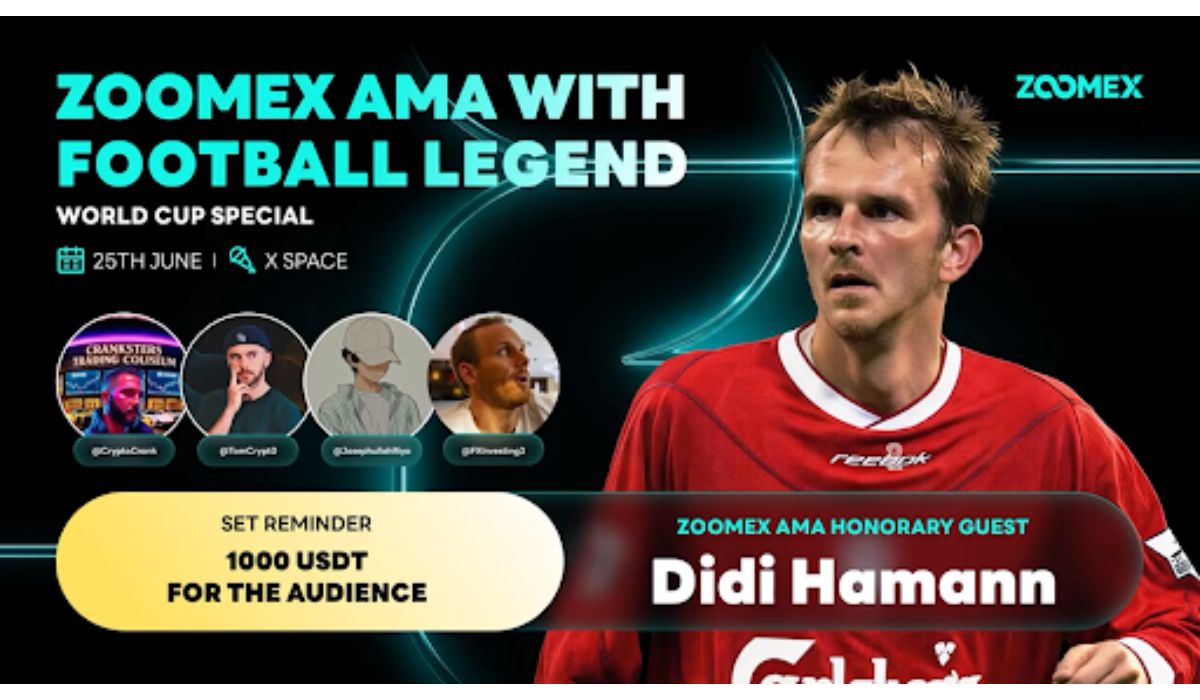
Zoomex hosted the second episode of its World Cup Edition X Space as part of the Zoomex World Cup Impact Pledge, bringing together Champions League winner Didi Hamann and three traders: Mario from Forex Trading & Investing, Crank, and Joseph. Fernando Aranda hosted the session, which spanned World Cup analysis, the German squad debate, career philosophy, and the kind of crypto-to-football comparisons that only hold together when neither side takes them too seriously.

 
The session continued the five-part charity initiative launched in the first episode. Across five World Cup episodes, Zoomex is committing 1,000 USDT per episode to a charity of each football guest’s choosing — rising by an additional 5,000 USDT if the guest’s prediction proves correct. Hamann backed Japan to beat Sweden and nominated a homeless support charity in Munich, a cause he backs regularly.
Nothing to Lose. Nothing to Fear.
Fernando opened by asking which is harder: a match you must win, or one you cannot afford to lose. Hamann said the question had never been put to him that way before — and his answer repositioned the difficulty entirely.
“I always say in football, the hardest thing is when you play against a team that has nothing to lose. Because we’ve seen a lot of upsets. When a team has nothing to lose, they’re the most dangerous — they just go for it. And if they lose, they lose. It doesn’t matter. But if they win, they can gain everything.”
A team chasing a must-win result still operates inside a calculation. A team with only upside has discarded the calculation entirely. From that vantage point, he said, having to win is probably the easier of the two situations. Morocco against Italy and South Africa against South Korea were the recent examples the panel kept returning to. “Nobody gave them a chance, and here they are in the last 32.”
Crank had watched the same dynamic play out in markets. Traders who enter without a prebuilt plan are playing from the same emotional state as a team with nothing to lose: exposed, reactive, and without the protection that structure provides. The difference is that in trading, the cost of that freedom comes directly out of your account.
The Game Does Not Change at 3-0 Down.
As a holding midfielder, Hamann gave himself one instruction regardless of the scoreboard — and never deviated from it.
“I always felt in my position I couldn’t afford to give the ball away because we have players who need to take risks. And I always felt I had to play the same way whether we are 3-0 up or 3-0 down, because I wasn’t the one changing games, scoring goals, or setting up goals. That wasn’t my job. But we had players to do that.”
Those players were Gerrard, Luis Garcia, Cissé, and Baros. His job was to win the ball, protect the structure, and put it on their feet as quickly as possible. Getting carried away when comfortable, or trying to do things that weren’t in his nature when three down, produced the same result: a team that had lost its shape.
Istanbul in 2005 is the case study. Hamann came on at half-time, three goals down against an AC Milan side regarded as the best club team in the world. His reading at that moment was simple.
“I was sure, warming up at half-time — I’m sure if we scored one, we’d score a second. And if it’s 3-2, even the most experienced teams make mistakes. And then after that first goal, the stadium came alive — 40,000 or 50,000 Liverpool fans. And I think AC Milan all of a sudden thought: maybe it’s not over.”
Three goals in six minutes. Penalties after that. Luck was part of it, he acknowledged — but the more durable point was that the process didn’t change. Win the ball. Don’t concede the wrong goal. Give the ball to the people with the license to take risks.
Joseph, in this session, brought the parallel into trading directly: “I always start with a plan, like a coach picks his starting eleven before the match. But if the market moves against me, don’t wait too long — just like a coach, make a quick substitution when the team is losing control. I exit my position early instead of hoping for a comeback. The best traders are not the ones who are always right. They are the ones who know how to manage risks when they are wrong.”
Attack Is Not Enough.
Fernando raised the old argument: attack wins games, defense wins championships. Hamann agreed, then sharpened it.
“It’s almost impossible to outscore teams on a regular basis. You need a good defense, you need a balance, and a good holding midfielder. You might get to the quarters, the semis, maybe even the final. But I don’t think you win the whole thing.”
The Barcelona side most often cited as the purest attacking team of the modern era — Messi, Suárez, Neymar — was built around Puyol and Piqué in central defense and Busquets holding midfield. That Busquets point is the sharper one: the best attacking team of the generation was built around arguably the best defensive midfielder of the same generation. France in this tournament ticks the same boxes — Mbappé at the front, two of the best center-backs in the world behind him, and a holding structure that doesn’t give teams space to breathe.
On the type of error he finds hardest to watch, Hamann drew a precise distinction: “I don’t mind a technical mistake. But what I don’t like is when teams make mental mistakes — when they give the ball away in areas where they shouldn’t, where they get a bit too smart and think they can get away with it. This is what drives me crazy.”
A technical error can be explained by fatigue or a fraction of a second. A mental error has no comparable excuse. At the highest level, with everything on the line, the only reason to stop thinking is overconfidence.
Mario put the trading equivalent cleanly: “The market is the man, and we follow the market. It doesn’t make sense not to change your view if the market is against you. You only lose money when you do it like that.” Then he gave the stop loss the most useful name of the session: “The stop loss is like being a good defender. Maybe like the libero. The last man. If you kick him, you get a red card. That’s the stop loss. Last line of defence.”
Joseph extended the metaphor: “It’s just like a football defence. If your back line is not organised, even a great goalkeeper cannot save you every time. In trading, protecting your capital is like protecting your goal. If you defend well, you will always have another chance to win.”
Brazil to Win. Ancelotti to Manage.
Hamann made his tournament pick before the first game was played — and he wasn’t changing it now.
“I said at the start of the tournament, Brazil, because I think it’s a long tournament. There will be a few problems within the team, and you need somebody to handle it. And in Ancelotti, they’ve got the perfect man.”
The best defence. A strong attack. An open question in midfield. And the right coach for a campaign that tests squads not just tactically but in terms of internal management. His second breath went to France. “I stick with Brazil, but it will take a very, very good team to beat France.”
Germany occupies a different kind of space in Hamann’s thinking — somewhere between professional assessment and obvious personal investment. His read on Undav was clear: “He’s probably the best sub of this tournament. So why change it? Because everybody knows when he comes on, there’s a boost going around the ground, there’s a boost through the team. That psychological effect disappears the moment he becomes expected from the first whistle. The weapon works because it has been withheld.”
On Mecha: “He’s not a flash player, but he does the things nobody wants to do. He’s got pace, physicality, he can score. I think he was very underrated in the last few years. We might even see him at a huge club after the World Cup.”
On the group stage as a concept, Hamann was pragmatic: “You just have to get out of the group. Nobody cares how you got out. That’s when it matters.”
Dark Horses and an 18-Year-Old Who Plays Like a Veteran
Among the nations that caught his attention, Hamann pointed first to Canada as exceptional. Mexico against England at the Azteca — with altitude and a full home crowd — “won’t be an easy game.” South Africa had made the sharpest impression: “The way they played. Absolutely brilliant. Nobody gave them a chance.”
Japan was his most dangerous pick from outside the traditional powers: “They beat Germany four years ago in Qatar, Spain as well. This is a nation that improves year after year. Before 2050, they want to win the World Cup. Not sure it’s going to happen this year. But they’re dangerous.”
On a Moroccan central midfielder — 18 years old — Hamann was unambiguous: “Brilliant. The maturity he plays with, I couldn’t believe. I had to look again. How old is he? 18. Because usually central midfielders get into their best age at 22, 24 — experience counts for a lot. But the way he plays, how composed. At 18 years of age. Unbelievable.”
The Hardest Opponents. The Best Teammates.
On Patrick Vieira, the answer came without hesitation — not because Vieira was unpleasant to play against, but because of his quality.
“The most frustrating was probably the best I played against. He was like a Rolls-Royce. Quick, strong, could pass, played in an exceptional team with Arsenal. For me, he was the best, and I never had fun playing against him.”
On superstars and whether teams win because of them or for them, Hamann was direct: “It’s got to be the team. The best example was the last World Cup, where 10 players worked for Messi, and then he made the difference. That’s how it should be. On your own, you’re nothing.”
No Emotions. No Exceptions.
Crank’s answer on the emotion question was the most absolute of the session: “No emotions in day trading. You are up against robots. Within these algorithms, emotions do not exist. And anybody trading for a living needs to understand that you’re going to be so numb you do the same thing every single day. But it’s a system. And once you have it dialed in, you don’t make those adjustments.”
His summary of the central choice in trading was the sharpest line of the session: “Do you want to be right, or do you want to be rich?”
Mario agreed: “No emotions in trading. That’s the worst thing you can do. Just stick to your plan. Every day doing the same thing that works.”
Joseph described the moment after a stop loss gets hit: “Getting stopped out and watching the price go back up, that’s one of the most annoying things in trading. But I have a personal rule: after a stop loss, I take a short break — 15 to 30 minutes — before opening any new trade. This stops me from revenge trading. It’s like a player who misses a penalty. The best one would take a breath before playing on. Every loss is a lesson, but revenge trading usually turns one mistake into two.”
Crank closed on where the market currently sits: “Now’s the time more than ever to exit all the noise and really focus. This is where you separate the boys and girls from the men and women. Be violent with your education right now because this is where lives are changed.”
Which Team Is Bitcoin?
Brazil collected the Bitcoin allocation from most of the panel — the longest track record, the deepest global fanbase, the benchmark against which everything else gets measured. Joseph assigned it to Argentina for a specific reason: the 2022 World Cup, where ten players organized themselves entirely in service of one, and that one delivered. In his view, that’s the most accurate representation of how Bitcoin’s entire ecosystem functions around a single thesis.
France drew Ethereum from most voices — technically foundational, expected to perform at the highest level, measured against a standard set years ago and not yet surpassed. Portugal went to Solana: fast, direct, talent-driven, with a single player whose presence changes every calculation. Mario pointed to Spain or the Netherlands as the surprise allocations — teams that could outperform expectations the way an asset can when its narrative finally catches up with its fundamentals.
Among tournament favorites, France drew the most votes, followed by Germany. Mario, a thirty-year-old German football supporter, crossed his fingers rather than naming names.
The Lesson From the Zoomex Space
The thread connecting both halves of the session held together when the situation changed and the original plan no longer applied.
Hamann’s philosophy as a midfielder — do not vary the process at 3-0 up or 3-0 down — is the same discipline the traders described as the line between consistent performance and emotional reaction. It is not about suppressing the awareness that the situation has changed. It is about having decided in advance what you do when it does.
The 2005 Champions League final is not a story about hope, momentum, or the magic of a particular night. It is a story about a team that kept doing the right things in the right order while three goals down, until the conditions changed. “If there were no mistakes, there wouldn’t be any goals,” Hamann said. That applies to both sides of the ball. The team that keeps its structure in a crisis doesn’t create the opening. It creates the conditions for the opening to appear.
Crank’s question applies equally. In football and in markets, the answer to whether you want to be right or rich determines how you behave when the scoreline — or the chart — tells you something you don’t want to hear.
The Zoomex World Cup Impact Pledge continues across three more episodes, each with a new football guest, a new charity selection, and a prediction on record. Brazil is going to win the World Cup. Didi Hamann said so — and the charity pool for Munich’s homeless depends on Japan clearing the first hurdle.
About Zoomex
Founded in 2021, Zoomex is a global cryptocurrency trading platform with over 3 million users across more than 35 countries and regions, offering 600+ trading pairs. Guided by its core values of “Simple × User-Friendly × Fast,” Zoomex is committed to fairness, integrity, and transparency in delivering a high-performance, low-barrier, trustworthy trading experience.
As an official partner of the Haas F1 Team and the global brand ambassador for goalkeeper Emiliano Martínez, Zoomex brings the same focus on speed, precision, and discipline from the racetrack and the pitch to trading. The platform holds regulatory licenses, including Canada MSB, U.S. MSB, U.S. NFA, and Australia AUSTRAC, and has passed security audits conducted by Hacken.


Be the first to comment