



Sentiment in crypto has dived lower than a snailfish in the Mariana Trench in recent months.
Miners are capitulating to AI, cold wallets are getting exploited, and you can hardly fire up LinkedIn without reading another message from a newly unemployed crypto journalist searching for new opportunities. Even for an industry that’s endured nation-state bans, exchange blowups, and years of regulatory pressure, morale has rarely felt this low.
With business models failing and public interest dropping, many long term crypto fans have begun to question whether we’ve all wasted a decade of our lives on a pipe dream.
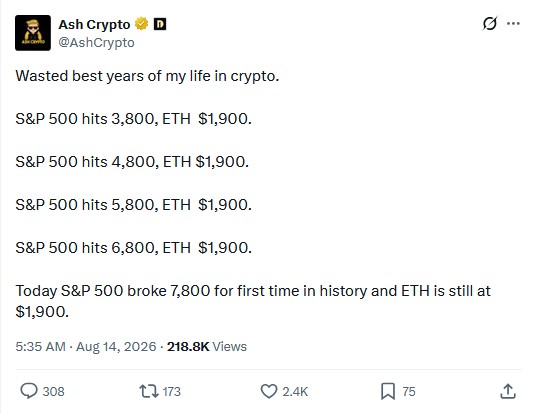
Source: Ash Crypto

Until the price went up that is.
Bitcoin has just seen its best August in years with a 26% return, while Ethereum gained 34%. President Trump even sang the praises of a decentralized offshore perpetual futures venue at the White House. Crypto’s finally getting interesting again.
But a short term price rise doesn’t mean all our dreams have come true. For anyone who spent years advocating for sovereign F-you money outside the control of the state and centralized entities, a custodial ETF is not exactly a version of BTC that sticks it to the man.
And there’s another problem with calling this a victory lap: many of the companies that helped build crypto’s foundations are no longer around to enjoy the latest pump.
Take BitMEX, one of the industry’s first Bitcoin futures exchanges that pioneered the perpetual swap and 100x leverage for degens. It’s shutting down operations in September after 11 years.
Former chief executive Stephan Lutz tells Magazine that BitMEX was a victim of its own success.
“Every legitimate crypto exchange is using the perpetual swap… every legitimate crypto exchange uses the funding mechanism to bring longs and shorts together that the founders invented originally… That isn’t going away… It’s just not a differentiating factor anymore.”
So what if crypto won — just not in the way we thought it would?
Crypto’s impact means it wasn’t a waste of time
Lutz doesn’t think crypto can simply disappear anymore because the technology has become too deeply embedded in traditional finance to be unwound.
“From my point of view, we passed the point of no return,” he says.
Utkarsh Ahuja, founder of Moonshot Capital, agrees that crypto proponents have not wasted their lives, and points to the industry’s impact on payment rails, settlement and tokenization.
Stablecoins, he says, can have a “very, very lasting impact” as they become integrated into financial payment infrastructure, and “you can literally tokenize anything.”
Related: 10 weirdest things ever tokenized… including farts
He points to crypto’s spillover into energy, healthcare and AI, arguing that the technology is being widely used beyond the industry that created it.
Decentralized finance has also made a meaningful impact on the world and is now closer to infrastructure, than an experiment. Wanja Oberhof, chief executive of Subsquid Labs, tells Magazine:
“DeFi built the first financial system where you don’t have to trust the operator’s word: you can verify the ledger yourself, in real time, down to every transaction.”
Settlement happens in minutes rather than days, he says, while markets run 24/7 and lending protocols can clear billions transparently:
“No bank consortium ever shipped anything like it. DeFi removed the intermediary and kept the market.”
But while DeFi’s infrastructure has greatly improved, Oberhof concedes the industry “over-promised on timelines and under-delivered on user experience.”
He says the real win will come when the technology “disappears into products people use without thinking about it.”
Institutions are adopting blockchain technology like crazy, and tokenized funds, stablecoins and blockchain-based settlement are no longer ideas confined to the hallways of crypto conferences.
But crypto isn’t so much replacing the financial system as being absorbed by it.
The crypto industry’s success is a key reason it no longer feels as exciting or impactful. The more TradFi becomes involved, the more boring crypto seems, especially when compared to the days when the Long Island Iced Tea Corp changed its name to Long Blockchain Corp back in December 2017 and the stock price surged 500%. (It was delisted two months later for misleading the market).
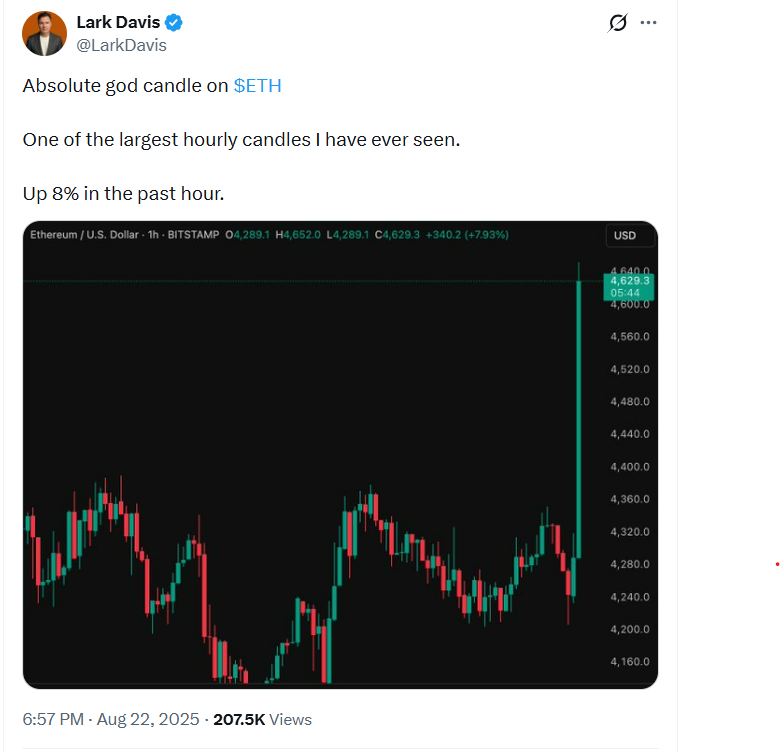
Ether printed a God candle on Aug. 22. Source: Lark Davis
Regulation has also made crypto much more legitimate but duller at the same time.
The EU has implemented its Markets in Crypto Assets (MiCA). The US has gone from treating crypto largely as a regulatory headache to building a framework around it. Senators may even pass the CLARITY act one day.
What did we lose along the way?
Despite increasing legitimacy, the crypto industry has failed to deliver on many things it promised. Dentacoin failed to revolutionize the dental industry. Bitcoin did not stop all wars. Ethereum is not the default home for global finance (at least, not yet.) Ahuja says:
“Has it delivered enough? Not yet, in my opinion. But has it changed our perception completely? Yes, it has.”
The audience has changed too.
Crypto is no longer some fringe hobby for a tiny band of libertarian cypherpunks and meme-weilding frog armies on Crypto Twitter.
Around one in five American adults, or 19%, now says they have invested in, traded or used cryptocurrency, according to Pew Research Center.
Broader ownership hasn’t made crypto easier to use. In fact, the explosion of assets and platforms has made the market harder to navigate. Users have to contemplate multiple networks, wallets, exchanges, bridges and onramps, creating the extra layers of friction that crypto was supposed to eliminate.

One in five Americans has used crypto. Source: Pew Research Center
Ahuja points to another irony: an asset class designed to be borderless is increasingly being shaped by national regulatory regimes, making it harder to move seamlessly across jurisdictions.
One Dubai-based crypto user Magazine spoke with receives their salary every month into a large centralized crypto exchange. They say they lose money when converting USDT into local currency, and then have to pay a flat 75 AED fee (roughly 20 USD) just to withdraw. They say:
“I wish I could receive a bank transfer instead.”
And then there’s the most basic promise of all: self-custody, arguably the biggest paradox the industry faces because the more valuable Bitcoin becomes, the more dangerous it is to hold your own private keys — whether for fear of being bludgeoned to death by a wrench or having your cold wallet exploited by an AI agent.
Arguably it’s this failure to deliver the future crypto once promised, that has made the bear market shutdowns and closures hit even harder.
Related: MiCA is coming for DeFi vaults, but regulation will be difficult
Layoffs are rampant throughout the industry. Projects that survived even the grizzly 2022 bear market have been shutting down this year, or being forced to reinvent themselves as the money and users pivot to AI — which is newer but has seen adoption crypto can only dream of so far.
Lutz doesn’t see BitMEX’s fate as evidence that the technology failed; quite the opposite: the technology worked so well that everyone copied it, and the industry has moved from a race to invent the infrastructure to a brutal fight over market share. He says:
“Now the differentiating factor is your aggressiveness in the competition, which is a completely different game. Some play that very well, others don’t.”
Perhaps the companies and projects that built crypto were never going to be the ones that ultimately benefited most from its adoption.
So have we wasted our lives?
Well, the purists may not have gotten their sovereign money, the early companies may not have survived, and the average user may still be waiting to catch a break.
But the technology is here, the infrastructure is becoming the rails, and the 20% daily candles sure are fun to watch.
And one thing that’s always been true, when the price starts going up, the narratives change quickly to explain why it may keep going up forever.
Magazine: Do the Coldcard attacks mean all hardware wallets are now insecure?
Cointelegraph publishes long-form journalism, analysis and narrative reporting produced by Cointelegraph’s in-house editorial team with subject-matter expertise. All articles are edited and reviewed by Cointelegraph editors in line with our editorial standards. Some articles contain affiliate links, from which Cointelegraph may earn a commission. These relationships do not influence which products we review or our editorial conclusions. Content published in here does not constitute financial, legal or investment advice. Readers should conduct their own research and consult qualified professionals where appropriate. Cointelegraph maintains full editorial independence.



Be the first to comment