


TL;DR
- Schwartz defends XRP crash: Ripple’s CTO Emeritus called market logic meaningless after XRP slid to $1.14 amid retail investor fury accusing leadership of using holders as “piggy banks”.
- Hoskinson takes a break from Cardano at 5-year low: ADA plunged to $0.1917 as the founder announced a break following a DReps rebellion that froze network scaling budgets.
- Coinbase SpaceX futures match capital flight: The launch of pre-IPO contracts sparked an institutional liquidity drain out of native Web3 tokens and into space and AI tech giants.
- Market capitulates for $2T loss ahead of NFP: Total crypto market cap plunged 48% since October fueled by Middle East shocks and investor panic with the June 5 US jobs report ahead.
David Schwartz on XRP’s drop to $1.14: “Crypto prices make no sense”
Ripple CTO Emeritus David Schwartz urged investors not to look for logic in digital asset price movements after XRP fell to $1.1432 amid capital outflows into the traditional high-tech sector.
The statement came in response to criticism from retail investors. One community member accused Ripple’s leadership of using token holders as “piggy banks”, noting that the asset was worth more nine years ago than it is today.

In response, the former CTO pointed to Bitcoin, which fell to $64,000 after peaking at $67,000 in November 2021, and stressed that cryptocurrency prices often make wild and objectively meaningless moves.
Schwartz’s words are supported by the broader macroeconomic picture. Since October 2025, the crypto market capitalization has fallen by 48%, losing more than $2 trillion.
Analysts, including Bitwise CEO Hunter Horsley, link this outcome to a pragmatic decision by major funds to redirect liquidity into the real sector to participate in upcoming historically significant IPOs of giants such as OpenAI, SpaceX and Anthropic.
When fundamental factors stop working, investors are left to rely on dry numbers, but the technical picture for XRP/USD also points to a prolonged crisis. On the hourly chart, the token continues its methodical decline near $1.1432, while the key medium-term volume interest level, or POC, remains far behind at $1.3578, confirming a critical lack of buyer strength needed to reverse the trend.
Hoskinson retreats into the background as Cardano hits a 5-year low
The price of Cardano (ADA) fell to $0.1917, recording a decline of more than 10% over the past 24 hours. According to a TradingView chart, the token lost ground throughout May in line with the broader bearish trend across the crypto market.
The final note of this drop was a brief statement from project founder Charles Hoskinson, who said he was taking a pause and would talk later.
Hoskinson’s break coincided with a severe internal split in the decentralized governance system. Delegated Representatives, or DReps, blocked funding for key initiatives by voting against allocating funds for the Cardano Summit and freezing grants for the research structure Input Output Global, or IOG.
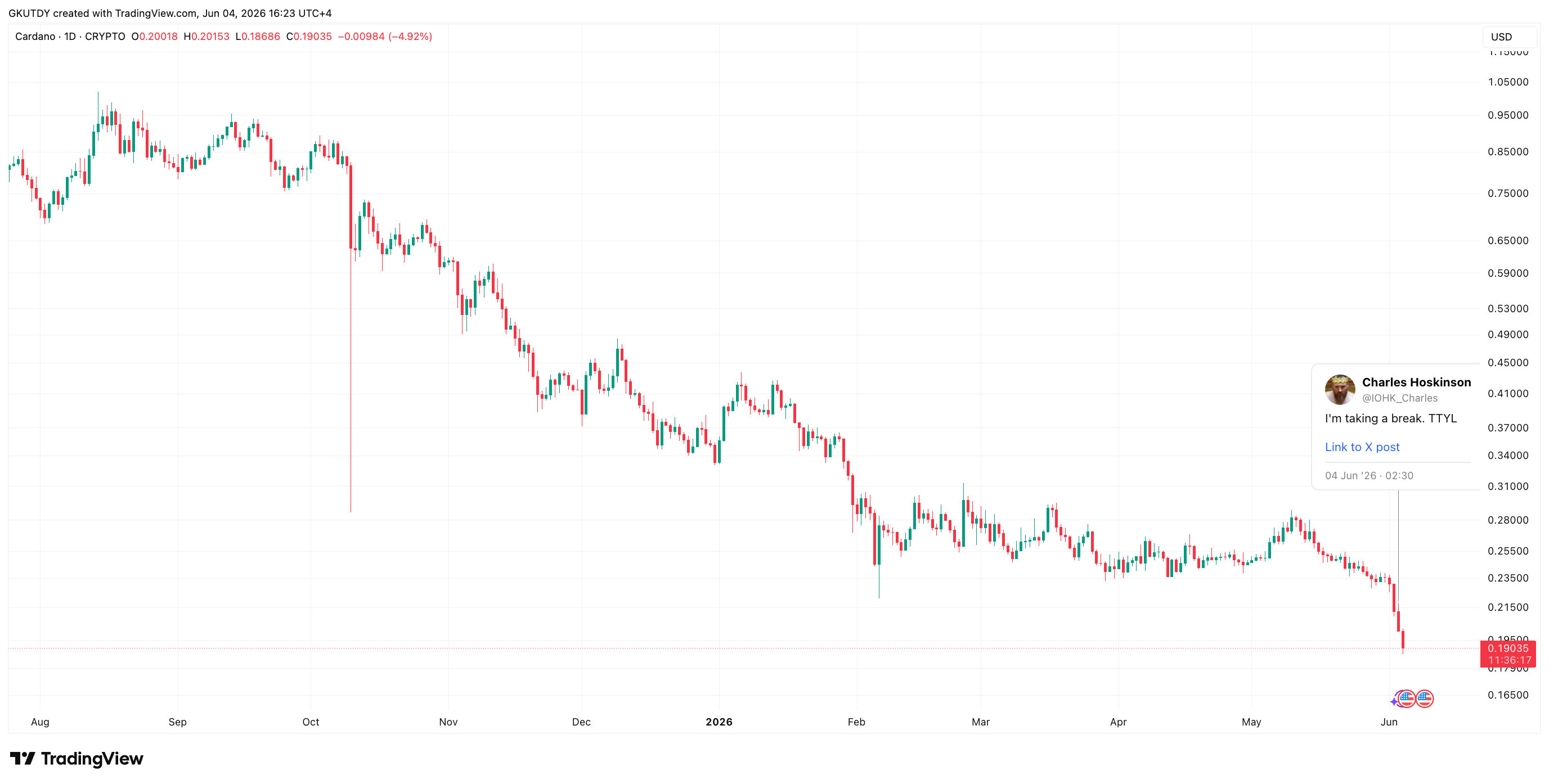
Commenting on the decision, Hoskinson stressed that since the community refuses to allocate treasury funds for network scaling, he is removing sole responsibility for its development from himself.
Against the backdrop of a prolonged market decline and a critical liquidity deficit, the Cardano ecosystem continues to lose key projects:
- TapTools: This week, the network’s leading analytics and trading platform announced its closure after four years of operation.
- JPG.Store: At the end of May, the blockchain’s largest NFT marketplace fully ceased operations.
As a result of the decline, ADA moved down to 14th place in the overall market capitalization ranking, falling behind Dogecoin and the Stellar blockchain, or XLM, which strengthened its position through the integration of MoneyGram’s MGUSD stablecoin.
In the current market phase, Cardano has faced the main challenges of decentralization – the network has entered a prolonged storm while simultaneously losing development budgets, key services and its main ideologist.
Why the SpaceX listing on Coinbase became a “red flag” for crypto
Crypto exchange Coinbase is expanding its derivatives lineup and launching perpetual pre-IPO futures on SpaceX through its Bermuda-based structure, offering qualified non-US participants round-the-clock synthetic exposure to the share price with settlement in USDC.
Decentralized platforms such as Hyperliquid are already actively trading a similar contract, forcing centralized competitors to accelerate the listing of traditional assets.
Despite the strong marketing move, experts see this event as a “red flag” and a marker of a deep systemic crisis in the cryptocurrency industry, which critically lacks internal catalysts to retain capital. The main marker of this problem lies in the enormous scale gap, because according to Bitwise CEO Hunter Horsley, once SpaceX goes public, the company alone will be worth about as much as the entire crypto market if stablecoins are excluded.
The emergence of such contracts only accelerates the outflow of liquidity from native crypto into so-called “dry powder,” since ahead of generational IPOs, investors traditionally sell risky assets to obtain maximum allocation in shares of the market leader, which now directly hits positions in Bitcoin and DeFi protocols.
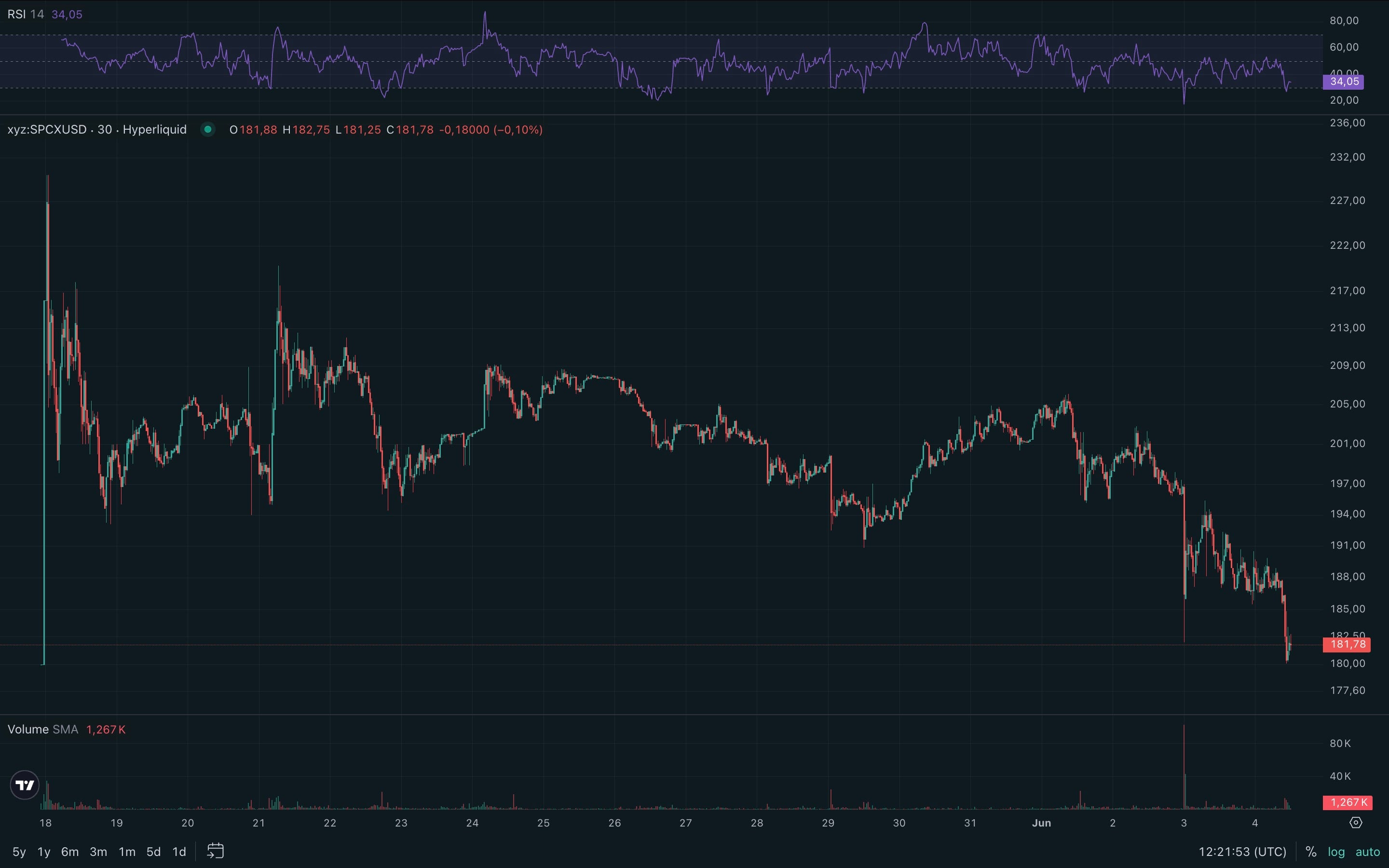
The situation is worsened by an emerging deadlock in the AI sector, where the main pools of “fast and slow money” are now concentrated. Since investment strategists expect AI infrastructure capital expenditure to slow after the first half of next year, Coinbase is proactively preparing the base for the inevitable capital rotation.
The freed-up billions of dollars will not flow into native tokens, but into prepared pre-IPO instruments tied to space and technology names.
The launch of SpaceX futures proves that without creating its own useful products, the crypto market risks permanently remaining only a technological layer for trading other people’s assets.
Crypto market outlook: BTC drops to 4-month low amid AI rotation
The crypto market is going through a severe capitulation due to the convergence of three factors: a geopolitical shock in the Middle East, a change in strategy among key institutional investors and liquidity outflows into the AI sector. The breakdown of peace talks triggered a surge in oil prices and activated a “flight from risk” mode.
Key checkpoints:
- Bitcoin price under pressure: BTC broke its weekly support structure and fell toward a four-month low in the $61,311-$62,580 area, triggering a cascade of long liquidations worth $1.63 billion. According to CryptoQuant, a major redistribution of ownership is underway in the market: the average entry price of investors, or Realized Price, is around $53,000-$54,000.
- Capital rotation into AI and pressure on crypto stocks: The institutional narrative is temporarily moving away from crypto toward AI giants amid the launch of the mega-IPO roadshow for SpaceX, jointly with xAI. This led to a prolonged series of outflows from spot Bitcoin ETFs and triggered a strong decline in shares of crypto companies, including Coinbase and Strategy, as well as miners such as MARA, Riot and CLSK.
- June 5 macroeconomic trigger: The main catalyst for volatility this week will be the release of the May unemployment report and US Non-Farm Payrolls. With Brent oil rising above $94, any signs of an overheated labor market will fully freeze expectations for a Federal Reserve rate cut, increasing pressure on cryptocurrency order books.
You Might Also Like



Be the first to comment