


AI Summary
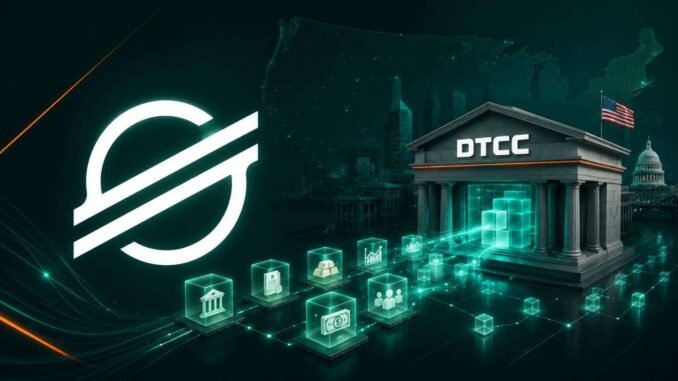
- DTCC — the Depository Trust & Clearing Corporation, whose depository subsidiary provides custody and asset servicing for securities issues valued at over $114 trillion — has announced plans to connect DTC’s tokenization service with the Stellar network.
- DTC-tokenized assets are expected to become available on Stellar in the first half of 2027.
- The collaboration builds on the SEC no-action relief DTC received in December 2025.
- Stellar is part of DTCC’s broader multi-chain tokenization strategy, alongside other networks under evaluation.
If you’ve been watching this space for the last few years, today’s news isn’t a surprise it’s a confirmation. The biggest, most boring, most systemically important plumbing in US capital markets just publicly named Stellar as a public blockchain partner in its multi-chain tokenization strategy.
DTCC — the Depository Trust and Clearing Corporation, which custodies and settles over $114 trillion in US securities has announced plans to connect its tokenization service with the Stellar network. Starting in the first half of 2027, DTC-custodied assets will become available on Stellar.
That means US Treasuries, ETFs tracking major indices, and constituents of the Russell 1000 on a public blockchain, with the same investor protections, entitlements, and safeguards as those currently held in DTC custody.
This isn’t an experimental partnership. This isn’t a sandbox pilot. This is the most important post-trade clearinghouse in the world publicly naming Stellar as part of its multi-chain tokenization strategy.

I TOLD YOU. Stellar Lumens XLM Chosen Officially By DTCC And Will Be Going Live *SOON*!!!!!!!!!!!!!
What was actually announced
From the Stellar Development Foundation’s official announcement:
“DTCC and the Stellar Development Foundation have announced plans to enable tokenization of DTC-custodied assets on the Stellar network, a configurable open-source blockchain used across securities, payments, and remittance applications. The collaboration builds on the SEC’s no-action letter to DTC received in December 2025. The letter authorized DTC to implement and operate a service that tokenizes real-world DTC-custodied assets. Market participants will be able to leverage traditional assets in a digital ecosystem while retaining the same investor protections, entitlements, and safeguards consistent with those applicable to traditionally held securities. DTC tokenized assets are expected to become available on Stellar’s network in the first half of 2027.”
Three things to unpack from that paragraph.
1. SEC no-action letter, December 2025
The December 2025 SEC no-action letter authorized DTC to operate a service tokenizing real-world DTC-custodied assets. That’s a regulatory green light from the agency for the largest securities depository in the world to bring trillions of dollars of US assets on-chain. The Stellar connection is the operational execution of that authority.
2. Same investor protections as traditional custody
The carefully-chosen language “same investor protections, entitlements, and safeguards consistent with those applicable to traditionally held securities” — is the key sentence. Tokenized securities through DTC’s pipe are not a separate asset class with separate legal status. They are the same securities, with the same custody framework, with a tokenized expression layered on top. That’s a fundamentally different category from on-chain stablecoins or even most RWA experiments to date.
3. H1 2027 timeline
This is not a multi-year roadmap. The first DTC tokenized assets are expected on Stellar’s network in the first half of 2027 within months, not years.
Four outcomes DTCC is targeting
DTCC explicitly framed the market-participant benefits in the announcement:
- Faster settlements. Potential to move from days to minutes for eligible asset transfers. T+1 was already a regulatory milestone. Tokenization compresses that into intraday or real-time finality.
- Greater asset mobility. Tokenized assets become available across digital venues without leaving the regulated perimeter meaning the same DTC-custodied US Treasury can move across multiple on-chain platforms while never leaving the regulated custody chain.
- Extended trading hours. Trading is no longer constrained by traditional market hours. Tokenized US assets on a 24/7 public chain is structural change for how global capital markets function.
- Lower costs and reduced risk. Fewer intermediary steps, less reconciliation overhead, lower operational risk. This is the unglamorous productivity gain that compounds across $114 trillion in custodial assets.
Asset classes under evaluation
The announcement specifically lists three categories of DTC-custodied assets being prepared for tokenization on Stellar:
- Constituents of the Russell 1000 the 1,000 largest US public companies by market cap, representing roughly 93% of US equity market capitalization.
- ETFs tracking major indices likely starting with the most liquid index trackers and expanding from there.
- US Treasuries (bonds and notes) the global benchmark safe-haven asset.
If you put those three lists end to end, you’ve covered the bulk of investable US securities. This is not a niche slice.
Why Stellar specifically
Nadine Chakar, who leads DTCC’s digital assets work and previously held senior digital asset roles at State Street, framed Stellar’s selection this way:
“Stellar’s proven track record with institutional assets on-chain is an important factor in our evaluation of blockchain networks. Its emphasis on compliance, transaction throughput, and low-cost operations meet our rigorous standards and will help ensure we’re ready for growth as usage of blockchain networks for real-world asset transactions increases.”
DTCC’s evaluation criteria for blockchain networks emphasize three properties: compliance, open infrastructure, and risk management capabilities. Stellar reportedly meets all three. That’s not a quick checkbox exercise it’s the conclusion of an evaluation process that took years.
The decade-long backstory
Here’s what makes today’s announcement extraordinary: it’s been quietly building since at least 2016. From a DTCC interview that year, when blockchain was still in its first-generation hype cycle:
“We’ve certainly developed a lot of use cases. Here at DTCC, we did an exercise where we came up with well over 25 or so use cases that we thought the industry could benefit from. We’re moving forward with a couple of those… I think we’ll learn probably quicker rather than later about just how disruptive this technology will be.”
That was DTCC ten years ago. They’ve been working on this exact problem set for a full decade, in public, with most of the crypto community not paying attention.
The Securrency acquisition
The connection between DTCC and Stellar runs deeper than today’s press release. DTCC acquired Securrency a tokenization compliance infrastructure provider — bringing its technology and team in-house. Securrency had already built deeply on Stellar.
Dan D’Onofrio, formerly Securrency’s CTO and now part of DTCC’s senior digital technology leadership, was a contributor to CAP-003 the Stellar Core Advancement Protocol that introduced asset clawback functionality. CAP-0035 is one of the building blocks that makes regulated assets viable on Stellar at all, because it gives issuers the ability to enforce regulatory clawback requirements at the protocol level.
D’Onofrio described the rationale in a 2020 Stellar Development Foundation conversation:
“We’re working with firms like WisdomTree to tokenize exchange-traded funds or other institutional assets to make them available in multiple markets. One of the key enablers required is being able to meet the regulatory requirements in each of those markets. Thanks to the power of the blockchain, you can actually use tools. Stellar has a great framework called SEP-8 that allows us to actually enforce in real time the regulations of multiple jurisdictions simultaneously.”
SEP-8 is Stellar’s compliance protocol that codifies regulatory rules directly into token logic. The same framework now becomes part of DTCC’s tokenization stack.
What this means in plain English
DTCC sits between every major US securities transaction. When a fund manager buys a million dollars of US Treasuries, when Vanguard rebalances its 401k portfolio, when an institution loans out shares for short selling — DTC custodies the assets and clears the trade. They are the back-office plumbing that the entire US securities market depends on.
Until today, that plumbing was strictly traditional infrastructure. Starting in the first half of 2027, that plumbing has a publicly-stated bridge to Stellar.
For market participants, this is the answer to the question every TradFi institution has been asking quietly for two years: “If we want our existing custodied portfolio to be tokenized on a public blockchain without leaving the regulated custody chain, who do we talk to?” The answer is now: DTCC. And the chain is Stellar.
Why this matters beyond Stellar
Three structural implications:
1. The “which chain wins for RWA?” question just got a partial answer. It’s never going to be one chain. We’ve seen Hedera win major use cases in Australia’s Project Acacia, XRP Ledger and RLUSD selected for Australian Government bond pilots, and Algorand picked by VersaBank for US-first tokenized deposits. Now Stellar gets DTCC. The institutional RWA market is going to be multi-chain, and the chains that win each segment are the ones that built the right compliance primitives years in advance.
2. SEP-8 + CAP-0035 just became core US capital markets infrastructure. Two technical Stellar protocols that few outside the Stellar ecosystem deeply understood are now poised to enforce compliance on tokenized DTC assets. Builders should pay attention — these are now standards with regulator-grade endorsement.
3. The 24/7, intraday-settled future of US capital markets is no longer hypothetical. Extended trading hours plus minute-level settlement plus public chain availability is structurally different from how US securities markets have ever worked. The implications for liquidity provision, market microstructure, and global access to US assets are going to take years to fully play out — and the first chapter starts in H1 2027.
What to watch
- DTCC tokenization service rollout: limited production trades expected July 2026, full service launch October 2026
- DTC tokenized assets available on Stellar: H1 2027 (the Stellar connection comes after the core service goes live)
- WisdomTree expansion announcements they’ve been building on Stellar with Securrency tech for years
- Other DTC tokenization service blockchain connections — the announcement specifically frames Stellar as one of multiple potential networks; watch which others get added and when
- Volume migration when an institutional asset goes from “custodied in DTC” to “custodied in DTC and tokenized on Stellar,” watch how trading and settlement volume shifts
Bigger picture
The biggest tokenization story of the next 18 months won’t be a new layer-1 launch or a memecoin run. It will be the steady, unglamorous migration of trillions of dollars of regulated US securities onto public blockchains happening through DTCC’s pipe, with Stellar as the first publicly-announced rail.
The crypto community spent five years arguing about which chain would win “RWA.” Stellar quietly built the compliance primitives, integrated with the post-trade clearinghouse that runs US capital markets, and just got publicly chosen for the role.
This is a different category of validation. The most boring, most regulated, most systemically important plumbing in the financial world just named Stellar as a public blockchain partner in its multi-chain tokenization strategy.
Sources
- Stellar Development Foundation — DTCC partnership announcement
- DTCC press release announcing tokenization service connection with Stellar
- SEC No-Action Letter to DTC (December 2025)
- Nadine Chakar (DTCC, leads digital assets work; previously State Street) — official statement on Stellar selection criteria
- Dan D’Onofrio (formerly Securrency CTO, now DTCC) historical Stellar Development Foundation interview on SEP-8 and CAP-0035 regulatory clawback framework
- DTCC 2016 interview on 25+ blockchain use cases historical context on a decade of buildup



Be the first to comment