



You don’t often see whale wallets spike 30x in a day while the chart bleeds red. Yet that’s exactly what showed up in ENA: big buyers quietly scooped roughly 20 million ENA over 24 hours as price slipped around 4%.
That kind of divergence sets off every trader’s radar. Who’s buying size into a down move, and why? Is it just an on-chain mirage, or is there a deeper rotation building under the surface?
Let’s unpack what moved, who’s likely behind it, and what it could mean for Ethena’s next act.

Across late June, ENA had the look of a tired token drifting lower on light liquidity. Then a burst of whale accumulation hit the tape. Nansen-tracked large wallets expanded their ENA balances dramatically while spot price kept shading down. For most retail traders, that’s maddening. For funds, that can be the moment to finally get inventory without lighting up slippage.
When price is soft and liquidity is decent, the cheapest way to build size is often to buy into red — not after the breakout. Whales care about inventory, not confirmation.
Why now? A few credible signals surfaced this month that change the institutional read-through on Ethena. That includes open-market buying by a major crypto venture arm, a traditional asset manager flagging work on regulated products, and a sizable allocation to tokenized credit via a well-known RWA platform. Together, that’s enough to pull in desks that were waiting for a cleaner macro window.
What ENA Represents and Why Big Money Cares
ENA sits next to, not inside, the dollar product
Ethena’s most visible product is the synthetic dollar, USDe. It targets dollar stability using a hedged strategy on liquid crypto collateral and derivatives. ENA is the separate governance and ecosystem token tied to the protocol’s growth. If USDe is the engine, ENA is the equity-like claim over the network’s direction and potential value capture mechanisms. They’re linked by narrative and adoption, but they’re not the same asset.
Why institutions might eye ENA
Institutions don’t just buy tokens for memes. They look for a credible path to scale: liquidity that can support size, partners who can open distribution, and revenue-adjacent flows that make the story durable. ENA has started to check a few of those boxes this quarter, which is why accumulation into weakness isn’t as strange as it looks at first glance.
How Whale Accumulation Spiked While Price Slipped
The raw on-chain stat is blunt. Over the 24-hour window into June 30, Nansen-tracked “whale” balances for ENA jumped about 3,166%, climbing from roughly 0.63 million ENA to 20.63 million ENA — about 20 million added, around $1.5 million at the time — while ENA’s price fell roughly 4.4% the same day (BeInCrypto reporting Nansen/Dune data).
What that usually means in practice
- Liquidity opens up on a red day. Order books get thicker as sellers hit bids; whales can take size without blasting the price.
- Aggregators spot block buying. You don’t see one massive print; you see steady clips that don’t push the candle up.
- Funds might be hedged. They can buy spot ENA and lean against it with futures or options if they only want exposure to specific catalysts.
- The data lags a bit. By the time dashboards update, price may not reflect the new holders yet.
In other words, accumulation into softness is a feature of patient capital. It’s not definitive proof of a near-term rally, but it’s not random either.

Institutional Bread Crumbs: Who Is Signaling What
It’s easier to buy weakness when you’ve got public signals pointing to real-world traction. Ethena saw a run of those in June.
| Date | Actor | Action | Why it matters | Source |
|---|---|---|---|---|
| June 2, 2026 | Coinbase Ventures | Purchased ENA on the open market; announced a partnership with Ethena, including work around USDC integration | Signals strategic alignment and potential distribution rails; VC buying on-market is rare enough to notice | The Block |
| June 9, 2026 | Janus Henderson’s ANTIK venture | Disclosed an ENA position; plans to work with Ethena on regulated investment products, including exchange-traded products | TradFi validation from a $480B manager; opens the door to structured, compliant exposure | The Block |
| June 12, 2026 | Ethena Labs | Announced a $250M allocation to Securitize’s tokenized AAA CLO fund (STAC) as part of an institutional RWA strategy | Connects Ethena’s ecosystem to tokenized credit markets; shows capacity to move sizable capital | The Block |
| June 30, 2026 | Nansen-tracked whales | Added roughly 20M ENA in a day while price slipped ~4.4% | Suggests patient accumulation into weakness; likely non-retail flows | BeInCrypto |
Reading the tea leaves
Each item on its own is a headline. Together, they form a simple picture: Ethena is building institutional pipes. Venture alignment plus a TradFi name exploring ETPs plus a tokenized credit allocation tells funds there’s a broader plan to plug into compliant capital flows. That doesn’t guarantee anything for price, but it helps explain why whales might want to own more ENA into a dip instead of chasing later.
Mechanics Behind Buying the Dip
Liquidity windows
On quiet summer days, a few million dollars can move mid-cap tokens around. If sellers are motivated and books are thick enough, large buyers can scale in with minimal footprint. Market makers see the flow; if they think size is real, they’ll refill offers and keep spreads tight, which actually helps whales finish their shopping list without tipping the whole market.
Hedged accumulation
Not every whale is “bullish naked.” A typical play is buying spot ENA and hedging market beta with perpetual futures or correlated assets. That way, if the whole market drifts lower, the hedge softens the blow, but you still hold the governance token ahead of catalysts. It’s a carry-friendly approach for funds that care more about being positioned than about calling the exact bottom.
Preparation for products and indices
If regulated products or institution-friendly wrappers are in active scoping, inventory needs to be sourced somewhere. Some of that happens OTC; some leaks into on-chain wallets as allocators test liquidity. The mention of exchange-traded products in connection with Janus Henderson’s ANTIK venture is a clear breadcrumb (The Block). It’s reasonable to think certain desks would rather be early owners than late chasers if they believe distribution will expand.
What the On-Chain Tells Us Right Now
Concentration cuts both ways
Rising whale balances show where power sits, not how it’ll be used. More concentration can support price on the way up and weigh on it if those wallets distribute later. If you’re tracking this day to day, watch not just balances but whether those wallets are depositing to exchanges or staying cold. Outflows to exchanges after a run-up usually precede supply hitting the market.
Context matters more than a single datapoint
The 3,166% jump in whale balances in 24 hours is striking, but it doesn’t exist in a vacuum. Layer it with June’s news run: Coinbase Ventures’ open-market buy and partnership around USDC integration (The Block), TradFi engagement via Janus Henderson’s ANTIK (The Block), and Ethena’s $250 million RWA allocation to Securitize’s STAC fund (The Block). The whale move fits that backdrop better than it fits a random pump setup.
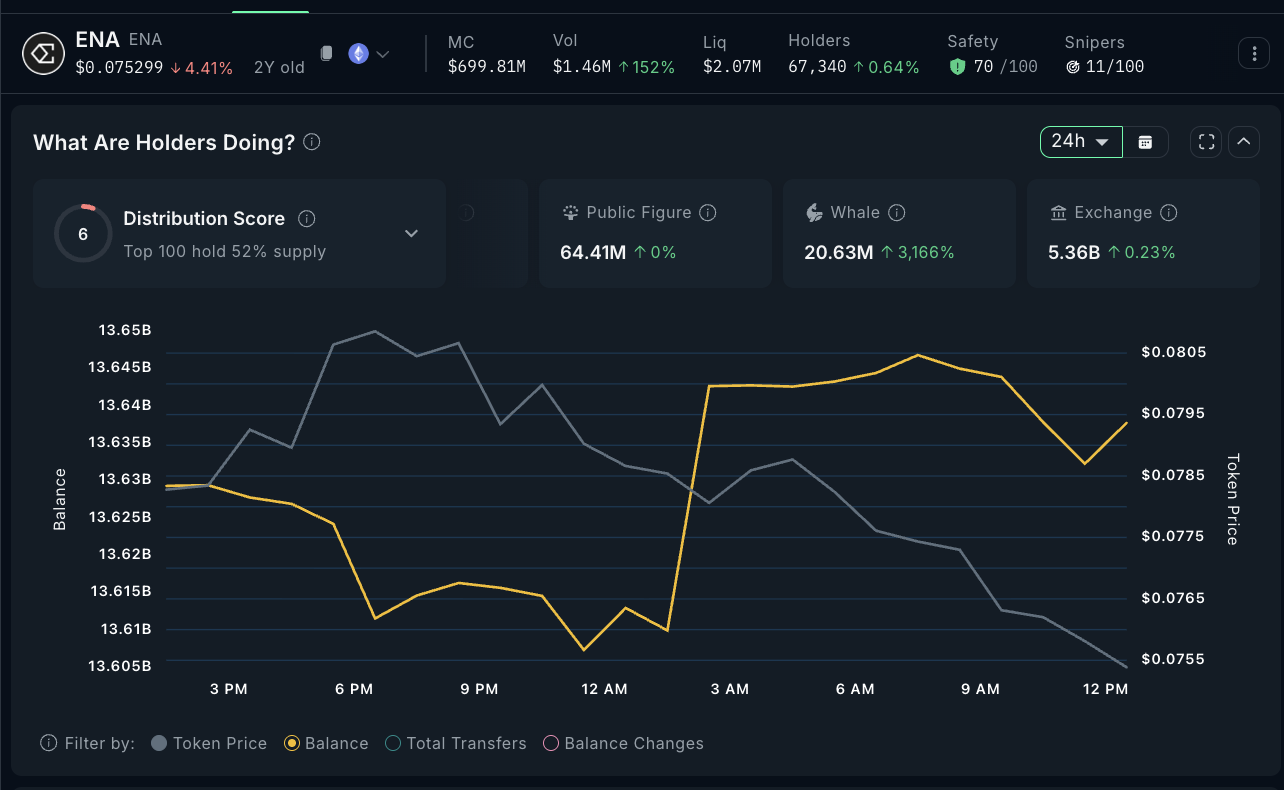
Nansen dashboard screenshot (via BeInCrypto) showing whale‑held ENA rising to 20.63M (a ~3,166% 24h increase) while the ENA token price declined — visual evidence of large holders accumulating on a dip. — Source: Nansen (screenshot hosted by BeInCrypto)
Outlook and Catalysts to Watch
What could pull more buyers in
- Clearer paths to regulated exposure. Any formal steps toward exchange-traded products tied to Ethena’s ecosystem would be a magnet for allocators. The ANTIK note about working on regulated products is the tell to monitor.
- Deeper integration with major exchanges and wallets. The Coinbase Ventures partnership and USDC-related work point in that direction. Execution details will matter.
- RWA follow-through. The $250M allocation to Securitize’s tokenized AAA CLO fund is a strong signal; investors will watch for performance, transparency, and whether it unlocks more institutional balance sheets.
- Liquidity improvements. More pairs, better market making, and healthy perps open interest can reduce slippage for future whales and, by extension, reduce volatility spikes.
All that said, markets are messy. A strong narrative can stall if macro turns risk-off or if crypto-wide liquidity dries up. Good ideas need a friendly tape.
Risks & What Could Go Wrong
- Token concentration risk: The same whales who accumulated could supply rallies later, capping upside.
- Smart contract and execution risk: Ethena’s core systems and RWA connections have technical and operational dependencies. Bugs or counterparty issues can bite.
- Regulatory overhang: Synthetic dollar models and tokenized credit are in active policy crosshairs in multiple regions. Rules can change quickly.
- Market structure risk: If derivatives funding or basis dynamics shift sharply, strategies that looked stable can wobble, pulling sentiment down across the stack.
- Unlocks and emissions: Any vesting, incentives, or treasury moves can add supply pressure if not well telegraphed.
- Partnership execution: Announced integrations and RWA allocations still need to land cleanly. Slippage here would dent the institutional story.
Whale buying is information, not insurance. If the macro tape turns or supply hits, even smart accumulation won’t hold the line.
For ongoing context and level-headed analysis around events like this, Crypto Daily keeps a steady feed of market structure notes and on-chain shifts without the noise. If you want a quick pulse check when headlines fly, it’s worth a bookmark: cryptodaily.co.uk.
Frequently Asked Questions
What exactly happened with ENA whales on June 30?
Nansen-tracked large wallets boosted their ENA holdings by about 3,166% over a 24-hour period, jumping from around 0.63 million to 20.63 million ENA — roughly 20 million added — while price fell about 4.4% that same day, per reporting of Nansen/Dune data (BeInCrypto). It’s a classic buy-the-dip pattern from bigger players.
Why would whales buy while price is falling?
Because it’s cheaper to build size when sellers are active and liquidity is thick. Some funds hedge broader market risk with derivatives, so they can focus on owning the token ahead of catalysts without calling the exact bottom.
Is Coinbase or Janus Henderson actually buying ENA?
Coinbase Ventures publicly said it purchased ENA on the open market and announced a partnership with Ethena, including USDC-related work, on June 2, 2026 (The Block). Janus Henderson’s ANTIK venture disclosed it took a position and intends to work with Ethena on regulated investment products, including potential ETPs, as of June 9, 2026 (The Block).
Does whale accumulation guarantee ENA will go up?
No. It’s a useful signal, not a promise. Big holders can support price… or sell into strength later. Always weigh concentration, exchange inflows, and upcoming supply events. None of this is financial advice.
How can I track ENA whale wallets and flows?
Use on-chain analytics dashboards that tag large wallets and track token balances and exchange deposits/withdrawals. Pair that with exchange order book data and derivatives funding to see if spot buying is supported by healthy market structure.
What are the most relevant Ethena catalysts right now?
Execution of the Coinbase-linked partnership work, progress toward any regulated product efforts referenced by Janus Henderson’s ANTIK, outcomes from Ethena’s $250M allocation to Securitize’s tokenized AAA CLO fund, and general liquidity improvements across spot and perps.
Is ENA the same thing as USDe?
No. USDe is Ethena’s synthetic dollar product; ENA is the ecosystem and governance token. They’re related but behave differently, especially during market stress.
Disclaimer: This article is provided for informational purposes only. It is not offered or intended to be used as legal, tax, investment, financial, or other advice.





Be the first to comment