

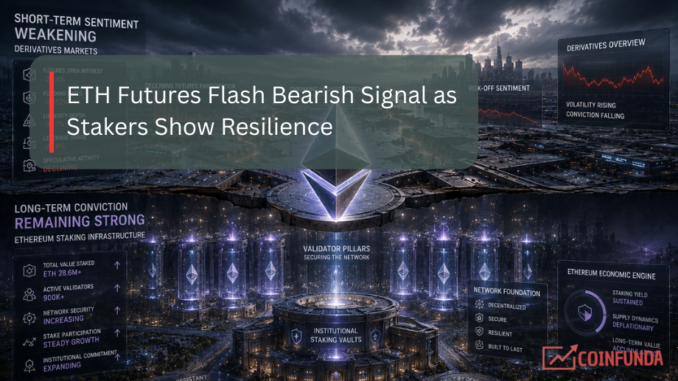

Ethereum continues facing mounting pressure from derivatives markets as traders reduce leveraged exposure and institutional participation weakens. However, while ETH Futures Flash Bearish Signal, several on-chain and staking metrics suggest that long-term confidence in the network remains surprisingly intact.
Ether has struggled to reclaim the $1,700 level in recent weeks, reflecting broader weakness across cryptocurrency markets. Unlike previous recovery attempts, traders have shown limited appetite for adding leveraged bullish positions despite a significant correction in price.
The growing concern that ETH Futures Flash Bearish Signal stems from deteriorating futures market conditions, shrinking open interest, and declining ETF demand. Yet beneath the surface, staking activity paints a much more optimistic picture for Ethereum’s long-term outlook.
Negative Funding Rates Reflect Growing Bearish Sentiment
One of the clearest reasons ETH Futures Flash Bearish Signal is the recent shift in perpetual futures funding rates. According to market data from Laevitas, Ethereum’s annualized perpetual futures funding rate turned negative on June 5. Negative funding rates generally indicate:

- Short sellers are paying premiums.
- Long traders are reducing exposure.
- Market confidence remains weak.
- Risk appetite is deteriorating.
The development is significant because Ethereum has already experienced a substantial correction over the past several weeks. Yet despite lower prices, traders remain hesitant to aggressively accumulate leveraged long positions. The fact that ETH Futures Flash Bearish Signal after a major correction suggests investors remain uncertain about Ethereum’s near-term recovery prospects.
Futures Open Interest Falls to Multi-Month Lows
Another reason ETH Futures Flash Bearish Signal is the sharp decline in futures open interest. Data from CoinGlass shows aggregate Ether futures exposure has fallen approximately 30% over the past month. The decline pushed total futures exposure to a 13-month low, highlighting a significant reduction in institutional and speculative activity.
Falling open interest often indicates:
- Reduced trader participation.
- Lower institutional engagement.
- Weakening speculative demand.
- Increased caution among market participants.
Historically, expanding open interest supports stronger trends because more capital enters the market. The opposite is occurring now as ETH Futures Flash Bearish Signal through declining participation levels.
Ether ETFs Continue Facing Outflows
Institutional demand has also weakened as ETH Futures Flash Bearish Signal across derivatives markets. Recent data shows US-listed spot Ether exchange-traded funds recorded approximately $323 million in net outflows over a two-week period. ETF outflows matter because they often provide insight into broader institutional sentiment.
The recent withdrawals suggest:
- Professional investors remain cautious.
- Demand for Ethereum exposure has softened.
- Capital is moving elsewhere.
- Market conviction remains limited.
The ETF trend aligns closely with the futures market data, reinforcing the narrative that ETH Futures Flash Bearish Signal due to declining institutional participation.
Ethereum’s On-Chain Activity Continues Weakening
Beyond derivatives markets, another reason ETH Futures Flash Bearish Signal involves weakening network activity. According to data from DefiLlama:
- Ethereum’s total value locked (TVL) fell 33% in two months.
- TVL declined to approximately $37.5 billion.
- DApp revenues dropped 43% in May.
- Network activity remains under pressure.
Declining activity often translates into:
- Lower fee generation.
- Reduced network utility.
- Weaker demand drivers.
- Slower ecosystem growth.
For many investors, these metrics help explain why ETH Futures Flash Bearish Signal despite Ethereum remaining the dominant smart-contract blockchain.
Staking Demand Tells a Different Story
Despite the bearish futures environment, one of the strongest counterarguments to the idea that ETH Futures Flash Bearish Signal permanently is Ethereum’s staking ecosystem. While traders reduce leverage, long-term holders continue committing capital to network security. Recent staking data reveals:
- Validator entry queues remain heavily populated.
- More than 2.9 million ETH sits in staking entry queues.
- Entry wait times approach 50 days.
- Exit queues show virtually no delays.
These metrics suggest investors continue locking ETH for long-term participation rather than seeking immediate liquidity. The contrast is striking because ETH Futures Flash Bearish Signal while staking demand simultaneously remains elevated.
Validator Queues Reflect Long-Term Confidence
Validator activity may be one of the most important indicators contradicting the view that ETH Futures Flash Bearish Signal necessarily means deeper weakness ahead. The absence of significant withdrawal demand suggests stakers remain committed despite:
- Falling prices.
- Weak derivatives activity.
- ETF outflows.
- Declining network revenues.
Historically, long-term participants often provide more reliable signals than short-term traders. The fact that validator entry demand remains strong while exit demand stays limited suggests many investors continue viewing Ethereum as a strategic long-term asset. This dynamic helps explain why ETH Futures Flash Bearish Signal may not fully capture broader investor sentiment.
Why Derivatives and Staking Are Sending Opposite Signals
One of the most fascinating aspects of the current market is how ETH Futures Flash Bearish Signal while staking data remains constructive. The difference largely reflects two different investor groups. Short-term traders focus on:
- Price momentum.
- Leverage opportunities.
- Macroeconomic risks.
- Market volatility.
Long-term stakers focus on:
- Network security.
- Yield generation.
- Future adoption.
- Multi-year investment horizons.
As a result, derivatives markets often react more quickly to negative sentiment, while staking trends reflect deeper conviction. The divergence helps explain why ETH Futures Flash Bearish Signal while underlying network participation remains surprisingly resilient.
Could Ethereum’s Long-Term Strength Outweigh Short-Term Weakness?
The key question facing investors is whether the factors causing ETH Futures Flash Bearish Signal represent temporary weakness or a deeper structural problem. Several challenges remain:
- Weak ETF demand.
- Falling TVL.
- Reduced DApp revenues.
- Negative funding rates.
- Lower open interest.
However, Ethereum still benefits from:
- The largest smart-contract ecosystem.
- Significant staking participation.
- Strong developer activity.
- Deep institutional infrastructure.
Many analysts believe the long-term health of the network may ultimately matter more than temporary futures positioning. That possibility explains why some investors remain optimistic even as ETH Futures Flash Bearish Signal across multiple market indicators.
Conclusion
Ethereum’s derivatives market is clearly sending warning signs. Negative funding rates, falling open interest, and continued ETF outflows all contribute to the growing narrative that ETH Futures Flash Bearish Signal in the short term. However, the broader picture is more nuanced.
Strong staking demand, growing validator queues, and the absence of meaningful withdrawal pressure suggest long-term investors remain committed to Ethereum’s future. While network activity has weakened and institutional participation has slowed, the underlying security and participation metrics remain remarkably resilient.
For now, ETH Futures Flash Bearish Signal, but Ethereum’s staking ecosystem continues providing evidence that confidence in the network itself remains far stronger than futures traders currently suggest.
FAQs
Why do ETH Futures Flash Bearish Signal?
Funding rates have turned negative, open interest has declined, and institutional participation has weakened significantly.
What does negative funding mean?
Negative funding means short sellers are paying long traders, typically reflecting bearish market sentiment.
Why is Ethereum staking important?
Staking helps secure the network and often serves as a measure of long-term investor confidence.
Does strong staking activity guarantee a price recovery?
No. Staking demand can remain strong even during periods of market weakness, but it often reflects longer-term confidence in the network.


Be the first to comment