



- Ethereum postponed the October 26 Glamsterdam upgrade on Hoodi while developers investigate potential smart contract compatibility issues involving EIP-8037.
- The delay affects testnet plans, not Ethereum mainnet. Developers have not announced a replacement date.
Ethereum developers have postponed the planned Glamsterdam upgrade on the Hoodi testnet after concerns emerged about how one of its proposed changes could affect existing smart contracts. The upgrade was scheduled for October 26, but developers have removed the activation date while they investigate the compatibility issues.
The Ethereum Foundation announced the delay on October 22, saying more time was needed to examine EIP-8037 and its interactions with contracts already running on Ethereum mainnet. The postponement does not mean a problem has been confirmed on the live network, and developers have not announced a new date for the Hoodi upgrade.
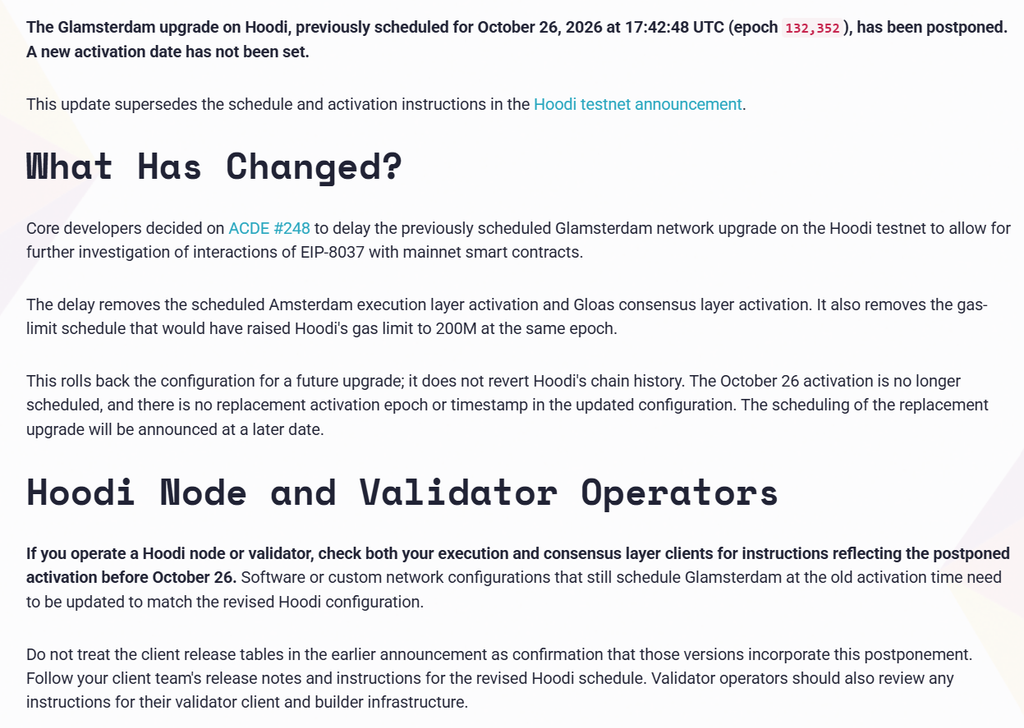
The original schedule also included an increase in Hoodi’s gas limit to 200 million at epoch 132,352. That change has been removed from the postponed activation plan.
EIP-8037 Raises Smart Contract Compatibility Questions
EIP-8037, known as State Creation Gas Cost Increase, proposes changing the gas fees charged when transactions create a new blockchain state, including accounts and persistent contract storage. The aim is to make these fees better reflect the long-term storage costs that Ethereum nodes must handle.
However, changes to gas costs can affect how existing smart contracts behave, particularly when their code relies on specific assumptions about transaction expenses. Security firm ChainSecurity reportedly identified 13 real-world examples of contract patterns that could be affected and has been working with relevant projects to investigate them.
Glamsterdam is a broader Ethereum upgrade that combines changes to the execution and consensus layers. Its planned improvements include enshrined proposer-builder separation, under EIP-7732, and block-level access lists, under EIP-7928. These proposals are intended to improve block production and transaction processing.
The upgrade has already reached the Sepolia testnet, where it activated on October 6. The Hoodi delay gives developers additional time to review the potential compatibility issues before proceeding with further testing.
For ETH holders and Ethereum mainnet users, the postponement does not require immediate action. The delay applies to Hoodi, a public test network, and does not establish a new mainnet launch date. Developers must resolve the outstanding concerns before confirming the next steps for the testnet upgrade.




Be the first to comment