



With Bitcoin, Ethereum, and Shiba Inu all exhibiting signs of renewed weakness, the cryptocurrency market is starting to lose steam following a robust recovery phase earlier this year. The overall structure indicates that traders are growing more defensive as selling pressure rises throughout the market, even though each asset is responding differently.
Bitcoin making a reversal
Among the three, Bitcoin is still the strongest asset, but the chart indicates that momentum is waning following rejection close to the $81,000 area of the 200-day moving average.
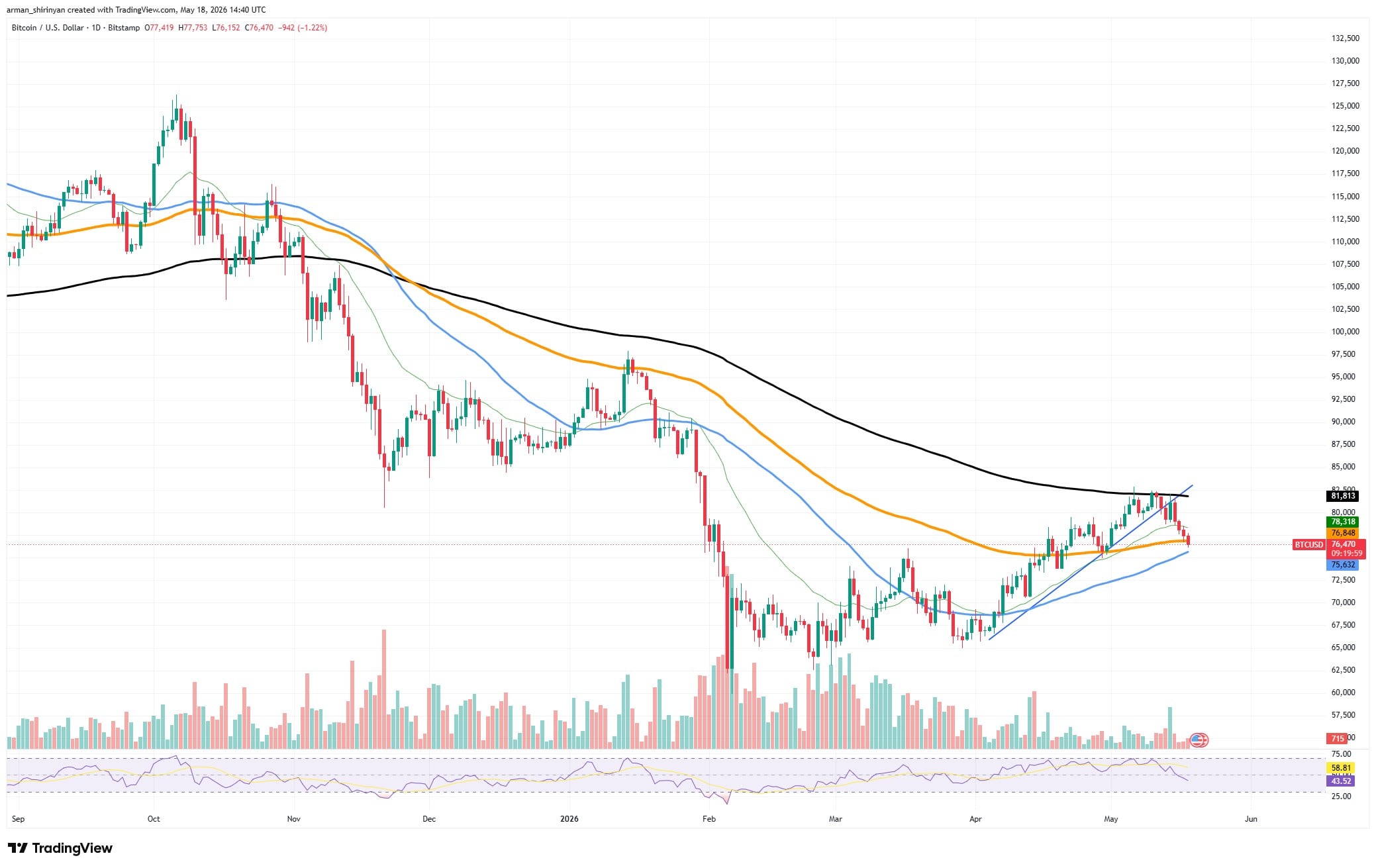
Recently, Bitcoin slipped back under a number of important moving averages after breaking below a short-term rising structure. Additionally, RSI momentum has decreased, indicating that buyers are no longer exerting the same level of control over the market as they did during the most recent recovery.

In comparison to other cryptocurrencies, Bitcoin maintains a comparatively stable structure despite the decline. Rather than a complete trend collapse, the current move appears to be more of a market cooldown and profit-taking event.
However, wider cryptocurrency weakness could pick up speed if Bitcoin loses support in the $75,000-$76,000 range. Because the stability of Bitcoin is still crucial to the rest of the market, its future is still very important.
Ethereum faces market weakening
After failing to overcome significant resistance close to $2,500, Ethereum is displaying a weaker structure than Bitcoin.
While staying below the 50-day, 100-day, and 200-day moving averages, the chart depicts ETH breaking out of a descending triangle formation.
You Might Also Like

Ethereum is more volatile than Bitcoin, but it frequently follows its trend. ETH started to lose steam as soon as BTC slowed down. If sellers continue to dominate the market, the asset now runs the risk of returning to the $2,000 range.
Additionally, investors are keeping an eye on whether DeFi activity and institutional demand will be sufficient to sustain Ethereum during the overall market downturn.
For SHIB, things get even worse
Of the three assets, Shiba Inu’s structure is still the weakest. SHIB is still below all major moving averages after breaking out of a rising wedge pattern recently. According to on-chain data, billions of SHIB tokens were moving onto exchanges, which also showed an increase in exchange inflows. Such activity typically indicates that whales and large holders are exerting more pressure to sell.
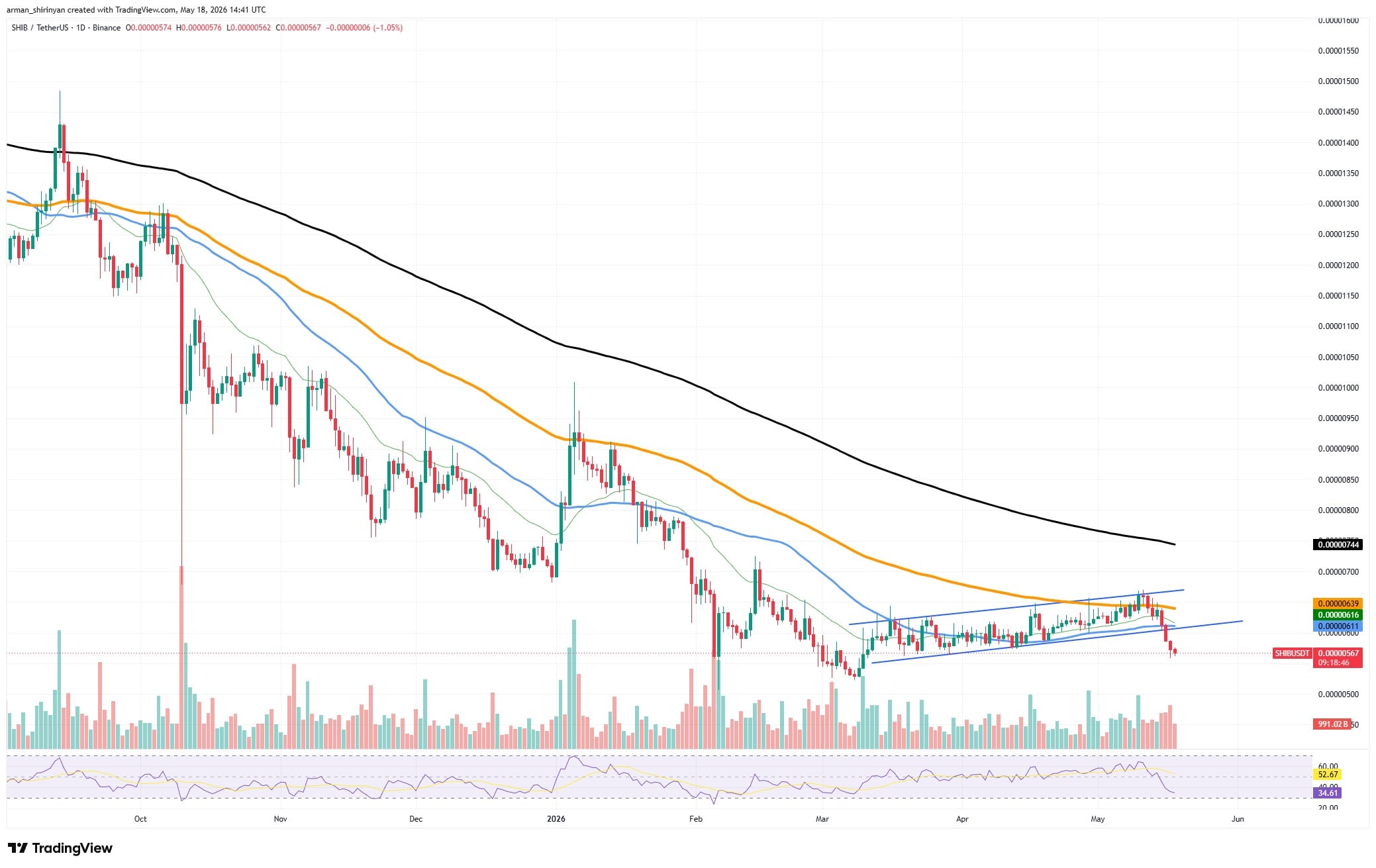
Because memecoins rely so heavily on speculative momentum, they often react more violently during market corrections. High-risk assets like SHIB frequently see steeper drops once Bitcoin and Ethereum start to weaken.
The RSI is still heading toward oversold territory, but there isn’t a strong bullish reversal signal on the chart right now.
XRP at least stabilizes
Although XRP appears to be more stable than the majority of altcoins at the moment, the chart still shows that the market is having difficulty generating genuine bullish momentum.
XRP has not entirely fallen below its recent trading range in contrast to SHIB and ETH. The asset is consolidating under significant resistance close to the 100-day and 200-day moving averages while maintaining a horizontal support zone around the $1.30-$1.32 range.
You Might Also Like

Instead of a complete breakdown, the structure looks like a compressed range. This is significant because XRP has withstood sell pressure for weeks without completely losing support. Additionally, when compared to weaker assets across the market, RSI stays largely neutral.
But bulls continue to face challenges. Every attempt at a breakout keeps failing quickly, and the price stays below the main long-term moving averages. Additionally, volume is still comparatively low, indicating that traders are reluctant to make large commitments while the general sentiment surrounding cryptocurrencies is still unclear.
XRP may eventually try a breakout toward the $1.45-$1.50 area if Bitcoin stabilizes. However, XRP will probably lose the current support range and rotate lower with the rest of the altcoin market if BTC continues to weaken.
Right now, XRP acts more defensively than aggressively bullish in comparison to Ethereum and SHIB.
Hyperliquid is back
Hyperliquid might become the biggest beneficiary of the most recent volatility surge on the market . HYPE is still in a strong upward trend, with steady higher lows and robust recovery behavior following pullbacks, while Bitcoin, Ethereum, and many other altcoins are losing steam.
Multiple support elements:
- clear support along a rising trendline,
- strong placement above the main moving averages,
- persistent bullish momentum,
- and frequent recovery following brief selloffs.
HYPE continues to quickly recover moving averages following corrections, in contrast to weaker assets that falter below resistance. Additionally, RSI maintains its strength without going into extreme exhaustion. This typically indicates active demand, rather than just speculative spikes.
You Might Also Like
HYPE’s strength stems in part from its ongoing focus on decentralized exchange narratives and perpetual trading infrastructure. Even as weaker altcoins and memecoins lose liquidity, traders frequently shift their money to projects that are still performing well overall.
However, if Bitcoin goes into a more significant correction phase, even strong charts could rapidly deteriorate. HYPE would probably retrace if BTC lost significant support, though most likely less forcefully than speculative memecoins.
As of right now, HYPE continues to be one of the market’s most obvious relative strength leaders.
The current market structure can be seen quite clearly when Bitcoin, Ethereum, Shiba Inu, XRP, and Hyperliquid are taken together. Three categories are emerging within the market:
Bitcoin is relatively stable. Large-cap alts are having difficulty gaining traction. Select compelling stories are still drawing funding.
Bitcoin continues to serve as the market anchor. Ethereum has a slower pace than Bitcoin. XRP is consolidating without completely collapsing; it is in the middle. SHIB represents speculative risk that is most severely impacted by market volatility. Meanwhile, HYPE is notable for being one of the few assets that continues to have a robust bullish structure.



Be the first to comment