



Ethereum staking reached a record 43.8 million ETH in the third quarter of 2026, representing 35.9% of the cryptocurrency’s total supply, according to Bitwise’s Q4 2026 Staking Report. The milestone marks a sixth consecutive quarter of growth, even as Ethereum’s staking yield declined to 2.63%. The divergence highlights growing participation in network security despite lower rewards for validators.
Ethereum Locks 43.8M ETH as Staking Demand Continues
Bitwise reported that Ethereum attracted net staking inflows of 1.99 million ETH during the quarter, pushing the total amount staked to an all-time high. The 35.9% staking ratio means more than one-third of ETH supply was committed to securing the network rather than remaining immediately available for ordinary transactions.
Continued growth can strengthen participation in Ethereum’s proof-of-stake consensus, although the headline figure alone does not measure how widely validator ownership is distributed.
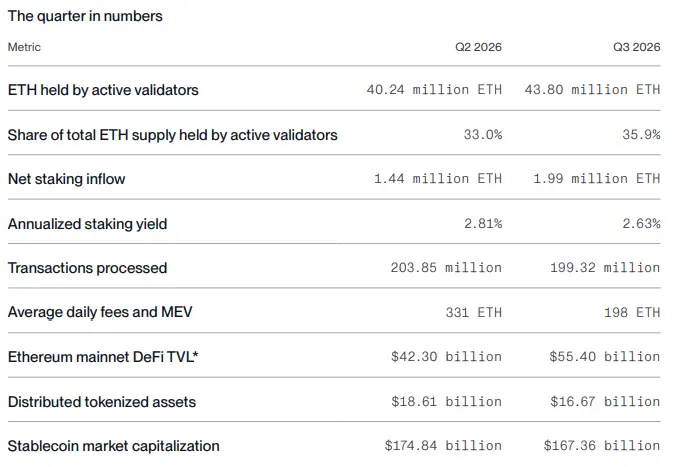
The increase also comes as Ethereum’s staking returns have weakened. Bitwise reported that the gross staking yield fell from 2.81% to 2.63% during the quarter. Lower yields can make staking less attractive to investors focused primarily on income, but participants may also stake to support network security or gain exposure through institutional products. The continued inflows suggest that rewards are not the only factor influencing staking decisions.

Also Read: Ethereum Price Stays Below $2,500 as BitMine Adds 12,535 ETH
Ethereum Validator Count Falls Despite Higher Staked Supply
Bitwise also reported that Ethereum’s validator count fell from approximately 1.1 million to 881,000. The decline does not necessarily mean less ETH is securing the network, because the amount staked increased during the same period. Instead, Bitwise linked the reduction to operators consolidating validators following EtTH’s Pectra upgrade, which made it easier for eligible validators to combine their balances.
Ethereum’s official staking documentation explains that Pectra introduced compounding validator credentials, allowing eligible validators to earn rewards on balances above the traditional 32 ETH threshold, up to 2,048 ETH.
This can reduce operational overhead for large staking operators while allowing rewards to compound. However, validator consolidation also makes it important to distinguish the number of validator records from the number of independent operators, since fewer validators do not automatically mean greater decentralization.
Lower Staking Yields Could Change ETH Investor Decisions
Ethereum’s 2.63% yield was below Solana’s reported 5.99% and NEAR’s 4.87% in Bitwise’s comparison. Those figures are not directly equivalent measures of investment performance, because each network has different token economics, validator requirements and risk profiles. Still, the comparison shows that Ethereum competes with other proof-of-stake networks for capital seeking staking rewards.
For ETH holders, the decision involves more than comparing headline yields. Staking rewards are denominated in ETH, so the dollar value of those rewards can rise or fall with the token’s market price. Investors using pooled or liquid staking services must also consider provider fees, redemption conditions and smart-contract risks. ETH’s official staking pool guide notes that withdrawal access and redemption speed can vary by provider.
Institutional Staking Growth Puts Network Security in Focus
The rising staking total may also matter to institutions seeking to earn rewards on ETH holdings. Staking products can offer additional returns, but participation involves operational responsibilities and risks that differ from simply holding spot ETH. For the wider network, more staked ETH increases the economic value committed to consensus, although security also depends on validator distribution, client diversity and reliable operation.
The next indicators to watch are staking inflows, validator concentration and changes in yield. If deposits continue rising while yields decline, it would suggest that demand to participate in ETH’s consensus remains resilient despite lower income. If inflows slow, investors may be reassessing the balance between staking rewards, liquidity and market risk.
Also Read: Ethereum EIP-8288: 8 MB/s Limit, 10M to 10k Gas Solution



Be the first to comment