



What to know:
- Ethereum staking reaches 41.7M ETH, locking 34.5% of supply despite a 44% price drop.
- BitMine stakes 4.9M ETH, while corporate treasuries strengthen validator participation.
- EIP-8363 renews debate as rising deposits cut yields and raise calls for reward burns.

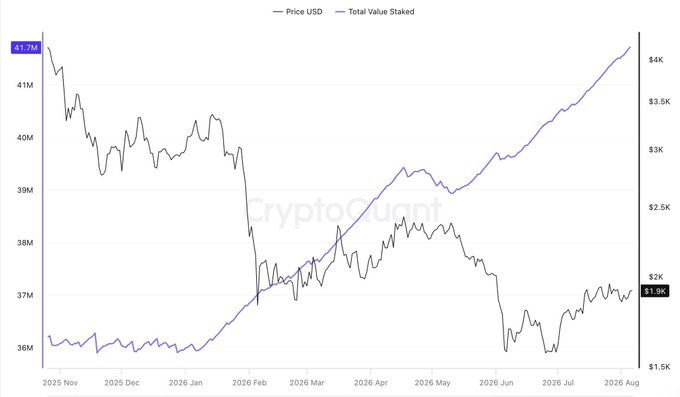
Ethereum staking reached a record 41.7 million ETH despite a price decline this year. The locked balance represents about 34.5% of the cryptocurrency’s 120.7 million circulating supply, showing that deposits continued to rise during weaker market conditions.
In an X post, Bitfinex shared the CryptoQuant chart on Aug. 10. It showed that the staked balance stayed near 36 million ETH through late 2025. Deposits began rising in February and accelerated between June and August.
Source: X
Why Ethereum Staking Rises Despite Lower Prices
Ethereum traded at $1,900 when Bitfinex published the data. It stood 44% below its January level of $3,400. Meanwhile, staking grew from 36.2 million ETH to 41.7 million ETH in less than seven months.
Also Read: Securitize Drives Avalanche RWA Market Near $2 Billion
Validators receive newly issued ETH when they propose blocks and validate transactions. They can even generate priority fees and maximum extractable value (MEV).
Some stakeholders reinvest these gains, enabling them to benefit from compounding their balances as the value of ETH falls. Their individual yield is reduced as Ethereum distributes its rewards using an increasing staking balance.
Treasury companies have also contributed to this trend. As of July 12, BitMine had staked around 4.9 million ETH, which constituted around 85% of the total Ethereum holdings of the company.
For the quarter ending May 31, BitMine earned $45.7 million from staking and validation operations. Its chairman, Tom Lee, believed that if BitMine staked all its treasuries, the annual income would be around $284 million.
SharpLink has also committed most of its ETH treasuries into staking. The strategy has continued to produce token rewards for the company. Low market prices, however, resulted in a loss of $394.3 million in the second quarter.
Record Staking Revives Issuance Debate
This has sparked debates regarding the reward mechanism of Ethereum. Some people believe that further deposits do not offer any additional value in terms of security once the staking ratio has been attained at a certain threshold.
EIP-8363, which is called Tapered Issuance Burn, advocates for burning more consensus rewards when the staking ratio goes higher. The issuance rewards will be zero when around 50% of Ethereum will have been staked.
The creators of the proposed change believe that there is no reduction in the rewards even if the security benefit has reduced with further deposits. It has not been approved as of now for implementing an Ethereum update.
Joseph Chalom, CEO of SharpLink, has strongly criticized this proposal. He believes that native yield attracts institutions and sets a benchmark in DeFi.
US Products Broaden Access to ETH Yield
The regulated investment offerings have opened the door to staking in the U.S. In January, Grayscale paid out $9.4 million of dividends to qualified ETHE shareholders. This represented the first-ever payment from a U.S.-listed Ethereum offering.
Similarly, Morgan Stanley incorporated staking capabilities in its filing for an Ethereum ETF. According to the company’s filing, there were 3.64 million ETH awaiting validation as of May 18. The amount suggested a potential lock-up period of 63 days.
Also Read: Peter Brandt Flags $58K Bitcoin Price Scenario as ETFs Draw $865 Million
This article contains market analysis and price predictions. These are not guarantees. Crypto markets are volatile. Always DYOR. Not financial advice.



Be the first to comment