



Key Takeaways
- ETH rose 29.8% in 7 days and reached nearly $2,546.
- Coinglass recorded $264.92M in ETH liquidations within a $1.21B crypto wipeout.
- Ethereum traders will watch $2,400 support and ETF flows after Aug. 22.
ETH was trading around $2,435 late Saturday at 5 p.m. EDT after cooling from the intraday price peak. The pullback followed a violent run from the mid-$1,800s to low-$1,900s, where ethereum had spent much of mid-August pinned inside a tight range. Its share of the broader crypto market, known as dominance, is now closing in on 11%.
Ethereum Blasts Out of Its Range
The breakout caught fire on Aug. 19, when ETH jumped about 17.5%, opening near $1,917 and closing above $2,250. Buyers kept pressing over the next two sessions, driving the price as high as $2,546.78 on Binance. Daily trading volume has repeatedly hit $25 billion to $33 billion during this run.
Bitcoin also ripped higher, with current exchange rates placing it around $77,300 at 5 p.m. EDT on Saturday as well. But ethereum moved faster this week, and its performance against bitcoin strengthened. That matters because traders were not simply throwing money at crypto across the board. Capital was also rotating into the network underpinning many stablecoins, tokenized assets and decentralized finance (DeFi) applications.

ETF Buyers Pile Back Into Ethereum
Spot ethereum exchange-traded funds (ETFs) pulled in about $697 million in net inflows for the week, according to the latest sosovalue data. The products attracted roughly $189 million on Aug. 19, $221 million on Aug. 20, and $185 million on Aug. 21, their hottest stretch since October 2025.
Blackrock’s ETHA swallowed much of that demand, while Grayscale Mini ETH and Fidelity’s FETH also joined the buying. Total assets under management in spot Ethereum ETFs climbed toward $14.3 billion, equal to about 4.85% of Ethereum’s market capitalization. Cumulative inflows since launch approached $12.2 billion.
Supply Tightens as Buyers Rush In
The rally slammed into a market with less ETH parked on exchanges. Exchange-held ethereum dropped about 15% from early June to mid-August, falling from about 7.7 million ETH to 6.54 million ETH. More than 42 million ETH, about 33.7% of the supply, is also locked in staking.

Staking is the process through which holders commit ETH to help run and secure Ethereum’s network in exchange for potential rewards. Coins staked or pulled from exchanges are not necessarily locked away from sellers, but they shrink the inventory immediately available to traders. That can turn aggressive buying into much larger price moves.
Futures Traders Pour Fuel on the Fire
Ethereum futures open interest, the value of active futures contracts, stood at $31.81 billion, or 13.06 million ETH, according to stats collected from coinglass.com. Binance controlled the largest chunk at $8.77 billion, followed by CME at $3.29 billion, Gate at $2.55 billion and Bybit at $2.21 billion.
Open interest rose 0.13% over the last hour and 0.35% in the past four hours, and it fell 1.60% lower over the last 24 hours. That combination shows fresh positioning is still creeping into the second-largest crypto asset‘s market after the earlier rally flushed other traders out. Futures can turbocharge gains and losses because traders frequently use borrowed exposure.
The immediate wipeout from today’s ether climb was brutal. Liquidation stats from coinglass.com indicate that ETH accounted for $264.92 million of the $1.21 billion in crypto liquidations recorded over 24 hours. The broader flush across the whole market hit 234,707 derivatives traders, while long positions accounted for $727.13 million and shorts for $481.62 million. ETH derivatives were the largest wipeouts today.
Liquidation occurs when an exchange automatically closes a leveraged position after losses burn through the trader’s collateral. ETH’s hefty share of the carnage shows just how violently derivatives markets repriced during the run. Earlier short covering poured fuel on the rally, but the latest figures show leveraged traders on both sides remained vulnerable to sudden reversals.
Options Traders Still Favor Calls
Ethereum options data this weekend shows a more bullish tilt among positions still open. Calls represented 58.41% of options open interest, or 1.60 million ETH. Puts accounted for 41.59%, or 1.14 million ETH, on Saturday afternoon.
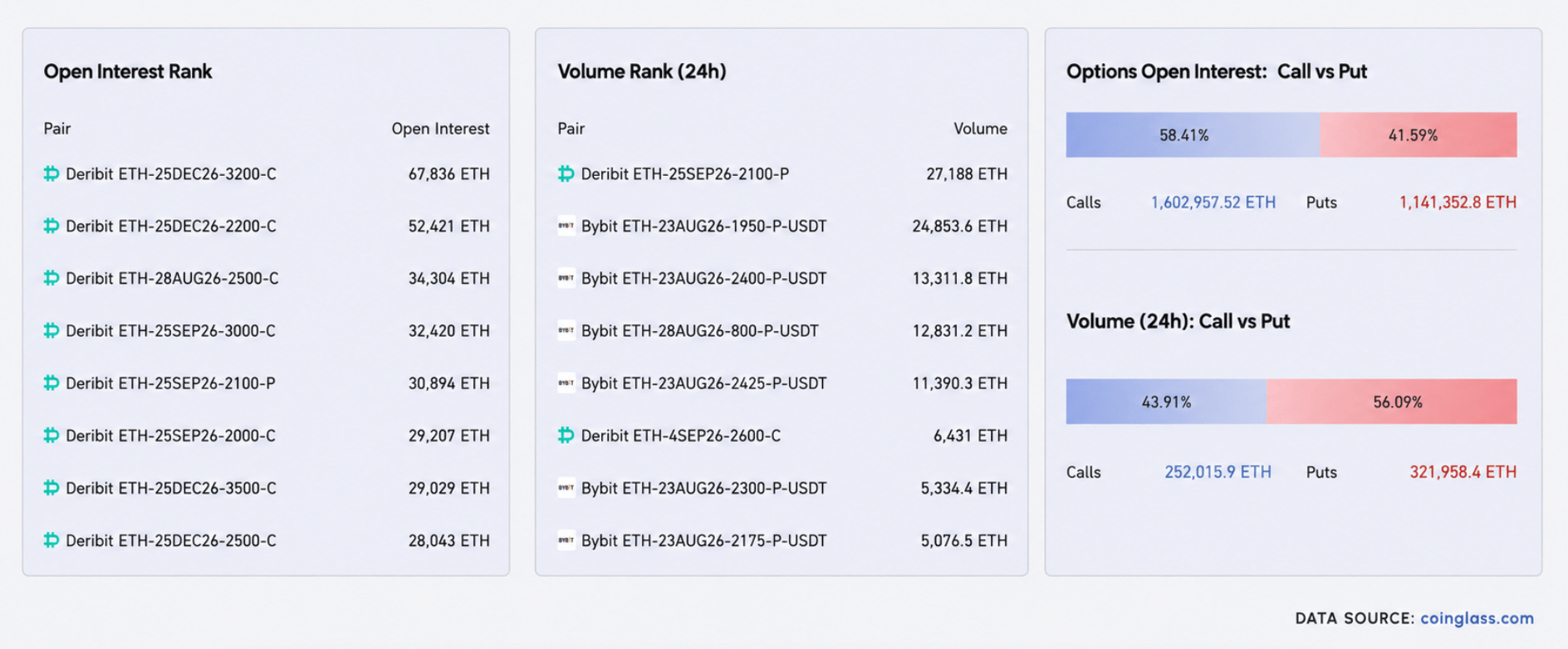
Fresh trading painted a more defensive picture. Put options represented 56.09% of 24-hour options volume, compared with 43.91% for calls. That could reflect traders scrambling for protection after the octane-fueled rally rather than simply betting prices are headed lower. Options essentially give buyers the right, but not the obligation, to buy or sell an asset at a predetermined price.
The largest listed options positions included ether calls at $3,200 per coin, $2,200, $2,500, $3,000 and $3,500 on Deribit. The busiest contracts were clustered around near-term puts, including a Deribit $2,100 put expiring Sept. 25 and several Bybit put contracts expiring Aug. 23. Those positions show traders are focused on whether ETH can defend this week’s gains.
Red-Hot Momentum Cuts Both Ways
The daily relative strength index (RSI) readings of 78 to 88 are commonly considered overbought, and that may be the case this weekend. The RSI measures the speed and size of recent price changes. A lofty reading does not guarantee a sell-off, but it often means a rally has run hard enough to attract profit-taking or trigger sideways consolidation.
Traders are now eyeing $2,400 to $2,450 as the first meaningful support zone, followed by $2,300. A clean break above the $2,546 to $2,550 high would bring $2,600 to $2,800 into play. A slide below $2,300, however, could crack open the door toward $2,150 to $2,200.
Liquidity and Policy Sweeten the Setup
The rally arrived alongside a broader rebound in appetite for risk. U.S. Treasury doubled long-duration bond buybacks to $4 billion per operation, helping cool yields and lift risk-sensitive assets. Political signals surrounding the proposed Clarity Act, which would clarify how U.S. law treats digital assets, also chipped away at regulatory uncertainty.
Those tailwinds can disappear quickly. ETF flows need to stay positive, broader markets must keep embracing crypto assets, and ethereum itself has to defend its newly established support levels.



Be the first to comment