


Ethereum’s AI-assisted verification shows that the meeting point of AI and blockchain continues to transition from the talk stage to actual implementation. Two events in particular demonstrate how large-scale networks are preparing for a future economy in which self-governing software not only has to be trustworthy but also has to be able to handle transactions.
With outlining the way Ethereum co-founder Vitalik Buterin was thinking of using an AI-assisted approach to formal verification to secure crucial sections of code, the XRP Ledger was added as a new settlement line to the Machine Payments Protocol, a collaborative, open-standard initiative between Stripe and Tempo permitting AI agents to settle through XRP.
Certifying Code with Ethereum’s AI-assisted Cerification
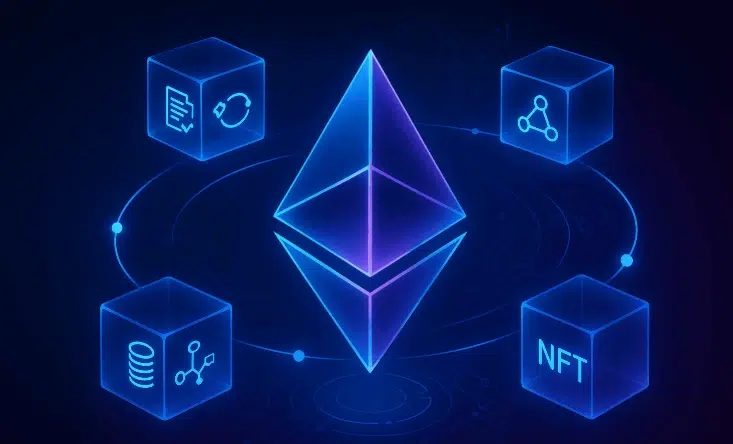
Buterin says that verifying code to allows the computer to be completely trusted and that does not have to be re-examined after scaling up, is a great idea. His point is: AI that is good enough to prove mathematical theories like Navier-Stokes or Fermat can prove a program is ‘secure’ as a theorem as well.
Formal verification is a process in which proofs are written by hand and checked with a computer to ensure that software behaves exactly based on its specs and not just pass some test cases.
Source: YouHodler
OpenAI’s EVMbench found that models still hallucinate vulnerabilities, and miss complex dependencies in Solidity which may result in overlooking a security flaw in code when an audit based purely on AI is performed.
That is another reason why Buterin emphasizes Ethereum’s AI-assisted verification as having verified proofs as a solution since bugs can happen any minute and verified proofs last forever which is very relevant for developers, Layer 2 teams, auditors, and institutions that are in the process of assessing risk.
Also Read: Ethereum Price Holds Above Breakout Zone as $2,600 Resistance Comes Into Focus
Full Stack Verification
In the past, only the teams would check the correctness of small, supposedly most critical parts of their code; the database networking, caching and server layers were left unprotected. Per Buterin, thanks to contemporary AI, Ethereum’s AI-assisted verification now makes it possible to conduct a full-fledged verification.
The main characters in this scene are Ethereum Foundation and Lean Ethereum, who are applying the Lean prover and Arklib, a verified STARKs package, to advance Ethereum’s AI-assisted verification and validate consensus clients, zero-knowledge systems, and EVMs like evm-asm.
The reason why Ethereum has to care is that AI will also give more power to the attackers. Even when they don’t do DeFi, the exploits still bring in hundreds of millions annually, as DefiLlama shows, and so unchecked code is, after all, the major technological risk for the platform. That is why Ethereum’s AI-assisted verification matters, but audits by AI alone are, of course, limited.
Also Read: Ethereum Price Targets $3,000 After Breaking Major Resistance
Giving Agents a Rail
XRPL is following another route. Unlike Ethereum’s AI-assisted verification approach that is integrated directly into one platform’s security layer, XRPL was incorporated as a settlement rail inside the Machine Payments Protocol, an open standard for machine to machine payments co-developed by Stripe and Tempo.
MPP is built for agentic commerce, where automating AI agents autonomously make micro-payments to access APIs data compute, or commerce services without human intervention. The integration enables settlement through XRP, which offers three to five second finality, low fees, native support for issued assets, and a built-in exchange.

Source: PYMNTS.com
Participants are Ripple and XRPL contributors, Stripe co-author, and Tempo, a company that focuses on payments for agentic systems. The move for XRPL means enterprise distribution, without requiring merchants to custody crypto. For exchanges and wallets, it signals demand for rails for micropayments and irreversible flows, an area that card networks fail to address.
Also Read: Ethereum Price Eyes $3,000 Breakout as RWA Market Dominance Strengthens
Two Models for Blockchain’s Role in AI
Together, the moves demonstrate two different, but complementary architectures. Ethereum addresses assurance through Ethereum’s AI-assisted verification, making sure AI-built code does not cause a systemic failure in systems securing tens of billions. XRPL addresses agency, making neutral settlement possible for software which acts economically.
Both are linked to regulatory paths. US and EU regulators are pushing for assurance of software in crucial financial infrastructures, towards clarity on stablecoins, automated payments and liability for autonomous agents under MICA. Networks delivering verified clients and auditable settlement, including those using Ethereum’s AI-assisted verification, are ready for migration
Source: LinkedIn
What is ahead will be counted in tooling. For Ethereum, watch for the Lean Ethereum release and how Ethereum’s AI-assisted verification drives verified EVM precompiles, and whether auditors will want machine-checked proofs or just manual spot checks.
For MPP, watch for pilot volumes, SDK availability, and whether additional chains like Ethereum L2s or Solana deliver as rails. One supports AI building safer systems, one makes them transaction-ready, both underpin the trust and economic layers an autonomous internet needs.
Also Read: Ethereum Glamsterdam Upgrade Faces Key Test Before Oct. 6


Be the first to comment