

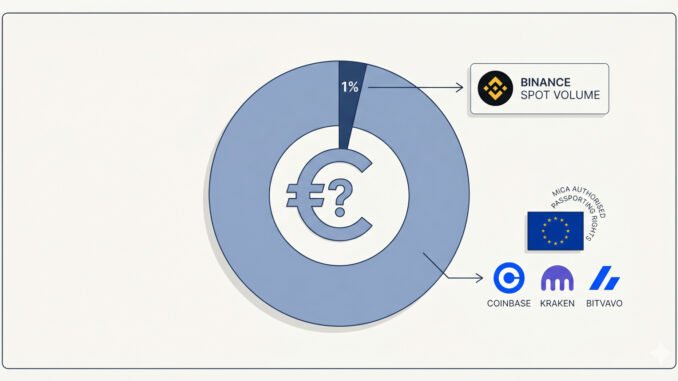

- Euro-denominated trading accounts for only about 1% of Binance’s global spot volume, according to CryptoQuant, limiting the exchange’s exposure to European regulatory disruption.
- Greece’s Hellenic Capital Market Commission is reportedly set to reject Binance’s licence application ahead of the EU’s July 1 MiCA transitional deadline.
- Rivals Kraken, Coinbase and Bitvavo have already secured MiCA authorisation, gaining passporting rights across all 27 EU member states.
Euro-denominated trading accounts for only about 1% of Binance’s global spot volume, data indicates, blunting the potential fallout as the world’s largest crypto exchange faces a reported rejection of its European licence under the EU’s MiCA framework.
CryptoQuant analyst Maartunn flagged the figure, noting that Binance’s daily euro-pair volume has generally ranged between US$100 million (AU$143 million) and US$250 million (AU$357.5 million) in 2026, occasionally spiking above US$600 million (AU$858 million).
“Binance’s inflows remain globally distributed, which may limit the impact of potential MiCA-related setbacks,” Maartunn stated.
Related: Algorand Races Ahead on Quantum Security, Targets Fully Quantum-Resistant Blockchain by 2027
A Reported License Rejection
The data emerged as Greece’s Hellenic Capital Market Commission is reportedly preparing to reject Binance’s licence application ahead of the July 1 transitional deadline under the Markets in Crypto-Assets regulation, according to Reuters, citing people familiar with the matter.
Authorisation in any single member state confers passporting rights across all 27 EU countries, so a rejection would complicate Binance’s ability to serve customers throughout the bloc.
The exchange’s competitors have moved faster: Kraken, Coinbase and Bitvavo have already secured MiCA authorisation and the passporting that comes with it, positioning them to absorb European demand that Binance may be forced to shed.
The July 1 deadline marks the end of a transitional window during which exchanges could keep operating while their applications were assessed. A rejection in Greece would remove that cover, leaving Binance without a clear route to serve EU residents under the new regime.
The thin euro share helps explain why Binance may weather the setback. A December 2024 report from data firm Kaiko found that Binance, Bitvavo, Kraken and Coinbase together accounted for more than 85% of all euro-denominated crypto trading volume, underscoring Binance’s importance in the European market even as EUR pairs represent only a small fraction of its global trading activity.
Losing EU access would cede European ground to already-licensed rivals and underscore a broader post-MiCA shakeout, with only about 210 of more than 1,200 crypto-asset service providers having obtained full authorisation, according to ESMA data cited by analyst Merlijn Geurds.
Read more: Gaming Industry Unites Against Prediction Market “Gambling Loophole”


Be the first to comment