


Energy Web At A Glance
| Category | Assessment |
|---|---|
| Product Type | Energy and sustainability blockchain ecosystem |
| Native Token | EWT |
| Core Network | Energy Web X, a Polkadot parachain using Nominated Proof-of-Stake |
| Main Focus | Energy markets, sustainability applications, clean mining, e-mobility, enterprise coordination, and verified compute |
| Key Infrastructure | Energy Web X, Energy Bridge, Energy Web Verified Compute Cloud, Energy Web X Marketplace |
| Main Strength | Deep energy-sector specialization and real infrastructure focus |
| Main Weakness | Complex ecosystem, enterprise-heavy adoption path, and limited retail simplicity |
| Risk Level | Medium to high |
| Editorial Score | 7.8/10 |
What Is Energy Web?
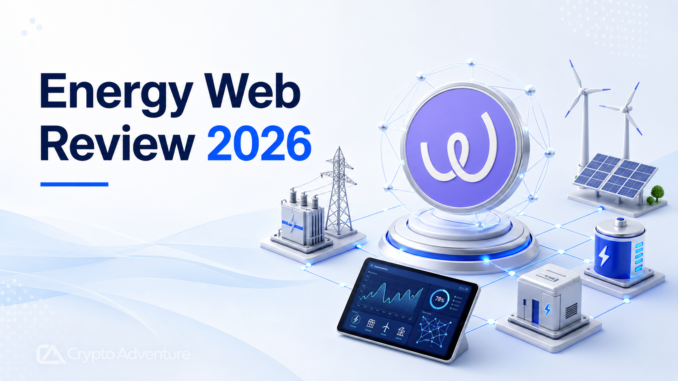
Energy Web is a blockchain ecosystem built around energy transition use cases rather than general-purpose consumer crypto. Its focus is sustainability infrastructure: electricity systems, e-mobility, clean mining, aviation, maritime, enterprise coordination, digital identity, and energy-related market applications. That positioning makes Energy Web different from most Layer 1 and DePIN projects. It is not only trying to host tokens. It is trying to provide coordination tools for companies, infrastructure operators, and sustainability markets.
The ecosystem’s core blockchain layer is Energy Web X, often referred to as EWX. EWX is a Polkadot parachain using Nominated Proof-of-Stake, with staking, onchain governance, and bridges that expand EWT mobility across Energy Web X, Energy Web Chain, and Ethereum. Energy Web’s broader architecture also includes an offchain business logic layer through Energy Web Verified Compute Cloud, which matters because energy-sector applications often need verified calculations, data coordination, and enterprise workflows that do not belong entirely onchain.

Energy Web is best understood as energy middleware with a blockchain settlement and coordination layer. The chain provides token utility, staking, governance, and transaction infrastructure. The offchain layer handles computation and business logic. Marketplace pools and sustainability applications sit on top of that stack.
How Energy Web Works
Energy Web’s architecture has two main layers. The first is the blockchain layer, Energy Web X. It supports staking, fees, governance, and token mobility. The second is the verified compute layer, which allows applications to run business logic connected to real energy and sustainability use cases. This split is important because energy systems need more than smart contracts. They need metering data, asset registries, grid signals, identity, compliance workflows, and verifiable offchain execution.
EWT is the utility token across the ecosystem. It is used for staking, network fees, governance, and the purchase or sale of deployed blockchain services. EWT has a fixed supply cap of 100 million, and its 2025 mobility upgrade enabled an ERC-20-compatible representation that can move between Energy Web Chain, Energy Web X, and Ethereum through official bridging infrastructure. That utility still needs to be separated from token value capture, because protocol revenue and token value can diverge when fees, staking demand, service usage, liquidity, and holder economics sit in different parts of the system.
The Energy Bridge is central to that mobility. It preserves supply on a 1:1 basis while moving EWT across supported chains. On Energy Web X, bridge movements use mint and burn mechanics. On Ethereum and Energy Web Chain, the system uses lock and unlock flows, with Energy Web Chain moving only upward to EWX. This structure improves access but still requires users to respect bridge risk, chain support, wallet compatibility, and transaction rules. Users moving EWT across networks should understand the difference between bridges, intents, and atomic swaps because each model creates different custody, settlement, liquidity, and failure assumptions.
Staking And Governance
Energy Web X uses Nominated Proof-of-Stake. Collators produce parachain blocks, and nominators delegate EWT to support selected collators. Finality is handled through the Polkadot Relay Chain validator set, which gives EWX a security model connected to Polkadot infrastructure rather than a standalone validator design.
Staking can make EWT more useful, but it is not a guaranteed yield product. Delegators share in rewards and can also share in slashing risk if the selected collator violates protocol rules or suffers serious downtime. Minimum staking is set at 1 EWT, unbonding has a two-era delay, and rewards are variable because governance and protocol parameters can change. The same basic risk logic appears across validator-backed systems: slashing risk is not only about reward loss, but also about operator quality, downtime, key management, governance rules, and correlated infrastructure failures.
Governance is another important part of the 2026 setup. Energy Web X is designed to evolve through onchain governance, moving more decision-making toward token holders and stakers. That is valuable for decentralization, but it also increases responsibility. Token holders need to understand upgrades, parameter changes, staking risks, and how governance decisions affect network economics.
Core Features
Energy Web’s strongest feature is energy-sector specialization. The ecosystem is not a generic chain searching for use cases. Its applications target electricity, clean energy, e-mobility, aviation, maritime, clean mining, and sustainability markets. That gives the project a clearer enterprise profile than many DePIN networks.
The second feature is verified compute. Energy applications often require calculations based on offchain data: carbon intensity, energy use, device activity, load flexibility, renewable generation, and market participation. Verified compute helps bridge those workflows with blockchain settlement and auditability. This is where Energy Web overlaps with the broader RWA risk map, because custody, redemption, liquidity, and regulation still matter whenever onchain records point to offchain energy systems, services, claims, or market participation.
The third feature is the Energy Web X Marketplace. New compute pools such as SmartFlow, Carbon-Aware, and GP4BTC show how the ecosystem is trying to connect protocol incentives with real sustainability and energy-market services. These pools need to be evaluated through usage, revenue, participant quality, and the reliability of the underlying business logic, not only token narratives. Developers building on top of those systems also need strong security review, because smart contract auditing and security tools remain part of the risk stack when energy-market logic, token flows, bridges, and governance controls interact.
User Fit
Energy Web fits enterprises, energy companies, infrastructure operators, validators, sustainability teams, DePIN developers, clean mining projects, and crypto users who want exposure to energy-transition infrastructure. It is less suitable for users looking for simple consumer apps or fast retail speculation.
The strongest builder fit is a team that needs identity, verification, energy asset coordination, compute-backed workflows, or energy-market settlement. For example, a project coordinating distributed energy resources may need device registries, usage proofs, incentives, and settlement. A clean mining project may need carbon-aware routing or proof mechanisms tied to electricity sources.
Retail users can stake EWT or interact with applications, but they should treat the ecosystem as infrastructure-heavy. Energy Web’s value depends on enterprise adoption, real service demand, governance execution, and successful energy-market integration. Users holding EWT across multiple networks should also handle custody carefully, and broader crypto wallet security habits matter more when staking, bridging, and governance all touch the same wallet stack.
Strengths
Energy Web’s biggest strength is focus. Energy infrastructure is difficult, regulated, fragmented, and data-heavy. A project that has spent years building around this sector has a different credibility profile from a generic chain adding sustainability language later.
The second strength is the EWX upgrade path. Moving toward a Polkadot parachain with staking, governance, and official EWT mobility makes the ecosystem more interoperable and easier to integrate with broader crypto infrastructure.
The third strength is real use-case depth. Energy Web’s applications touch actual market needs: traceability, decentralized coordination, clean energy verification, device participation, grid flexibility, and sustainability-focused compute. That gives the project stronger substance than broad green-crypto branding.
Weaknesses And Risks
Energy Web’s main weakness is complexity. The ecosystem includes EWT, EWX, bridges, staking, governance, verified compute, marketplace pools, enterprise workflows, and sector-specific applications. That can make the project harder for ordinary users to understand and harder for exchanges, wallets, and apps to present clearly.
The second risk is enterprise adoption speed. Energy markets move slowly because utilities, regulators, grid operators, and large infrastructure companies require long procurement cycles and strict compliance. Strong technology does not automatically create fast adoption.
The third risk is staking and bridge exposure. EWT holders need to understand slashing, unbonding, bridge mechanics, liquidity, wallet support, and governance changes. None of these systems should be treated as risk-free. Portfolio tracking can help users separate long-term holdings from active staking and crosschain movement, especially when tools such as CoinStats are used to monitor balances across wallets and exchanges rather than relying on one app view.
Verdict
Energy Web earns a 7.8/10 because it remains one of the most serious blockchain projects focused on the energy transition. EWX, EWT mobility, staking, verified compute, and marketplace pools give the ecosystem a credible infrastructure stack. The score is not higher because the project is complex, adoption depends heavily on enterprise and energy-sector execution, and users need to understand technical and governance risks before participating.
Energy Web is strongest when evaluated as specialized infrastructure rather than a retail crypto app. Its upside depends on whether energy companies, sustainability markets, and decentralized infrastructure operators use the network for real coordination and settlement.
Conclusion
Energy Web is a focused energy blockchain ecosystem with a stronger infrastructure story than most sustainability-themed crypto projects. EWT now has broader mobility, Energy Web X adds staking and governance, verified compute supports offchain energy logic, and marketplace pools create clearer pathways toward service demand. The project’s challenge is not narrative. It is execution across slow, regulated, infrastructure-heavy markets where adoption depends on trust, integration, and measurable utility.



Be the first to comment