

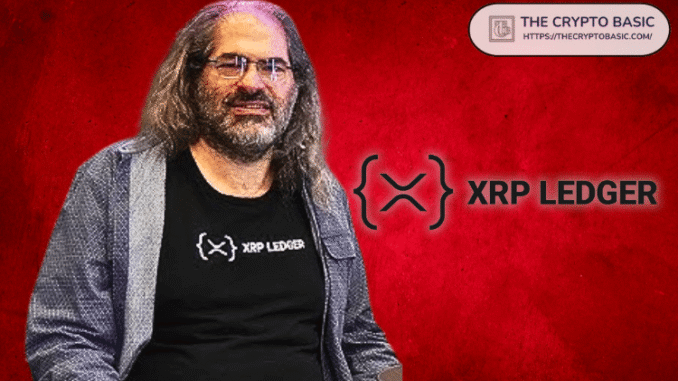


Former Ripple CTO David Schwartz believes the XRP Ledger’s utility is expanding beyond payments and stablecoins.
He said enterprises are increasingly using the blockchain to bring traditional financial assets on-chain.
Speaking in a recent edition of XRP in One Minute, Schwartz highlighted how the XRP Ledger has evolved since its launch. He said it is now positioning itself as a platform not only for digital assets like XRP, but also for tokenized real-world assets.
Key Points
- David Schwartz says the XRP Ledger is evolving beyond payments into a platform for tokenized real-world assets.
- He expects enterprises to bring tokenized stocks, securities, and money market funds onto XRPL.
- Schwartz also sees tokenized repos and loans expanding access, efficiency, and transparency in finance.
- He argues enterprise adoption will drive retail participation as blockchain-based financial products grow.
XRP Ledger Moving Beyond Payments
According to Schwartz, Bitcoin introduced the concept of a public blockchain that allows users to hold and transfer value digitally. The XRP Ledger followed soon after, offering a native digital asset, XRP, alongside support for issued assets.

These issued assets can represent stablecoins and a broad range of tokenized instruments. Schwartz said enterprises are already using the XRP Ledger to issue tokenized real-world assets (RWAs).
The RWA sector has gained significant traction across the blockchain industry. Institutions are increasingly exploring ways to bring traditional financial products onto decentralized networks.
Tokenized Stocks and Securities Coming to XRPL
Looking ahead, Schwartz said the XRP Ledger will support an even wider range of tokenized financial products.
According to him, enterprises will soon offer tokenized securities, money market funds, and tokenized stocks on the network. He suggested that these products could become a major part of the ledger’s future ecosystem.
Schwartz’s remarks suggest the XRP Ledger’s future role could extend well beyond cross-border payments. Instead, it may serve as infrastructure for a growing ecosystem of tokenized financial assets.
Tokenized Repos and Loans Next
Schwartz also pointed to additional financial products that could arrive on the XRP Ledger in the near future. These include tokenized repurchase agreements (repos) and tokenized loans.
Repos are a core part of traditional financial markets. They allow institutions to borrow and lend short-term liquidity using securities as collateral.
Bringing repos on-chain could improve settlement efficiency and transparency. It could also expand participation by making these markets more accessible.
Schwartz added that tokenized loans could similarly broaden access to credit markets through blockchain-based infrastructure.
@Ripple CTO Emeritus @JoelKatz on where XRP is headed:
“Tokenized securities. Money market funds. Stocks. Repos. Loans.”
Enterprise adoption is already here. Mass retail is next.
XRP in a Minute ⬇️ https://t.co/DljGy2Hp9S pic.twitter.com/7DpmNbMPAP
— RippleX (@RippleXDev) June 5, 2026
Enterprises Could Drive Mass Retail Adoption
Schwartz argued that enterprise adoption will be key to attracting mainstream users to decentralized finance.
He said businesses will create the products and services that encourage mass retail participation. In his view, enterprises can help bridge the gap between traditional finance and decentralized financial systems.
Schwartz suggested that as more real-world financial products become available on blockchain networks, decentralized finance could move closer to delivering services traditionally provided by banks and other intermediaries.
His comments come as the XRP Ledger continues expanding its tokenization capabilities. At the same time, institutional interest in blockchain securities, funds, and other real-world assets continues to grow across the digital asset industry.
RWA Sector at a Glance
According to RWA.xyz, the total value of tokenized real-world assets on blockchains currently stands at about $31.18 billion in distributed asset value. This represents freely transferable on-chain tokenized assets.
Meanwhile, represented asset value totals $280.58 billion, including restricted or platform-bound asset representations. Stablecoins, or tokenized fiat currencies, account for an additional $299 billion.
Notably, earlier data from RWA.xyz showed that the XRP Ledger climbed 63% in the platform’s RWA rankings over a 30-day period as of May. During that time, XRPL accumulated more than $3.6 billion in tokenized real-world assets within five months.
Separately, data from Evernorth showed that tokenized U.S. Treasuries on XRPL increased from $50 million last year to $418 million in April, marking an eightfold increase. Platforms such as Ondo Finance, OpenEden, and Zeconomy have contributed to the growth.
However, these figures have since declined amid the ongoing downturn in the crypto market.
DisClamier: This content is informational and should not be considered financial advice. The views expressed in this article may include the author’s personal opinions and do not reflect The Crypto Basic opinion. Readers are encouraged to do thorough research before making any investment decisions. The Crypto Basic is not responsible for any financial losses.


Be the first to comment