

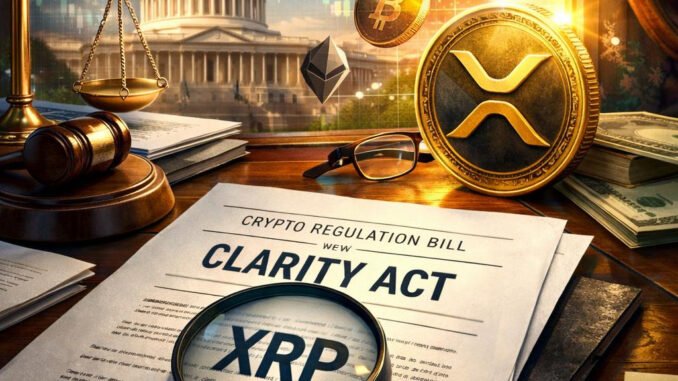

A major piece of US crypto legislation is now in the spotlight with XRP at the center: the CLARITY Act draft text was released Monday night, totaling 309 pages and arriving ahead of a key Senate markup scheduled for Thursday.
The bill has been delayed since January, but the appearance of the full draft has already triggered intense attention from XRP analysts who believe important parts of the document could meaningfully improve the altcoin’s regulatory outlook.
‘Legally Favorable’ For XRP
According to market expert Bull Winkle, several provisions in the draft point to “significant bullish categories” for XRP. In a post shared after the release, Winkle said his reaction was not only excitement, but a sense that the framework is unusually favorable in legal and structural terms.
He began by focusing on the early pages of the draft which creates a new regulatory category for a “network token.” In his reading, the bill defines a network token as a digital asset intrinsically tied to a distributed ledger, where the value comes from the network’s use rather than from any company’s profits.

Related Reading
He argued that this is the type of model XRP fits into, noting that the altcoin’s value, as he describes it, is tied to activity on the XRP Ledger (XRPL)—specifically payments, settlement, and utility—rather than Ripple’s profitability.
He also emphasized that, in this view, the XRP Ledger continues running whether Ripple exists or not, and that the “network token” definition appears to be written for an asset with that exact structure.
From there, Winkle pointed to what he said was the most striking legal detail he found in the draft. He said Section 105, spanning pages 110 to 112, includes language inside the decentralization test that he believes has major implications.
The Best Regulatory Framework For Crypto?
The clause he highlighted states that if a court has already determined that a transaction was not a security before the law was enacted, then the asset cannot later be reclassified as a security. In Winkle’s interpretation, this language is directly connected to the Ripple-related court findings that have already been established.
He also referenced the legal context he believes matters most: Judge Torres’ ruling that XRP secondary market sales were not securities transactions, which he described as final.
He characterized this as the single most important legal protection XRP has ever received, in part because it would put a firm boundary around how future re-interpretations could be handled.
Related Reading
Winkle’s post also cited Section 401, located on pages 195 through 204, and described it as a provision that explicitly authorizes banks and credit unions—along with their subsidiaries—to use digital assets for payments, custody, clearing, and settlement.
In his view, this is not just a general permission slip, but an on-ramp for the banking sector to move forward with the same operational capabilities that XRP advocates have associated with payment infrastructure work.
Even with his bullish conclusion, Winkle was careful to note that the CLARITY Act is still a Senate draft and has not passed yet. That means the provisions he highlighted remain subject to change as lawmakers negotiate and vote.
Still, he argued that the document already contains the most favorable regulatory framework for XRP that the US government has put on paper to date.
Featured image created with OpenArt, chart from TradingView.com




Be the first to comment