

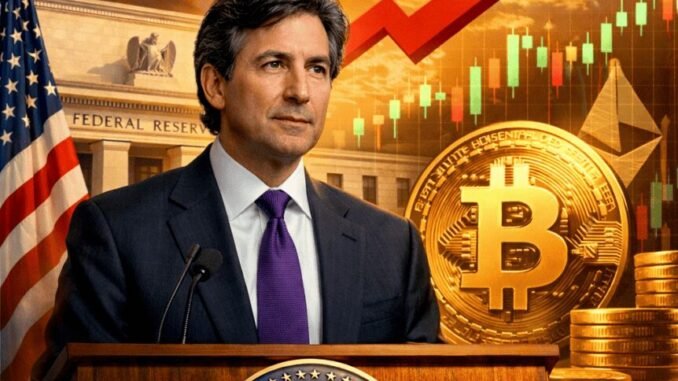

Kevin Warsh was sworn in as chair of the United States Federal Reserve, but the market’s focus quickly shifted to the policy path that will shape crypto markets and broader risk assets through 2026. The latest CME Group FedWatch data suggests investors are pricing in virtually no chance of rate cuts this year, signaling a higher-for-longer stance that could influence liquidity and risk appetite across crypto and equities.
During the swearing-in ceremony, President Donald Trump framed Warsh’s tenure as one defined by independence from the Executive Branch on monetary policy, while underscoring a belief that a booming economy should guide growth alongside inflation containment. “We want to stop inflation, but we don’t want to stop greatness,” Trump said, a line that captured the tension between price stability and growth the new administration seeks to navigate.
“We want to stop inflation, but we don’t want to stop greatness.”
Warsh inherits a policy backdrop where inflation, employment, and debt dynamics intersect with a market environment that had been pricing little relief in the near term. The Trump administration’s emphasis on growth as a lever to manage debt sits beside persistent macro uncertainty, complicating how traders read even the first signals from the new leadership at the Fed.
Key takeaways
- No rate cuts expected in 2026, based on CME FedWatch data, reinforcing a higher-for-longer policy trajectory.
- Near-term odds of a 25 basis point hike at the June meeting sit at about 3.5%, with the current federal funds target at 3.50%–3.75%.
- Probability of a rate hike at the July meeting rises to roughly 17%, and about 67% of traders expect a hike at the December meeting.
- The leadership change at the Fed comes amid inflation concerns and growth considerations, with markets parsing how the new chair’s approach will balance these forces.
- Crypto and other risk assets could face headwinds if the expected pause on rate cuts persists, as liquidity and risk sentiment remain sensitive to policy signals.
Fed leadership and policy signals
The swearing-in of Warsh as chair places the Fed at a critical inflection point. While details of his forthcoming policy communications remain to be seen, the market is already responding to the prevailing assumption that monetary easing via rate cuts is unlikely in the near term. In a regime where the Fed’s stance on inflation and growth will guide the tempo of liquidity, crypto traders are attuned to any shift in language or data that might alter the balance between price stability and economic expansion.
Trump’s remarks at the event underscored a deliberate narrative: Warsh’s independence should enable a policy path that prioritizes growth while attempting to keep inflation in check. The president’s framing, coupled with inflation and employment dynamics, creates a backdrop in which the Fed’s credibility will be tested as markets weigh the odds of future policy moves against evolving macro data releases.
Markets, rates and crypto implications
Market pricing through the CME FedWatch tool indicates a remarkably low likelihood of rate cuts in 2026. The immediate implication is a constrained environment for policy ease, which tends to support tighter financial conditions. In practice, this translates into higher real interest rates and a spotlight on the trajectory of inflation, growth signals, and debt sustainability as the Fed’s mandate remains in focus.
The June 17 FOMC meeting is seen as a potential touchpoint for a small policy adjustment, with a 3.5% probability of a 25 basis point rate hike. With the current target range at 3.50% to 3.75%, even a modest move would be read as a continuation of the higher-for-longer theme, rather than the start of a rapid easing cycle.
Beyond June, the odds shift toward a greater probability of action later in the year. A July hike carries roughly a 17% chance, while the December meeting is seen as the more likely period for a rate move, with about two-thirds of traders expecting a hike then. Taken together, the data imply a policy stance that remains tight through the year, creating a backdrop of higher borrowing costs and a slower easing pace than many crypto and equity markets had priced in during earlier cycles.
In the crypto ecosystem, this environment has a nuanced set of implications. Historically, lower interest rates have been supportive of risk-on assets, including Bitcoin and broader crypto markets, by boosting liquidity and search for yield in higher-risk corners of the market. Yet the flip side is that cheap credit can fuel inflationary pressures or misallocation if it leads to a wave of leveraged speculation. As the Fed maintains a careful watch on inflation and growth, crypto traders will be watching not only the headline rate moves but also any shifts in the Fed’s communications that could tilt expectations for the cost of capital and the availability of liquidity.
What this means for investors and builders
For investors, the current outlook reinforces the idea that capital will continue to be priced with an eye toward central bank policy and macro data. Portfolios with exposure to crypto and other risk assets may need to tolerate continued volatility as rate expectations swing with new data releases and statements from Fed leadership. The absence of imminent rate cuts suggests a period of consolidation for risk assets, even as the underlying fundamentals of blockchain networks, DeFi protocols, and institutional involvement in crypto continue to evolve.
For builders and developers in the crypto space, the environment underscores the importance of funding resilience and product-market fit independent of a passive liquidity tailwind. Projects that demonstrate real utility, robust security, and clear paths to revenue may fare better in a regime where liquidity remains tethered to policy signals, rather than a broad, rate-driven liquidity flood.
And for regulators and policymakers outside the Fed, the ongoing conversation around inflation control, debt management, and economic growth will intersect with how the crypto sector is treated within the broader financial system. As policy makers weigh the CLARITY Act and other regulatory contours, the market will assess whether legislative actions could alter the risk-and-reward dynamics that crypto projects navigate daily.
The immediate takeaway is clear: the Fed’s leadership transition arrives at a moment when policy clarity, inflation momentum, and growth trajectories will jointly shape the path of crypto and risk assets. Investors should stay attentive to the Fed’s communications, inflation prints, and any shifts in the rate-path narrative that could alter funding conditions for digital assets and their traditional counterparts.
Readers should monitor upcoming FOMC communications and macro data releases, as any hint of a policy pivot or a renewed emphasis on price stability could recalibrate sentiment across cryptocurrencies and the broader market.



Be the first to comment