


Disclaimer: The below article is sponsored, and the views in it do not represent those of ZyCrypto. Readers should conduct independent research before taking any actions related to the project mentioned in this piece. This article should not be regarded as investment advice.
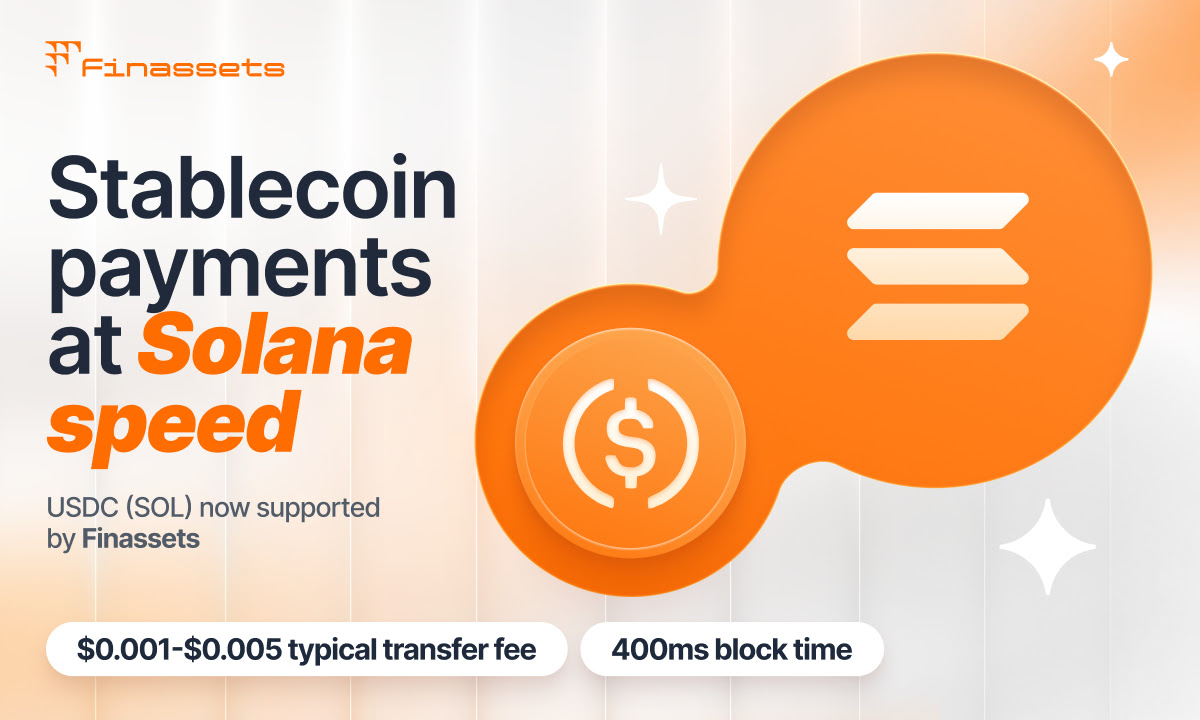
Finassets.io, a crypto payment gateway for businesses, has added USDC (SOL) to its Back Office — giving merchants access to one of the fastest, lowest-cost networks for settling stablecoin payments.

Merchants can now accept and process USDC on Solana alongside 70+ other supported cryptocurrencies, using the same Back Office, payment button, checkout, and API already in place. No new integration, no separate product.
Solana Already Carries Billions in USDC
Solana holds the second-largest share of circulating USDC after Ethereum — roughly $6.7 billion of Circle’s total supply — on a network built for higher throughput than most alternatives.
Solana’s mainnet has also run without an outage for more than two years, giving merchants both scale and reliability.

 
Built for Stablecoin Payments Across Multiple Assets
USDT and USDC already run across multiple networks in the Finassets Back Office, and USDC (SOL) extends that setup rather than complicating it. With Auto-Convert, incoming crypto is converted to a stablecoin the moment a payment arrives, with the rate fixed at that instant — protecting merchants from price fluctuations.
Network choice still affects the two numbers merchants care about most: what a transfer costs, and how long it takes to confirm. On both counts, Solana comes out faster and cheaper than Ethereum — making it one of the most cost-effective networks for settling USDC available today.
No New Integration Required for Existing Merchants
Merchants already using Finassets can enable USDC (SOL) directly in the Back Office — through the same payment button, checkout, and API they’ve already connected. Those onboarding now can choose one of two integration methods:
1. Payment button — Installs on a website or online store with no backend development required; customers pay directly from a Solana wallet.
2. API integration — Generates a unique Solana wallet address per transaction and tracks transaction details, including destination and confirmation, via webhook.
Both paths include sandbox access and step-by-step setup documentation for testing before go-live.
“USDC on Solana is one of the most efficient stablecoin payment options available today. It combines a widely used dollar stablecoin with one of the fastest and lowest-cost networks. We added it to give merchants a faster, more cost-effective way to move USDC — especially when they’re processing payments at scale,” said Vitalijs F., CEO of Finassets.
USDC (SOL) Uses the Same Finassets Infrastructure
Once enabled, USDC (SOL) follows the same operational rules as every other asset Finassets supports:
Transaction status and history are tracked per asset in the Back Office. Deposits are typically credited within about 30 seconds of network confirmation. Security runs at the same standard across every asset — MPC-based wallet technology, two-factor authentication, role-based access control, and IP whitelisting.
USDC (SOL) support is available to eligible merchants in selected international markets, subject to Finassets program terms, verification, and applicable compliance requirements.
Register and enable USDC on Solana payments for your business at finassets.io.
About Finassets
Finassets is a low-fee crypto payment gateway for iGaming and eCommerce, providing payment infrastructure that spans a crypto payment button, crypto checkout, crypto invoicing, crypto mass payouts, B2B crypto exchange, and API integration. Merchants can accept 70+ cryptocurrencies, including stablecoins like USDT and USDC across multiple networks. Fees start from 0.40% and scale down to 0.20% as volume grows — with no hidden fees and full visibility into every transaction.
Founded in 2021, Finassets is a Panama-registered B2B crypto payment infrastructure provider supporting cross-border and crypto-driven businesses across eligible markets.




Be the first to comment