



TL;DR: U.S. FinCEN has withdrawn its 2020 unhosted wallet reporting rule and 2023 crypto mixer proposal as the CFTC proposes a federal framework for digital currency exchanges. Chainalysis reports China’s P2P stablecoin wallets grew 43-fold despite restrictions, and the ECB outlined three models for on-chain central bank money.
Key Takeaways:
US FinCEN scraps proposed $10,000 reporting rule for crypto
On October 4, the U.S. Treasury Department dropped two long-stalled crypto proposals.
The Financial Crimes Enforcement Network (FinCEN), the Treasury’s financial crimes unit, has scrapped proposed digital asset-related rules, one of which dates to December 2020.
The 2020 proposal would have required banks and digital currency exchanges to report transfers of over $10,000 to or from self-controlled unhosted wallets, including smaller transfers made within 24 hours. With this rule, firms would have had to collect information about the customer and the wallet on the other side of the transfer.

Following its release, the proposal received thousands of public comments and has remained unresolved since 2020.
FinCEN also dropped a 2023 proposal that, if passed, would have classified crypto mixing transactions as a primary money-laundering concern, allowing the government to impose additional reporting requirements on financial institutions that handle them.
“FinCEN has considered the comments submitted in response to these proposals and is withdrawing them as part of the Trump Administration’s deregulatory agenda and ongoing efforts to ensure digital asset regulations are fit-for-purpose,” a press release from the agency read.
The withdrawal came amid the Commodity Futures Trading Commission (CFTC)’s Monday proposal for a new federal crypto framework, which would allow U.S. digital currency exchanges to opt into federal oversight rather than state money-transmitter licenses.
“For years, entrepreneurs building on the new frontier of finance faced uncertainty about whether there was a place for them in our markets. We are giving them an answer,” said CFTC Chairman Michael Selig.
If passed, the CFTC will establish a new category of CFTC-regulated trading venues called “crypto asset maker” for exchanges that offer margined or leveraged trading to customers. The platforms would be subject to specific requirements, such as anti-market-manipulation measures and a “proof of reserves” obligation.
In addition, the agency wants registered futures commission merchants (FCMs) to act as intermediaries for customer trades on this new category of exchanges. The CFTC won’t set leverage caps, but exchanges offering leverage products would need staff approval first.
The proposals come after Congress stalled the CLARITY Act, which would have given the CFTC the power to police the spot crypto market.
P2P stablecoin transactions grew 43x in China despite restrictions: Chainalysis
Elsewhere, a new Chainalysis report on “East Asia Crypto Adoption” claimed that China’s unique wallets sending peer-to-peer (P2P) stablecoins increased 43-fold between the first quarter of 2024 and the second quarter of 2026.
Chainalysis recorded that $104.1 billion was moved across 18.1 million transfers involving China’s self-custodied stablecoin holdings during this year’s reporting period.
Stablecoin holdings in China surged 33.2x per year, more than three times the global world average of 9.3x, a pattern the blockchain analytics firm said was consistent with users treating the asset as working capital.
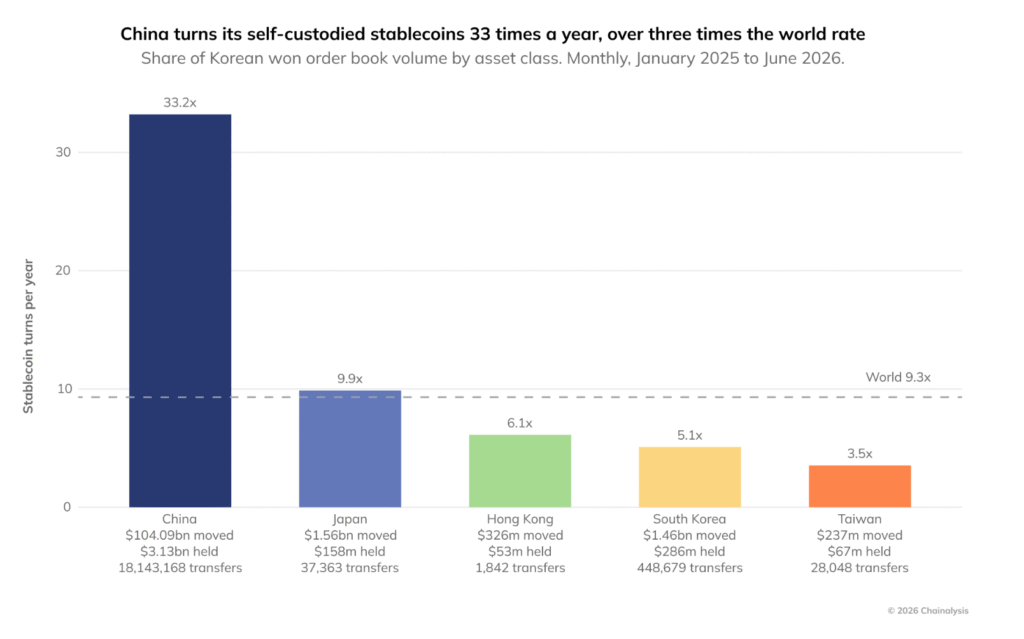
According to their findings, China’s crypto economy is worth $176.3 billion, with domestic P2P activity accounting for 59.1% of its all-in economy in 2026. This growth happened amidst China’s strict rules on crypto trading.
Overall, the Chainalysis report found positive digital currency adoption in East Asia, with South Korea leading the region with a $449.1 billion digital currency economy. Japan follows this at $228.3 billion, Hong Kong at $192.2 billion, China at $176.3 billion, and Taiwan at $140.4 billion.
ECB sets 3 models for central bank money on-chain
Returning to the West, the European Central Bank‘s (ECB) Executive Board Member Isabel Schnabel shared at the Bank of England‘s (BoE) Future of Money that the ECB is considering three models to bring central bank money on-chain.
Schnabel explained in a presentation that one option would be for the central bank to issue reserves directly on a programmable platform. In another model, the EB’s existing real-time gross settlement system remains in place, with an interoperability layer connecting it to other DLT platforms.
The ECB board member clarified that the reserves will not be tokenized, but the two models would be linked by hash.
In the third model, the approach is that tokenized reserves are held at the central bank, and those reserves fully back the issue-settlement tokens. According to Schnabel, those tokens would be private claims.
Schnabel also explained how a blockchain-based monetary system could retain the two-tier structure used today. According to her, the settlement would still be anchored in central bank money, while commercial banks would go on supplying money and financial services to their customers.
Under this setup, central bank money will be operating on DLT alongside tokenized assets such as securities, deposits, and stablecoins.
The newly proposed ECB framework comes amid financial institution leaders increasing their focus on tokenization.
Recently, a survey by Lloyd’s Banking Group found that 60% of respondents in the U.K. finance sector cited faster payments and transaction settlement as benefits of tokenization. Meanwhile, 41% pointed to a more efficient collateral and liquidity management as the biggest benefit.
Stablecoins are another key focus, as over 50,000 Europeans urged the European Commission last week to allow stablecoins to offer rewards following calls from EU central banks for stricter stablecoin restrictions.
FAQs:
Why did FinCEN withdraw its crypto proposals?
FinCEN said it reviewed public comments and is withdrawing the proposals as part of the Trump Administration’s deregulatory agenda and its efforts to make digital asset rules fit for purpose. It announced the move on October 4.
What was the FinCEN $10,000 crypto wallet rule?
The 2020 proposal would have required banks and exchanges to report transfers over $10,000 to or from unhosted wallets, including smaller transfers within 24 hours, and to collect customer and wallet information.
What was the FinCEN crypto mixer proposal?
The 2023 proposal would have designated crypto mixing transactions as a primary money-laundering concern, imposing additional reporting requirements on institutions that handle them. FinCEN has now withdrawn it.
What is the CFTC’s new crypto framework?
It lets U.S. crypto exchanges opt into federal oversight rather than state licensing. A new “crypto asset maker” category would cover leveraged trading venues, with anti-manipulation and proof-of-reserves requirements.
How much did China’s P2P stablecoin activity grow?
Chainalysis says the number of unique wallets sending P2P stablecoins in China grew 43-fold from Q1 2024 to Q2 2026, with $104.1 billion transferred between July 2025 and June 2026.
How big is China’s crypto economy?
Chainalysis values it at $176 billion, with domestic P2P activity making up 59.1% of the total.
What are the ECB’s three models for on-chain central bank money?
They are direct reserve issuance on a programmable platform, an interoperability layer linking the existing settlement system to DLT platforms, and settlement tokens backed by tokenized reserves.
Watch: What Happens When Blockchain Becomes Invisible?



Be the first to comment