



The U.S. Treasury’s Financial Crimes Enforcement Network (FinCEN) is withdrawing a 2020 proposal that would have imposed reporting, recordkeeping and customer-verification requirements on certain crypto transactions involving unhosted wallets. FinCEN said it will take no further action on the proposal, marking a significant change from an earlier approach to monitoring transfers involving self-custodied digital assets.
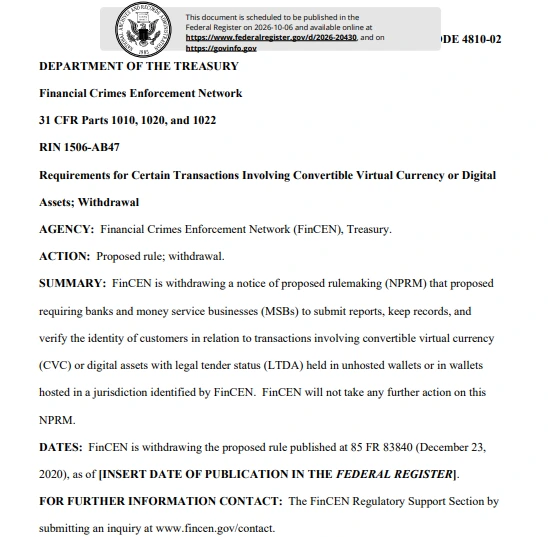
FinCEN’s 2020 Proposal Set $10,000 and $3,000 Thresholds
The withdrawn proposal targeted banks and money services businesses handling convertible virtual currency or digital assets with legal tender status. It would have required reporting when a transaction involving an unhosted or other covered wallet exceeded $10,000, including transactions that aggregated above that amount within 24 hours.
For transactions above $3,000, the proposal would also have required financial institutions and MSBs to keep records and verify customer identities when the counterparty used an unhosted or otherwise covered wallet. The requirements would have applied to institutions rather than directly imposing reporting duties on individual wallet holders.
Also Read: Binance Linked To Bitzlato’s Money Laundering: FinCEN’s Report

The proposal was published in December 2020 and attracted substantial industry attention because it addressed transactions involving wallets controlled directly by users rather than financial institutions. FinCEN later said it had received more than 7,500 comments during the original comment period, reflecting the sensitivity of the issue for the crypto industry and other stakeholders.
The withdrawal means the 2020 NPRM will not move forward in its proposed form. It does not, however, mean that transactions involving self-hosted wallets are outside U.S. anti-money-laundering or sanctions requirements, because banks and MSBs remain subject to other applicable Bank Secrecy Act obligations.
FinCEN Withdrawal Signals Shift in U.S. Digital Asset Policy
FinCEN said the decision is part of the Trump administration’s effort to ensure digital-asset regulations are “fit-for-purpose.” The move follows a broader policy shift toward establishing clearer rules for digital assets while reducing regulatory requirements viewed as unsuitable for the technology.
That direction can also be seen at the Securities and Exchange Commission. On October 1, the SEC proposed a crypto custody framework that would, under specified conditions, allow investment advisers and regulated funds to use self-custody for crypto assets. The two actions involve different agencies and legal regimes, but together they show greater attention to regulatory frameworks that account for how blockchain custody actually works.
Self-Custody Debate Moves Toward a New U.S. Regulatory Framework
For crypto users, the immediate significance is that the withdrawn proposal will not create the specific reporting and recordkeeping regime originally envisioned for transfers involving unhosted wallets. For exchanges, banks and MSBs, the decision removes uncertainty over whether those particular 2020 requirements would eventually take effect.
The next question is whether U.S. agencies replace the withdrawn approach with narrower rules aimed at illicit finance risks without treating self-custody itself as an intermediary activity. FinCEN’s decision leaves that policy question open, while the SEC’s recent custody proposal indicates that U.S. regulators are continuing to develop more specialized rules for digital assets.
Also Read: Tether Targets Top 10 U.S. Treasury Bill Holders by 2026


Be the first to comment