

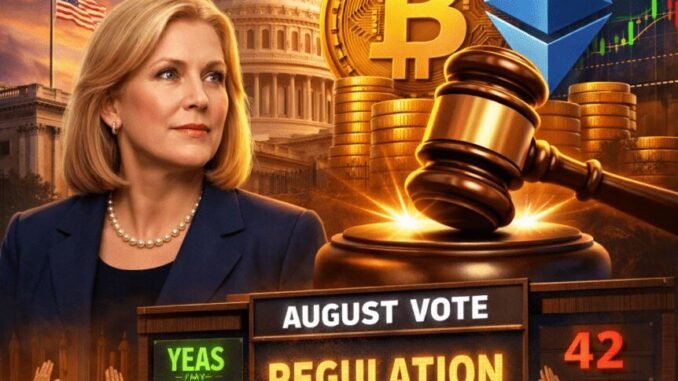

US Senator Kirsten Gillibrand indicated at the Consensus conference in Miami that the fate of the digital asset market structure bill hinges on lawmakers meeting three practical conditions before the Senate can consider a vote. Speaking on the record, she identified consumer protection, illicit finance controls, and ethics provisions as essential elements that must be addressed prior to any action on the CLARITY Act. She suggested that if Congress can merge the market structure framework with the version already advanced by the Senate Agriculture Committee and attach robust ethics language, a vote could occur before the August recess that begins on August 10.
“There will be no one voting for this bill if we don’t have an ethics provision,” Gillibrand said, underscoring that integrity standards are non-negotiable in a landscape where public officials’ involvement in the industry could raise conflicts of interest. “Because the truth is, we cannot allow members of Congress, senior administration officials, presidents or vice presidents, to get rich off of these industries because of their insider status. It is the worst form of pay for play.”
While Gillibrand did not name specific individuals, the remarks come amid renewed scrutiny of ties between public figures and crypto ventures. The broader political debate surrounds the CLARITY Act as lawmakers weigh how to regulate a fast-evolving sector, including stablecoins, DeFi platforms, and tokenized equities, within a cohesive federal framework.
Beyond the ethics question, the evolving policy conversation has touched the linkage between regulatory risk and industry structure. Last week, senators on the Senate Banking Committee announced a deal on stablecoin yield issues that could help move the market structure legislation forward, although the agreement did not address language on potential conflicts of interest among public officials. The development signals that it is possible to find bipartisan consensus on certain technical elements while leaving other concerns to future negotiations.

In the broader policy discourse, industry voices have pressed for timely progress. Ripple CEO Brad Garlinghouse pointed to a narrow window for legislators to address the bill before it becomes entangled in electoral-year dynamics, a sentiment echoed by other executives who argue that delay raises uncertainty for infrastructure planning, product launches, and institutional compliance programs.
From the regulatory side, former Commodity Futures Trading Commission commissioner and Blockchain Association chief executive Summer Mersinger described the current moment as a critical juncture—the window to act could open briefly, and if missed, there is no guarantee it will reappear in the same form. Her remarks highlighted the practical implication for compliance teams and legal professionals who must map to evolving standards and potential licensing regimes.
Key takeaways
- The CLARITY Act’s path to a Senate vote depends on three conditions: consumer protection, illicit finance safeguards, and ethics provisions.
- Lawmakers aim to merge the market structure bill with the Agriculture Committee version and attach ethics language, with possible action before the August recess.
- Ethics provisions are framed as essential to prevent conflicts of interest and pay-for-play risks in crypto policymaking.
- Recent discussions on stablecoin yield could facilitate movement on the bill, though work remains on public official conflicts language.
- Industry voices view the timing as delicate: act now to avoid entrenchment during the midterm cycle and potential political headwinds.
Legislative status and the regulatory backdrop
The market structure bill, which seeks to establish a comprehensive federal framework for digital assets, has become a focal point of regulatory policy debates in Washington. As of the week described, the Senate Banking Committee had not yet rescheduled a markup after postponing it earlier in the year. The postponement followed public criticism from some industry participants who argued that the bill, in its current form, may unduly constrain innovation in areas such as decentralized finance, stablecoins, and tokenized equities.
Coinciding with legislative momentum, industry leaders have stressed the need for precise and enforceable rules that align with existing financial oversight while safeguarding innovation. The stance from Coinbase’s leadership earlier this year, which signaled reservations about certain provisions, illustrates the sensitivity around DeFi and crypto token classifications. In this context, the ethics language Gillibrand emphasized would address concerns about potential corruption risks in the legislative process and strengthen the bill’s legitimacy from a governance perspective.
On the regulatory horizon, the interplay with cross-border and domestic regimes remains a strategic consideration. In the European Union, MiCA represents a parallel trend toward centralized regulatory clarity for crypto assets and stablecoins, influencing how U.S. policymakers think about licensing, supervision, and market integrity. Although the CLARITY Act is a U.S.-centric initiative, its design and potential impact will be evaluated against international practice, especially in areas related to consumer protection, AML/KYC requirements, and orderly markets.
In public commentary, industry participants have flagged specific policy areas requiring careful calibration. Regulatory and enforcement considerations—ranging from disclosures and fiduciary duties to anti-money laundering controls and executive ethics requirements—shape what compliance teams must prepare for. The need for robust governance language is underscored by discussions about conflicts of interest and the integrity of public decision-making when it touches crypto markets.
Timing, signals, and practical implications for institutions
Timely action on the market structure bill matters for exchanges, banks, and institutional investors that seek clear, predictable rules for custody, settlement, and product structuring. A stable policy framework can reduce the risk of ad hoc enforcement actions and provide a stable basis for licensing, risk management, and operational compliance. The recent stablecoin yield discussions—though not sealing language on conflicts of interest—underscore efforts to resolve key technical issues that affect product design, liquidity management, and capital treatment for regulated entities interacting with crypto assets.
From a market perspective, traders and risk managers have tracked predictions about the bill’s prospects. Prediction-market platforms reflect divergent expectations: one platform assigns a higher probability to passage by year-end, while another assigns a more immediate likelihood of action within the August window. These signals influence how institutions calibrate internal roadmaps for product launches, governance reviews, and regulatory reporting.
Industry advocates argue that progress on the CLARITY Act could harmonize U.S. oversight with evolving international standards, reducing fragmentation across markets and jurisdictions. The emphasis on consumer protection, illicit finance controls, and ethics aligns with a growing consensus that credible crypto regulation must balance innovation with oversight, a balance that institutions require to manage risk, ensure compliance, and preserve customer trust.
Enforcement, compliance, and policy implications
Legal and compliance teams should monitor the potential alignment between the CLARITY Act and broader enforcement priorities. The proposed ethics provisions would likely shape internal governance policies, whistleblower channels, and disclosures related to political contributions, corporate sponsorships, and senior leadership ties to the industry. For banks and regulated intermediaries, the framework could inform licensing expectations, disclosure regimes, and risk-based AML/KYC programs tailored to crypto assets.
lawmakers are also weighing how to articulate standards for consumer protection—ranging from product disclosures to protections against misrepresentation and fraudulent schemes. The delicate balance between enabling new financial products and safeguarding consumers will influence how firms structure disclosures, marketing materials, and relationship-based risk controls. The discussion also intersects with anti-money laundering and countering the financing of terrorism regimes, where clarity in definitions, reporting obligations, and enforcement mechanisms matters for integration with existing financial compliance ecosystems.
On the enforcement front, the CLARITY Act would potentially interact with actions by the SEC, the CFTC, and the DOJ as agencies delineate jurisdictional boundaries and supervisory expectations. Institutions would need to map regulatory requirements across agencies, ensuring that liquidity management, custody, and trading activities align with the evolving standard for crypto assets and digital securities. The outcome could also influence cross-border operations, especially for firms with global exposures and interconnected stablecoin initiatives.
Closing perspective
As policymakers continue to refine the bill, the central questions revolve around how to reconcile innovation, investor protection, and governance integrity within a coherent legal framework. The window for consensus appears to be narrowing as the August recess approaches and midterm dynamics intensify. Observers should watch for developments on the ethical governance provisions, the final alignment of the House and Senate market structure texts, and any forthcoming language on conflicts of interest that could determine whether the CLARITY Act advances in its current form. In practice, the outcome will influence not only regulatory clarity for crypto markets but also the risk and compliance posture of a broad set of financial institutions engaging with digital assets.



Be the first to comment