


Key Insights
- Geopolitical tensions and trade disputes over semiconductors between the US and China impacted investor sentiment in global markets.
- ETF outflows from Bitcoin indicated reduced risk appetite among institutions amid macroeconomic uncertainty.
- Although volatile, there remain those who still see cryptocurrencies as an alternative to the traditional financial system in the long term.
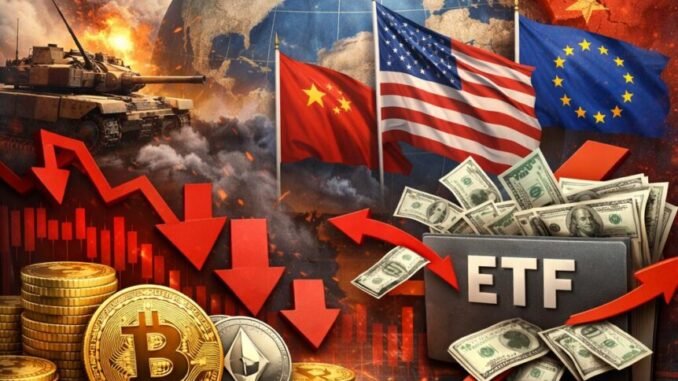
Sentiment among investors in global financial markets was lower this week due to geopolitical tensions, Bitcoin ETF selling, and the semiconductor trade dispute. Digital assets reflected similar performance to equities and other sectors sensitive to risks as market participants reevaluated their positions in speculative markets.
There was higher volatility within the crypto market as investors took notice of fresh concerns related to geopolitical tensions and strategic economic competition among key nations. Developments in the US, China, Iran, and Taiwan all played a role in contributing to uncertainty in both traditional and digital asset markets.
Geopolitical tensions tend to lead to reduced investor confidence in high-risk markets like cryptocurrency and technology. This resulted in a more defensive strategy among institutional and individual investors.
Market Dynamics under the Influence of Semiconductor Competition
One of the key sources of market uncertainty included semiconductor competition between the United States and China. Investors followed conversations about China’s plans to decrease its dependence on US suppliers and increase domestic production of semiconductors.

Semiconductors continue playing a pivotal role in artificial intelligence infrastructure, cloud computing, automation, and manufacturing. Any disturbance or increased competition in this market often impacts market expectations about future technology leadership and economic development.
Cryptocurrency trader James Wynn brought further attention to this problem in a widely discussed post on X regarding China’s domestic technology development efforts and NVIDIA chips. These statements were perceived by many traders as another example of how the gap between the two largest economies is widening.
LIKE, REPOST, TAG, SHARE ‼️
🇺🇸 Trump confirmed today that China is refusing to buy NVIDIA chips because they are developing their own
This once again confirms that the US has lost the main bargaining card with China 🇨🇳
🇨🇳 China has refused to stop buying oil from Iran🇮🇷…
— James Wynn (@JamesWynnReal) May 16, 2026
Investors in the technology sector became more cautious as semiconductor-related uncertainty started spreading across the stock market. It was argued that ongoing trade disputes could speed up domestic production and restructure supply chains in the long term.
Increasingly, emphasis on strategic independence and technology self-reliance influenced institutional decisions in high-growth industries such as artificial intelligence and semiconductor-related equities.
Geopolitical Concerns Spark Risk-off Mentality
Market anxieties did not just center around trade disputes; geopolitical matters also played their part in creating pressure for investors. Tensions regarding Taiwan, as well as reports about potential military escalation against Iran, furthered uncertainty in global markets.
Commodity markets, too, were highly sensitive to news related to Iranian oil exports and sanctions. Energy markets are known to react strongly to any form of geopolitical unrest that threatens supply and international relations.
Stock markets also saw heightened volatility, as investors sought safer bets in times of uncertainty. It was reported that close to $900 billion in market value was wiped out over the last few days.
Diplomatic talks between Vladimir Putin and Xi Jinping were also being watched closely by investors due to changing economic allegiances affecting global trade and monetary influence.
Bitcoin ETF Outflows Exert Additional Pressure on Cryptocurrency Market
Cryptocurrencies were impacted by the overall macroeconomic weakness seen in the financial markets as sentiments from institutions deteriorated due to recent volatility. Bitcoin ETF outflows, as well as related investment products from BlackRock, exerted additional pressure on cryptocurrencies.
ETF flows now constitute one of the main indicators used to measure institutional sentiment within the cryptocurrency market. Consistent outflows indicate declining sentiments amongst big investors amid weak macroeconomic conditions.
Bitcoin and other cryptocurrencies usually exhibit more volatile price movements under conditions of increased geopolitical tensions and financial market instability. Traders tend to reduce their exposure to speculative instruments as soon as they face increased volatility in the equity, commodity, and currency markets.
Additional worries arose after the release of information regarding share sales related to investment portfolios belonging to Bill Gates. Portfolio changes conducted by prominent figures tend to affect retail investor psychology amidst market uncertainty.
Despite short-term weakness, cryptocurrencies remain an interesting alternative for investors searching for non-traditional monetary systems. Although volatility is still high, some participants remain convinced that cryptocurrencies can have greater importance in the long term.



Be the first to comment