

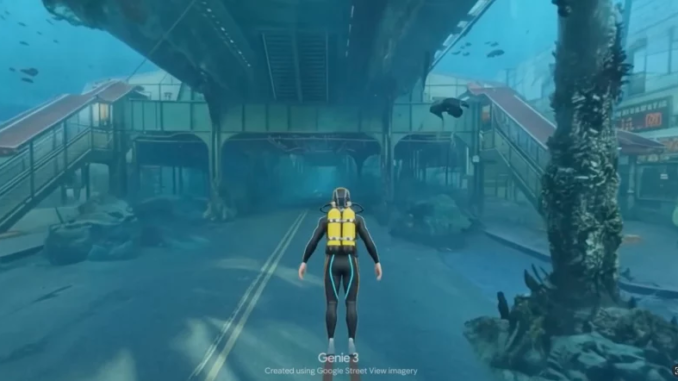

Google DeepMind is merging its Street View imagery with Project Genie, a generative AI system that converts simple text prompts into interactive, photorealistic environments. The result is something that sounds like it belongs in a sci-fi film: type a description, and a navigable 3D-ish world materializes in real time, complete with controllable characters and dynamic conditions.
The tool is built on Genie 3, DeepMind’s latest world model, and it targets applications across robotics training, gaming, and virtual exploration.
How Project Genie actually works
Genie 3 takes a text prompt, or even a single image, and generates an interactive environment without requiring traditional 3D assets. No hand-modeled buildings, no texture libraries, no months of level design. The AI handles all of it.
Users can create worlds, select how they want to explore them, and generate movement paths in real time. Prompts that reference “Google Street View” or “GoPro” perspectives are particularly effective at producing convincing urban landscapes.

DeepMind envisions this as a tool for robotics teams that need diverse training environments, game developers prototyping worlds, and anyone interested in virtual travel simulations.
Access is currently limited to Google AI Ultra subscribers in the US.
Why crypto and metaverse builders should pay attention
Project Genie has no token, no decentralized governance, no onchain component whatsoever. But its implications for the crypto-native metaverse and gaming sectors are hard to ignore.
For years, onchain gaming and metaverse platforms have struggled with a fundamental problem: visual fidelity. Projects like Decentraland and The Sandbox built decentralized virtual worlds, but the graphics often looked like they were running on a Nintendo 64.
Genie 3’s ability to generate photorealistic environments from text prompts, with no 3D asset pipeline required, represents a potential leap in what’s achievable. If this kind of technology becomes more widely accessible, or if open-source competitors emerge, it could dramatically lower the cost and complexity of building visually compelling metaverse experiences.
The centralization question and what comes next
Google is one of the most centralized entities on the planet, and Project Genie runs entirely on its infrastructure, trained on its proprietary Street View data. There is no user ownership of generated worlds, no interoperability with other platforms, and no way to verify what training data was used or how environments are constructed.
Google can ship product quality that most decentralized teams cannot match, largely because it has access to data assets (Street View, Earth, Maps) that no one else possesses. But it does so under terms that give users zero sovereignty over the outputs.
Robotics is another angle worth watching. DeepMind explicitly positions Genie as a training environment generator for robots, which overlaps with several crypto-adjacent robotics and AI agent projects that have attracted significant capital over the past year.



Be the first to comment