


GRAM has rebounded toward $1.40 after Telegram began releasing its self-custodial Gram Wallet to selected users, while trading volume jumped about 137% around the announcement.
Summary
- GRAM gained about 2% over 24 hours after briefly approaching $1.46.
- Telegram will release Gram Wallet gradually to its billion-plus users.
- The wallet supports self-custody, fee-free transfers, and Telegram Collectibles.
- GRAM faces immediate resistance near $1.39, followed by $1.45.
Telegram begins phased Gram Wallet release
Telegram CEO Pavel Durov said the company had started giving selected users access to Gram Wallet before expanding availability over the next several weeks.

“We’ll be gradually rolling it out to our billion+ users over the next couple of weeks,” Durov said in a Telegram post.
Built directly into the messaging app, Gram Wallet will become the default wallet displayed in Telegram’s user settings. The product uses a self-custodial structure, allowing users to control their assets instead of leaving custody with a centralized service provider.
Telegram plans to support instant, zero-fee transactions through the wallet, according to Durov. Users will be able to send funds, make payments, and purchase products or services inside the app. Gram Wallet will also support Telegram Collectibles, a category that includes digital gifts, usernames, and phone numbers.
The release follows an announcement in July, when Durov said Telegram would bring a native, non-custodial wallet to every version of its app. As crypto.news reported at the time, the company did not provide details about identity checks, account recovery, security safeguards, or regional restrictions.
Telegram reported more than 1 billion monthly active users in 2025. Durov has not disclosed an adoption target for Gram Wallet or specified how many users received access during the first phase.
According to Durov, network validators approved the smart contract that powers the wallet before the rollout began. Its design allows developers to upgrade the product without forcing users to transfer their holdings to a replacement contract.
Gram Wallet and Walt serve different functions
Alongside the new product, Wallet in Telegram has changed its name to Walt and will no longer appear as the platform’s default crypto wallet.
Telegram’s product structure assigns everyday transfers, payments and purchases to Gram Wallet. Walt will remain available through Telegram search for users seeking trading, investment, and multichain services.
The two products will remain connected, with Walt supporting multichain deposits into Gram Wallet. Walt currently handles deposits, withdrawals and holdings for more than 300 crypto assets across four blockchains, according to an announcement shared with Cointelegraph.
Its trading service covers more than 200 assets, while its tokenized-asset catalog contains over 100 stocks, exchange-traded funds and metals. Walt also offers yield products and perpetual futures tied to more than 70 assets, including cryptocurrencies, oil, natural gas, and metals.
Andrew Rogozov, founder and CEO of The Open Platform and Walt, said the service started as a simple product for purchasing Toncoin before adding Earn products, real-world assets, and perpetual trading over the past four years.
Gram Wallet, by comparison, has been positioned as a simpler payment product built around GRAM and Telegram’s internal services. Telegram has not said whether every feature will be available in all countries when the phased release is completed.
GRAM rebrand restored Toncoin’s original name
The wallet launch has arrived about two and a half months after Toncoin officially became Gram.
A community vote approved the change with 81.22% support, and the new identity took effect on June 15. The blockchain retained The Open Network name, while its native asset changed from Toncoin and the TON ticker to Gram and GRAM.
A guide to the rebrand published in June explained that the change did not create a new token or require a swap. Wallet balances, addresses, smart contracts and staking positions remained in place, with only the asset’s name, ticker and logo changing.
GRAM previously gained nearly 19% when Durov first disclosed the planned rename in early June. The token reached about $2.21 before giving back part of the move, according to earlier market coverage.
The Gram name originated in Telegram’s 2018 blockchain project, but its first planned distribution faced enforcement action in the United States. The SEC sued Telegram in 2019, alleging that its $1.7 billion fundraising arrangement and planned token distribution formed an unregistered securities offering.
A federal court later blocked the distribution, and Telegram settled the case in 2020. According to an SEC commissioner’s account, the settlement included $1.2 billion in disgorgement for returning money to purchasers. Telegram also agreed to pay an $18.5 million civil penalty.
Independent developers continued working on the open-source network after Telegram left the original project. The current GRAM token is the renamed native asset of the network that emerged from that independent development, rather than a new distribution of the tokens blocked in the 2020 case.
GRAM price tests resistance near $1.39
Market data showed GRAM trading near $1.40 at press time, up approximately 2.07% over 24 hours. The announcement initially carried the token close to $1.45 before sellers erased part of the advance, while trading volume increased by about 137%.
On the 4-hour chart, the latest displayed candle opened at $1.338, reached $1.457, and fell as low as $1.332 before returning to approximately $1.385. The candle represented a gain of about 3.44%, although its long upper wick showed that selling increased above $1.45.
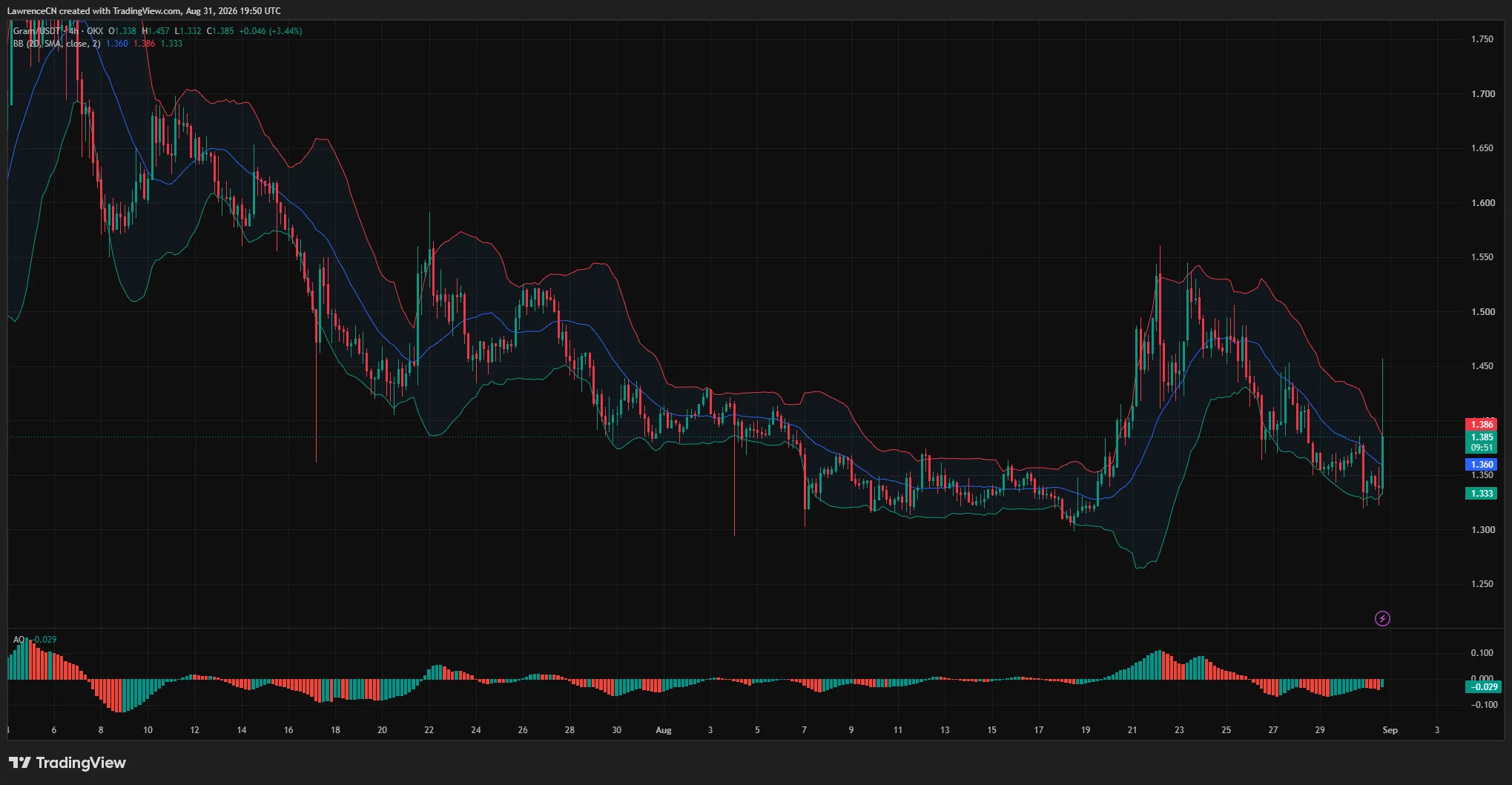
Bollinger Bands on the chart placed the 20-period midpoint near $1.360. GRAM moved above that line during the rebound and reached the upper band at approximately $1.386, making the $1.385–$1.40 range the first resistance area visible on the indicator.
A sustained move above $1.40 would leave the recent $1.45–$1.46 rejection zone as the next chart barrier. The 4-hour chart shows that sellers previously defended the same region during the wallet-driven price spike.
On the downside, the Bollinger midpoint near $1.360 provides the first visible support, followed by the lower band around $1.333. The Awesome Oscillator remained below zero at approximately minus 0.029, showing that bearish momentum had not fully cleared despite the rebound in the latest candle.


Be the first to comment