



TL;DR
- Grayscale reports that the AI-focused crypto sector gained 54% in September, outperforming the broader market’s 24% advance.
- Despite the rally, the sector remains the smallest of six crypto categories at roughly $15 billion.
- Grayscale sees potential for blockchain networks to support AI agents through payments, identity, private computing and verifiable data, with NEAR, Bittensor, World and Venice among the leading projects.
Artificial intelligence is increasingly becoming a major force across technology markets, and crypto is positioning itself around a different part of that transformation. According to Grayscale, the AI crypto sector gained 54% in September, more than doubling the 24% advance recorded by the broader crypto market.
September belonged to crypto x artificial intelligence (AI):$NEAR up 183%$VVV up 70%$WLD up 47%$TAO up 37%
Grayscale’s Artificial Intelligence Crypto Sector returned 54% for the month, versus 24% for the broader crypto market. The move may reflect growing interest in… pic.twitter.com/OtdJYPgOa5
— Grayscale (@Grayscale) October 2, 2026
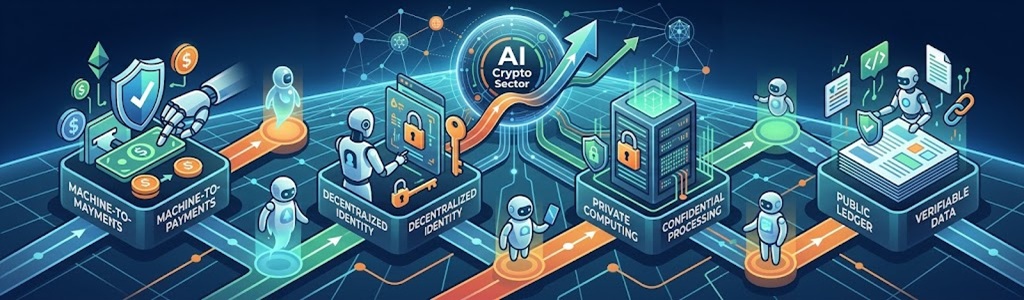
The report argues that public blockchains can complement centralized AI systems by supplying infrastructure that conventional platforms may struggle to provide independently. Blockchain networks can enable machine-to-machine payments, decentralized identity, private computation and verifiable records, creating new rails for autonomous software agents.
The opportunity remains relatively early. Even after September’s strong performance, Grayscale estimates the AI sector at approximately $15 billion, making it the smallest of the six crypto sectors tracked by the firm. That limited size also leaves room for individual networks to capture meaningful market share if blockchain-based AI applications gain adoption.

Grayscale Identifies Key AI Crypto Projects
Several tokens recorded substantial gains during September, reflecting growing investor attention toward crypto infrastructure connected to artificial intelligence. NEAR rose 183%, while Bittensor gained 37%, World advanced 47% and Venice climbed 70%.
NEAR is developing infrastructure aimed at agentic commerce, where autonomous software can interact with applications and conduct transactions. Bittensor takes a decentralized approach to AI by connecting specialized networks focused on areas such as inference, data and computing resources.
World focuses on digital proof of human identity, an issue that becomes increasingly relevant as AI-generated content and autonomous agents expand online. Venice, meanwhile, provides an AI chatbot designed around privacy, allowing users to interact with models without storing their prompts or responses.
These different approaches illustrate how crypto and AI can intersect across multiple layers, rather than through a single application category. Payments, identity, computing and data verification could all become relevant as autonomous agents perform more tasks without direct human intervention.
Blockchain Infrastructure Could Support Agent Economy
Grayscale expects the AI crypto sector to potentially produce one or more major projects over the next five years, although the report also emphasizes that the market remains small and developing.
The broader thesis is that autonomous agents will need infrastructure capable of operating across open digital environments. Blockchains already provide programmable settlement, transparent records and token-based incentives, giving developers tools to build systems where software can transact and coordinate independently.



Be the first to comment