



Hedera played a notable role in Australia’s Project Acacia, the Reserve Bank of Australia and DFCRC’s flagship test of tokenized wholesale asset markets, digital money and pilot wholesale CBDC.
Hedera Tested in Both Public And Private Setups
The Project Acacia Final Report, released on May 18, showed Hedera was one of five DLT platforms tested and the only one used in both public and private configurations: Hedera Mainnet and HashSphere, a private permissioned network built on Hedera’s Hiero codebase.
Australian Payments Plus, a Hedera Governing Council member that operates national payment rails including EFTPOS, BPAY and the New Payments Platform, ran pilots on HashSphere.
Key Hedera-linked pilots included AP+ Token Interchange, which tested conversion between tokenized private money, such as AUDD, and pilot wholesale CBDC; NPP-Token Integration, which explored links between tokenized assets and Australia’s real-time payments infrastructure; and Imperium Markets pilots covering tokenized term deposits, certificates of deposit and annuities.

🚨WATCH THE RESERVE BANK OF AUSTRALIA ON HOW PROJECT WITH $HBAR, & $XRP HAS GIVEN THEM A TASTE FOR TOKENISATION!
Brad Jones of the Reserve Bank of Australia said Project Acacia has only given them a taste of what tokenised finance can become. pic.twitter.com/G6na1P3NtK
— ALLINCRYPTO (@RealAllinCrypto) May 19, 2026
The RBA’s pilot wholesale CBDC was issued as a real legal claim, redeemable 1:1 for Australian dollars. It operated as EVM-compatible ERC-20 tokens with RBA controls.
Private wCBDC ran on HashSphere and synchronized with public Hedera through a “white coin” mechanism designed to support atomic settlement.
The experiments ran from August 2025 to February 2026 and involved real-value settlement.
HBAR Price Eyes 10% Bounce
HBAR is trying to rebound from the lower trendline of a symmetrical triangle, a pattern that forms when price gets squeezed between falling resistance and rising support.
For beginners: this means buyers are stepping in at slightly higher levels, but sellers are also rejecting each bounce at lower levels. The market is compressing, and a bigger move usually follows once either side breaks.
As of May 20, HBAR was trading near $0.0886, close to the triangle’s support. A bounce from here could send the token toward the triangle’s upper trendline near $0.097, up roughly 9.5%–10% from current levels.
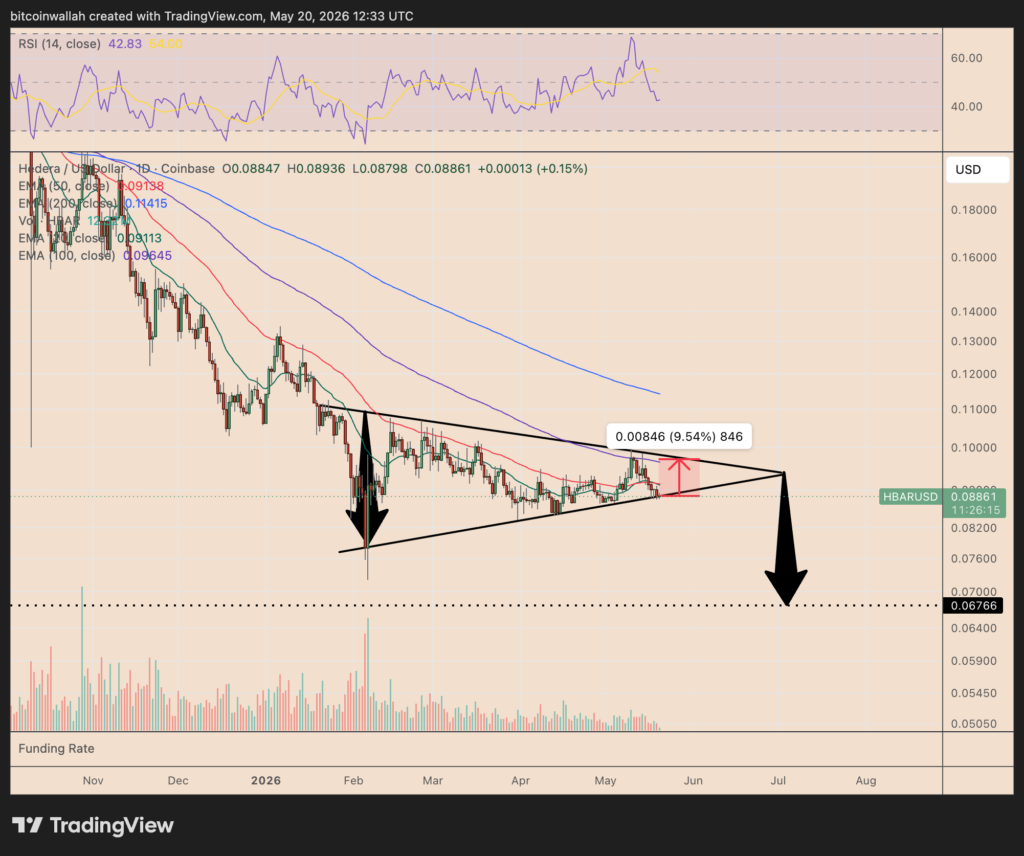
However, the broader setup still looks fragile. HBAR remains below its key daily moving averages, including the 50-day EMA near $0.091, the 100-day EMA near $0.096, and the 200-day EMA near $0.114. That suggests sellers still control the larger trend.
A clean break below the triangle support would weaken the short-term bounce case and could open the door to a deeper drop toward $0.067, the next major downside target marked on the chart. That would represent a decline of about 27% from current prices.
In simple terms, HBAR may first bounce toward $0.097, but unless it breaks above the triangle resistance with strong volume, the risk remains tilted toward a breakdown.



Be the first to comment