

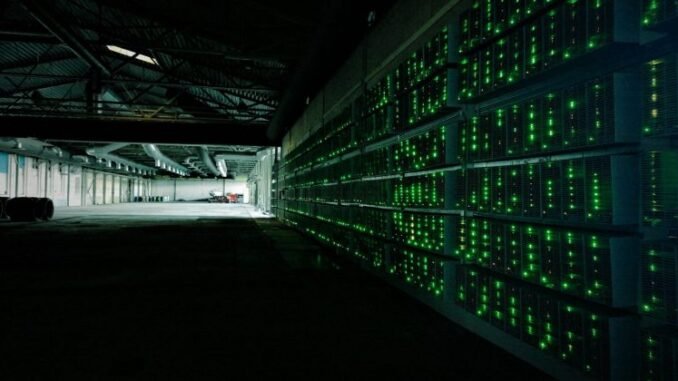

HIVE Digital Technologies just told the market it’s not really a Bitcoin miner anymore. The company’s stock jumped roughly 35% after it unveiled plans to build a 320-megawatt AI gigafactory in the Greater Toronto Area, a facility designed to house more than 100,000 GPUs at full capacity.
The project, channeled through HIVE’s subsidiary BUZZ High Performance Computing Inc., carries an expected price tag of CAD $3.5 billion. If that number sounds enormous for a company with a market cap of approximately $706.26 million as of mid-May, well, that’s because it is.
From hashrate to horsepower
HIVE’s roots are firmly planted in crypto mining. As of January 2026, the company reported a hashrate of 22.2 EH/s, representing a 290% year-over-year increase. It controls over 850 MW of power capacity globally. Those are not small numbers in the mining world.
But here’s the thing. The economics of AI compute are pulling former miners like moths to a very expensive, very bright flame. HIVE has already secured contracts worth $30 million in AI cloud services, and this gigafactory represents the company going all-in on that transition.

The Toronto facility is targeted to become operational in the second half of 2027. At full build-out, those 100,000-plus GPUs would make it one of the largest AI infrastructure projects in Canada, period. The company says the project will create over 800 construction jobs along with hundreds of permanent high-skilled positions.
Think of it as converting a fleet of delivery trucks into a private airline. The underlying asset, power infrastructure, stays the same. The payload changes completely.
Why investors piled in
A 35% single-day move for a publicly traded company isn’t subtle. The market is clearly pricing in a thesis that AI infrastructure revenue will dwarf what HIVE could earn pointing machines at Bitcoin blocks.
That thesis has some numbers behind it. Forecasts suggest annual revenues between $400 million and $550 million once the gigafactory reaches full operational capacity. For context, that revenue range would represent a transformative leap for a company currently valued under $750 million.
The demand side of the equation is straightforward. Enterprises and governments need compute. Lots of it. Training and running large language models, running inference workloads, processing the kind of data that makes sovereign AI possible: all of it requires GPU-dense facilities with massive power budgets. HIVE already has the power. Now it’s building the facility to match.
The “sovereign AI” angle matters here too. Countries and provinces are increasingly uncomfortable with the idea that their AI workloads run on infrastructure controlled by foreign hyperscalers. A domestically owned, Canadian-based gigafactory speaks directly to that anxiety, which could open doors to government contracts and partnerships that a pure-play crypto miner would never land.
The bigger picture: miners becoming AI landlords
HIVE isn’t the first Bitcoin miner to pivot toward AI, and it won’t be the last. The playbook has become almost predictable: company builds out cheap power for mining, realizes that same power infrastructure is catnip for AI workloads, rebrands as a “digital infrastructure” company, and watches its stock rerate.
The logic is sound. Bitcoin mining already requires exactly the things AI data centers need: cheap electricity, cooling infrastructure, and experience managing high-density compute at scale. The margins on AI hosting tend to be more predictable than mining, where revenue fluctuates with Bitcoin’s price and network difficulty adjustments.
But the CAD $3.5 billion question is execution. Building a facility of this scale is not the same as scaling a mining operation. Data center construction timelines have a well-documented tendency to slip. Supply chains for high-end GPUs remain tight. And financing a project worth several multiples of your current market cap introduces dilution risk that investors should weigh carefully.
HIVE’s existing power portfolio of over 850 MW globally gives it a genuine structural advantage. Power is the bottleneck for AI infrastructure right now, and companies that already control it don’t have to fight utilities, regulators, and NIMBYs to get new capacity online. That head start is real.
Still, the gap between announcing a gigafactory and actually delivering one is where many ambitious plans quietly die. The second half of 2027 operational target gives HIVE roughly 18 months from announcement to first operations. That’s aggressive for a facility of this magnitude.
For investors watching the crypto-to-AI pipeline, HIVE’s move crystallizes a trend that’s reshaping how the market values former mining companies. The premium is no longer tied to Bitcoin exposure. It’s tied to power capacity, GPU density, and the ability to sign enterprise contracts. HIVE’s $30 million in existing AI cloud service contracts is a start, but it’s a rounding error compared to the revenue the gigafactory is supposed to generate.
The risk-reward calculus here is binary in a way that should make cautious investors pause. If HIVE delivers on the Toronto facility at anything close to projected timelines and costs, the current valuation looks cheap relative to $400-550 million in annual revenue potential. If construction delays, financing challenges, or GPU supply constraints push the timeline out, that 35% surge could look premature. Watch the financing structure and construction milestones, because those will tell you whether this is a genuine transformation or an expensive press release.


Be the first to comment