



While traditional stock markets still close at 4 p.m. ET and settle trades in T+1 (or T+2 in some places), a parallel equity market has quietly gone live on blockchain. Apple ($AAPL), Tesla ($TSLA), Nvidia ($NVDA), Alphabet ($GOOGL), Microsoft ($MSFT), Amazon ($AMZN), and dozens of other major stocks now exist as tokenized versions.
Most current products are custodian-backed tracker instruments: a regulated entity holds the real share, and the token gives you economic exposure but not direct share ownership, voting rights, or the full dividend.
A newer model changes this: Issuer-Sponsored Tokens (ISTs), introduced by Securitize and Computershare in April 2026, represent actual shares in token form with all shareholder rights intact. You can buy fractional exposure with stablecoins like USDT, hold it in a crypto wallet, use it as collateral in DeFi, and trade it even on weekends.
What Tokenized Equities Actually Are
A tokenized equity is a blockchain token that provides exposure to a traditional stock:
- A regulated custodian (for example Alpaca Securities) buys and holds the real $AAPL or $TSLA share.
- An issuer (Ondo Finance, Backed Finance’s xStocks, etc.) mints a corresponding token: $AAPLX, $TSLAX, $AAPLon, $TSLAon.
- The token is 1:1 backed, audited (often via Chainlink Proof of Reserves), and programmable for compliance.
Dividends are typically reinvested (minus withholding taxes), and redemptions can convert tokens back to underlying shares or cash. Voting rights are generally not passed through to token holders in the tracker model. Access to most platforms is also restricted to non-U.S. investors under Regulation S; U.S. retail access remains gated.
In the event of custodian insolvency, token holders are generally unsecured creditors, not direct shareholders — recovery depends on the legal structure of the issuing SPV.
Real-world examples you can trade right now (as of May 2026):
- AAPLX / AAPLon (Apple) – Stable blue-chip favorite for long-term holders.
- TSLAX / TSLAon (Tesla) – High-volatility favorite, often among the most actively traded.
- NVDAX / NVDAon (Nvidia) – Extremely popular due to AI boom; frequently ranks in top volumes.
- GOOGLX / GOOGLon (Alphabet/Google).
- MSFTon (Microsoft) and AMZNx (Amazon) – Tech giants with strong institutional interest.
- SPYon / SPYx (SPDR S&P 500 ETF) and QQQon (Invesco QQQ Nasdaq-100 ETF) – Broad market exposure in tokenized form.
- Others: Circle (CRCLon/CRCLx – often leads in market cap), Intel (INTCon), Broadcom (AVGOon), PayPal, and even pre-IPO or niche names like Figma in some Ondo listings.
The Numbers: Explosive but Still Under-the-Radar Growth
Tokenized equities have scaled dramatically since mid-2025 launches:
- Market cap: Tokenized stocks reached ~$486M by end-Q1 2026 and now sit at $1.21 billion (as of May 4, 2026), up ~27% in the past 30 days alone. Earlier 2025 figures were under $30–$32 million, a 2.800%+ surge in roughly a year.
- Ondo Finance dominance: Holds the largest share of the tokenized equities market; its total TVL across all tokenized products, including Treasuries and money market funds, exceeds $3B.
- xStocks ecosystem: Over $25 billion in cumulative transaction volume since June 2025 launch.
- Trading activity: Q1 2026 spot volume for tokenized stocks hit $15.1 billion, already surpassing H2 2025 totals.
- Broader RWA context: Total on-chain RWAs (ex-stablecoins) exceed $30 billion in Distributed Asset Value, with equities still a small but fastest-growing slice.
- Circle’s tokenized stock (CRCLon/x) actually leads by total asset value (~$158M+), showing how even corporate treasuries are jumping in.
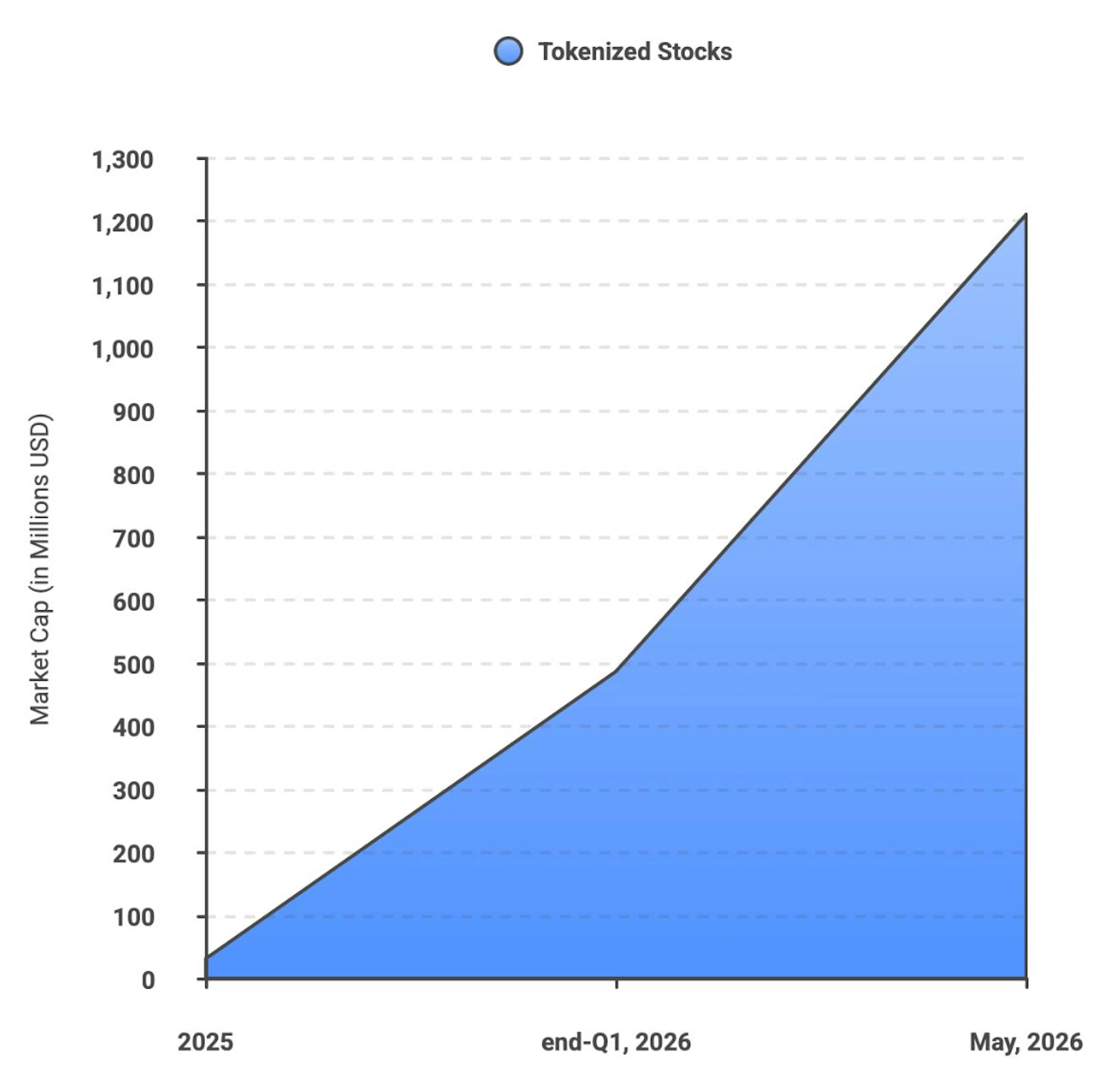 Growth of Tokenized Stock Market
US retail access remains gated, though pilots like DTCC’s “digital twins” and NYSE’s on-chain plans. The SEC’s December 2025 guidance on broker-dealer custody of tokenized securities and the DTCC pilot for Russell 1000 equities have created breathing room for digital securities.
This revolution is happening in crypto wallets and DEXes, not on Bloomberg terminals. Traditional investors still think crypto = Bitcoin volatility. Meanwhile, emerging-market and crypto-native users get 24/7 access to US blue-chips without brokers or wire delays. It’s worth being precise about what that access actually means today: xStocks and Ondo tokens track the price and reinvest dividends, but holders are not shareholders of record and have no voting rights. The Computershare–Securitize IST model is the first structure where on-chain holders get full equity ownership — but that infrastructure is just launching.
Where This Is Heading
Analysts project tokenized securities could reach $4–5 trillion by 2030 (Citigroup, 2023). Even 1% of the ~$148 trillion global stock market tokenized equals trillions in on-chain value.
What changes:
- 24/7 global markets with atomic settlement (no counterparty risk).
- DeFi stability: Use tokenized Tesla as collateral to borrow stablecoins.
- Fractional ownership + emerging markets: Anyone with a $10 USDT balance can own a slice of Apple.
- Programmable corporate actions: Automated dividends, on-chain voting, instant cap-table updates.
- Efficiency: T+0 settlement, lower costs, reduced intermediaries. Nasdaq has filed rule-change proposals to trade tokenized securities alongside traditional ones on its exchange. NYSE is building a dedicated tokenized equity venue in partnership with Securitize.
As for the challenges: liquidity is fragmented across chains and issuers, meaning the same tokenized Apple share can trade at different prices on different platforms with no guaranteed arbitrage. Custodian risk is real in the current structure, these are newer, less regulated intermediaries than the ones they replace, and a custody failure, oracle lag, or redemption pause can cascade into pricing dislocations and collateral stress across DeFi protocols.
Stocks trading on-chain are live today, quietly powering billions in volume and attracting hundreds of thousands of holders. Regulators are playing catch-up with new laws and pilots, while the average Main Street investor still checks Yahoo Finance.
Full on-chain governance and trillions in TVL will make today’s $1.2 billion market cap look like the earliest days of the internet. The on-chain shift is already underway.


Be the first to comment