

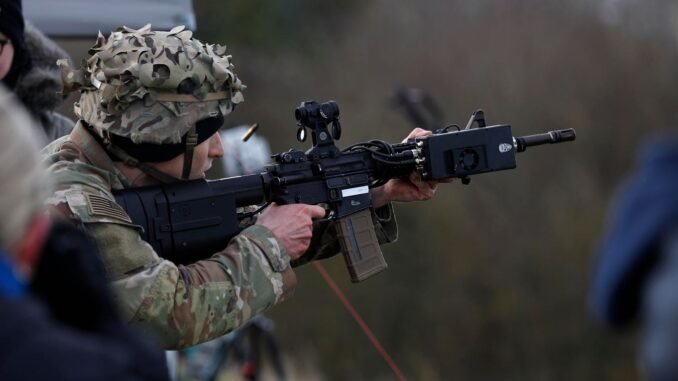


A participant uses a drone defense rifle during Project Flytrap 4.5 in November 2025 in Putlos, Germany. The Flytrap exercises are expanding into larger efforts that increase unity and tactical cohesion among allied forces. (Photo by Morris MacMatzen/Getty Images)
Getty Images
The U.S. Army conducted an exercise this month alongside troops from the United Kingdom to combine drone warfare tactics in an ongoing effort to increase effective anti-drone tactics across allied nations of the North Atlantic Treaty Organization.
The joint exercise called Project Flytrap 5.0 was held in Lithuania about 30 kilometers from the border with Belarus, and marked a significant expansion of the abilities of NATO troops fighting side by side to successfully defeat unmanned aircraft systems in mobile combat.
The Flytrap exercise series, which began last year, is part of NATO’s Eastern Flank Deterrence Initiative to protect its eastern borders. It has been held in Germany and Poland and is getting progressively larger and more comprehensive to meet the expanding dimensions of drone warfare.
Led by the U.S. Army’s V Corps and U.S. Army Europe and Africa, this latest version of the exercise saw American units face off against British paratroopers to repel drone attacks at the squadron level. Participants tested over 50 innovations including counter-drone interceptors, sensors and unmanned ground vehicles and provided instant feedback to manufacturers represented. The next iteration of the exercise will increase troop strength to brigade level.

The Need For Maneuver Warfare Against Drones
A U.S. Army infantryman patrols a forested area during the force-on-force phase of Project Flytrap in Lithuania in May 2026. (U.S. Army photo by Sgt. Max Elliott)
U.S. Army
Dr. Alexander Miller, the U.S. Army’s Chief Technology Officer, says the exercises have progressively sharpened the skills of NATO forces to respond cohesively to drone incursions by combining tactics and technology.
The Flytrap project sprung from a need to move past the defense of static targets and integrate sensors and counter-drone tactics into close combat and maneuver warfare, he told Forbes in an interview.
“How do you bring this all together in a way that soldiers can still fight, move and communicate with the defense system working around them to protect them? That is the origin of Flytrap,” said Miller.
“Part of the counter-unmanned systems strategy includes not only all the high-tech stuff but all the small stuff. It’s maneuver. It’s camouflage. It’s netting. It’s the simple things. All of those tactics matter.”
How NATO Partners Are Contributing
U.S. Army signal support systems specialists explain the capabilities of a counter-unmanned aerial system to a paratrooper with the U.K. Parachute Regiment ahead of Project Flytrap 5.0 in Lithuania on April 30, 2026. (U.S. Army photo by Sgt. Max Elliott)
U.S. Army
He explained that all partners involved have benefited on a tactical level from mutual cooperation.
“There’s some amazing things that we are doing at scale that only the U.S. can do,” he said. “I’m so proud of our soldiers out here taking the bull by the horns, literally learning how to use these technologies in a couple of days and then sitting with the engineers of the companies here and giving direct feedback.”
British and American troops worked together to combine a tactical data architecture system to use against attacking drones. Miller said the U.K. has been a reliable partner and is contributing unique approaches to using technology.
“The U.K. in particular has been with us on the journey from the beginning. They are getting serious about soldier-worn protection in terms of what every individual soldier or rifleman has on them to alert them to what’s happening around them,” he said, adding that British troops are also fielding innovative drone systems.
Other NATO partners bring diverse tactical approaches to the table, such as using technology in close urban environments with distinctive European methods that are informative, Miller added.
“We have a saying: ‘How do you kill what’s killing you?’ Instead of just being defensive, how do you take it back to the enemy?” he explained.
“How can we have a common way to share this information from all these sensors, share with our partners, and give guidance about how to attack back? It’s been amazing to see the evolution.”
Experimenting With Drone-Killing Ammunition
A U.S. Army infantryman monitors a tablet displaying unmanned aerial system feed data during Project Flytrap in Lithuania on May 4, 2026. (U.S. Army photo by Sgt. Max Elliott)
U.S. Army
Miller said that the U.S. Army is expanding efforts to reduce the cost of drone-killing systems by exploring creative alternatives, such as fragmenting munitions.
“We are not only using interceptors on drones, but we are also experimenting with different kinds of ammunition to allow us to use our existing weapons systems with potentially some proximity fuzes,” he said.
“Instead of having to use multi-thousand dollar weapon systems, missiles or interceptor drones, we are experimenting with being able to use our machine guns with special munitions and rounds that explode when they get close, creating fragments that can take down drones.”
Miller said these experiments reflect the Army’s approach to tactically innovate while being cost-effective.
“You don’t have to go for the highest-end, most exquisite solution. You just have to really understand the problem and understand what solves it quickly.”
He anticipates the next version of Flytrap could take longer to organize but will be its most challenging and comprehensive so far. At a time when NATO is being tested and effective means to fight back against drones are urgently needed around the globe, joint exercises like Flytrap enhance not only training but the U.S. Army’s strategic position by strengthening unity with European allies.


Be the first to comment