



Average daily non-vote transactions on Solana reached a record 112.6 million in the first quarter of 2026, and about 2.2 million fee payers were active each day, according to Messari’s State of Solana Q1 2026 report. Public endpoints are meant for light use, so production apps usually move to a managed service. A Solana node provider runs the validator-grade nodes, exposes them over HTTP, WebSocket, and often gRPC, and bills by request, credit, or bandwidth. The real differences between vendors sit in streaming support, rate limits, and how usage is metered.
“Choosing a primary Solana RPC provider matters as much as choosing a backup, because a business with complex operations always needs a fallback endpoint in place.”
— Kate Liftshits, CBDO of NOWPayments
Below is the ranked list of leading Solana node providers for 2026:

- NOWNodes
- Chainstack
- OnFinality
- Uniblock
- QuickNode
How We Ranked the Best Solana RPC Node Providers
This comparison draws on each vendor’s own pricing and product pages, with the replacement entries checked on October 14, 2026. Figures taken from vendor marketing are labeled as stated by the vendor.
- Network Coverage and Node Types. Solana networks served, shared and dedicated capacity, and the data interfaces on offer.
- Performance and Reliability. Rate limits, published uptime terms, streaming products, and failover design.
- Pricing and Support. Free allowance, entry price, billing unit, and stated support response times.
The table sets the five Solana RPC providers side by side.
| Feature |
1. NOWNodes |
2. Chainstack |
3. OnFinality |
4. Uniblock |
5. QuickNode |
|---|---|---|---|---|---|
| Chains / networks | 120+ | 70+ chains | 134 networks | Multi-chain | 79+ |
| Real-time data | WebSocket | WebSocket, gRPC |
WebSocket | Confirm interface |
Streams, gRPC |
| Dedicated nodes | Yes | Yes | Yes | Enterprise | Yes |
| Free access | 100K requests, 1 month |
3M RUs/month | 400K response units/day |
40M CUs/month | 10M credits, 1 month |
| Entry price | €20/month | $49/month | $49/month | $49/month | $49/month |
| Paid throughput | No set limit | 250 to 600; custom |
200 to 500 units/s |
2K to 20K CUs/s |
50 to 500 |
| Support response | 3 minutes stated |
Under 24 hours; upgrades |
Plan-dependent | Plan-dependent | 8 to 24 hours |
| Best For | Multi-chain stacks |
Production Solana workloads |
Historical data, analytics |
Unified API access |
Compliance reviews |
*Rates, supported chains, and limits change frequently. Verify current terms on each provider’s official site before committing.
NOWNodes
Best for: teams that add Solana to a multi-chain stack.
NOWNodes is one of the best RPC providers for teams that run Solana alongside many other chains. It is a blockchain node provider based in Tallinn that covers 120+ networks from one account. Its solana rpc page lists shared and dedicated nodes for Solana mainnet, with RPC and WebSocket access. The service states 99.9% uptime and no predefined RPS limits on paid plans. It suits teams that already send Bitcoin, EVM, and other traffic through one vendor.
Network Coverage and Node Types. The Solana page lists mainnet only, so teams that run integration tests on devnet need another endpoint. Solana-specific data products such as parsed token or NFT APIs are not listed either.
Performance and Reliability. The vendor describes geo-balanced clusters that fail over automatically when a node goes offline. Paid plans state no predefined RPS ceiling, though real throughput depends on the capacity a cluster has at that moment. Solana-specific latency figures are absent, so measure your own p95 before committing.
Pricing and Support. Start is free for 100,000 requests over one month, which makes it a trial. Listed prices are €20 a month for Pro (1 million requests) and €200 for Business (30 million), and Business overage is €1 per 100,000 requests. The pricing page states a three-minute support response on every plan.
Chainstack
Best for: production Solana applications that need fast reads, account queries, and real-time streaming.
Chainstack takes second place following its October 2026 Solana infrastructure upgrade. The rollout targets slow account scans, method limits, and streaming capacity, making it a top choice for wallets, trading applications, and services handling sustained Solana traffic.
Network Coverage and Node Types. Chainstack supports Solana mainnet and devnet, with Global Nodes, Dedicated Nodes, and Chainstack Self-Hosted options. Solana Mainnet Global Nodes now run entirely on GEN 2.0, with method-aware routing that separates heavy scans from general requests.
Performance and Reliability. Chainstack reports that median getLatestBlockhash latency in Frankfurt dropped from about 17 ms to about 2 ms. The getSupply limit rose from 2 to 300 RPS, and filtered getProgramAccounts calls reach 20 RPS for programs under 10,000 accounts. Rebuilt indexes and automatic caching improve repeated scans. Results vary by method and region, and plan limits still apply.
Pricing and Support. Developer includes 3 million request units monthly at 25 RPS for free. Growth costs $49 monthly for 20 million request units and 250 RPS. Yellowstone gRPC is a separate add-on, starting at $49 monthly for two concurrent streams. Standard support on paid plans lists a response target under 24 hours.
OnFinality
Best for: managed Solana RPC with historical data and usage visibility.
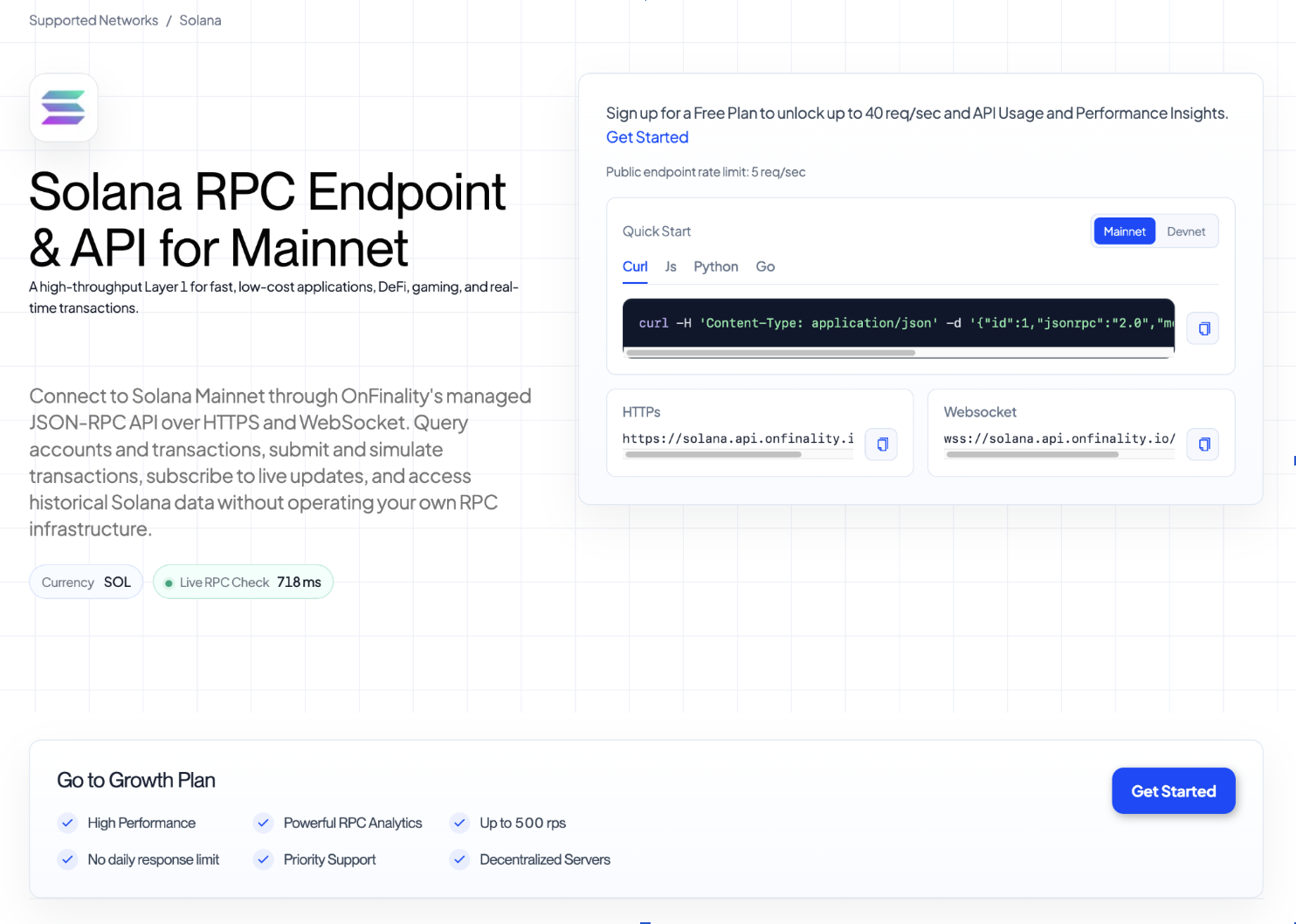
OnFinality provides managed Solana RPC for account queries, transaction submission, and live subscriptions without operating your own nodes. Shared API access and dedicated infrastructure give teams a path from development to larger workloads.
Network Coverage and Node Types. OnFinality supports Solana mainnet and devnet through HTTPS and WebSocket endpoints. Its Solana offering includes archive access and dedicated node options.
Performance and Reliability. The public mainnet endpoint is limited to 5 RPS. Authenticated access has higher limits, while the pricing page measures plan throughput in response units per second. API usage and performance insights help teams investigate endpoint behavior. Confirm the effective limit for your method mix rather than treating response units as unrestricted calls.
Pricing and Support. Developer includes 400,000 response units daily for free. Growth costs $49 monthly, includes 20 million response units, and charges $6 per million additional units. Dedicated node costs are separate. Paid plans add support channels; confirm response commitments for your chosen tier.
Uniblock
Best for: multi-chain applications that want unified API access and provider management.
Uniblock provides a unified API layer for blockchain infrastructure. Teams can consolidate integrations, provider management, and billing instead of maintaining a separate relationship with every RPC vendor. It suits products that use Solana alongside other networks.
Network Coverage and Node Types. Uniblock lists Solana in its chain catalog and documents JSON-RPC access for mainnet and devnet. Dedicated infrastructure is available through custom Enterprise arrangements.
Performance and Reliability. Plans include routing and backup features, with more routing control at higher tiers. Throughput is measured in compute units per second, so compare capacity using your actual Solana methods rather than converting the allowance directly into RPS.
Pricing and Support. Startup is free with up to 40 million compute units monthly and 1,000 compute units per second. Growth costs $49 monthly for up to 500 million compute units and 2,000 compute units per second. Higher tiers add throughput, routing controls, and premium support. Confirm method weights and support terms before choosing a plan.
QuickNode
Best for: teams that want audit paperwork and a stepped credit plan.
QuickNode is a multi-chain provider covering 79+ chains, and its Solana products include gRPC, Streams, and a Metaplex Digital Asset API. Usage is metered in API credits, and the ladder runs from a trial to negotiated Enterprise contracts. Enterprise lists SOC 1 Type 2, SOC 2 Type 2, ISO 27001, and DORA reports on request. It suits teams that answer to compliance reviewers.
Network Coverage and Node Types. Dedicated Clusters belong to the Enterprise plan, so smaller teams run on shared endpoints. Solana gRPC is a paid add-on on the lower plans, with concurrent streams listed at 10 on Scale and 25 on Business. Paid plans below Enterprise allow 5 active Solana streams.
Performance and Reliability. Limits climb with the plan: 15 RPS on the trial, then 50 on Build, 125 on Accelerate, 250 on Scale, and 500 on Business. Written uptime commitments are listed only under Enterprise.
Pricing and Support. A one-month trial carries 10 million credits and needs no card. Build is $49 monthly or $34 on annual billing, and includes 80 million credits with a 24-hour support SLA. Credit weights differ by method, so a Solana bill depends on the call mix, and there is no permanent free plan.
How to Choose a Solana RPC Node Provider
Start with what the application does all day, then check whose terms match that pattern. Headline specs say little about billing and limits under real load.
- Decide whether Solana is the only chain. A multi-chain vendor keeps one key and one bill, while a Solana-only vendor usually ships deeper data products.
- Pick the streaming interface first. WebSocket covers light subscriptions, and gRPC suits high-volume account and transaction feeds.
- Convert the billing unit. Credits, requests, and bandwidth count the same call differently, so price one real month.
- Check where streaming is gated. Some vendors reserve mainnet gRPC for mid-priced tiers or sell it as an add-on.
- Read the support terms. Confirm whether a response time is a stated target or a contractual term.
On Solana, streaming availability matters more than a headline RPS figure, since a rate cap can be engineered around and a missing feed cannot. Pilot two providers with production-representative traffic before committing.
When a Solana RPC Provider May Not Be the Right Fit
A managed endpoint solves a real problem for most production teams, yet some setups gain little from one. Five situations come up often enough to name, and each one changes what a team should buy.
- Prototypes and low-volume scripts. Solana’s public mainnet endpoint allows 100 requests per 10 seconds per IP and 40 per 10 seconds for any single method. That covers a bot that checks a balance every few seconds, and the free tier from Chainstack covers small projects on private endpoints. The Solana documentation states that public endpoints are not meant for production applications, so the arrangement suits testing only. Once real users depend on the app, a private endpoint becomes necessary.
- Teams that need control of the validator itself. Custom Geyser plugins, private snapshots, or a modified client sit outside what a shared service exposes. Dedicated nodes narrow the gap, but the vendor still runs the hardware. Chainstack Self-Hosted offers deployment and lifecycle management on infrastructure a team controls. Teams with client-level requirements should price their own bare-metal node against a dedicated plan before signing.
- Workloads bound by residency rules or audits. Auditors often ask for signed reports and named data locations. QuickNode lists compliance reports on request at Enterprise, and Chainstack lists SOC 2 Type II and ISO 27001 certification. A compliance team should verify report scope, deployment locations, and contractual terms directly.
- Ledger-scale analytics and backfills. Per-call billing grows quickly when a job scans years of history. QuickNode charges 30 credits per Solana call, while OnFinality and Uniblock use weighted usage units, so a multi-year backfill becomes a large line item. Bulk data exports or a self-run indexer usually fit these jobs better than metered RPC.
- Products that cannot tolerate one vendor’s outage. A single provider is a single point of failure, whatever uptime figure its pricing page shows. Teams in this position need a second endpoint from a different vendor or their own fallback node. QuickNode lists contractual SLAs at Enterprise. For every provider, confirm the written availability terms for the service and plan you select. Buying one managed service alone leaves that gap open.
None of these cases rules out a managed service for every part of a system. A team can run its own node for validator-level work while routing ordinary wallet traffic through a vendor. The decision applies to each workload separately.
Solana RPC Provider Pricing Compared
Sticker prices for a Solana node service say little until they are converted into one usage figure. Credits, requests, and bandwidth count the same call differently, and Solana calls carry heavy weights at some vendors. The table prices a mid-sized production workload of 30 million requests a month, about 12 requests per second on average, at each vendor’s listed monthly rate.
| Provider | Pricing Model | Free Tier | Entry Price | Cost at 30M calls/month |
|---|---|---|---|---|
| NOWNodes | Monthly request tiers | 100K requests, 1 month | €20/month | €200/month |
| Chainstack | Monthly request units | 3M RUs/month | $49/month | $199/month on Pro |
| OnFinality | Monthly response units | 400K units/day | $49/month | Depends on method weights |
| Uniblock | Monthly compute units | 40M CUs/month | $49/month | Depends on method weights |
| QuickNode | API credits | 10M credits, 1 month | $49/month | $499/month |
The figures assume standard read calls. Chainstack’s Pro plan includes 80 million request units, covering 30 million calls at one RU each, excluding streaming add-ons. QuickNode bills 30 credits per Solana call. OnFinality and Uniblock require a method mix to convert requests into billable units. NOWNodes prices in euros and the other four in dollars; listed subscription prices use monthly billing.
Rates, supported chains, and limits change frequently. Verify current terms on each provider’s official site before committing.
Multi-Chain Generalists vs. Solana Specialists
The most useful split among these five vendors is chain focus. It predicts what each one ships for Solana, and how much of the surrounding product a Solana team has to build itself.
Multi-chain coverage: NOWNodes, Chainstack, OnFinality, Uniblock, and QuickNode. NOWNodes covers 120+ networks and Chainstack 70+, so both let a team keep one account and one invoice across many chains. For a wallet or payment processor that handles Bitcoin, EVM, and Solana traffic side by side, that consolidation removes vendor management work no Solana-only feature replaces. Solana is one product among many on these platforms, and the depth shows in what each lists.
Chainstack combines multi-chain coverage with upgraded Solana account scans, Yellowstone gRPC and Unlimited Node add-on. QuickNode lists Solana gRPC, Streams, and a Metaplex Digital Asset API, plus compliance reports at Enterprise. NOWNodes lists RPC and WebSocket on its Solana page. OnFinality adds historical data and usage insights, while Uniblock focuses on unified access and provider routing.
Solana-specific depth still matters. Chainstack’s October upgrade addresses method contention, account indexes, and scan limits. OnFinality documents Solana account queries, transaction methods, and WebSocket subscriptions. Uniblock’s unified API model suits teams that want provider management alongside Solana access. Compare the interfaces your application needs rather than judging depth from chain coverage alone.
The trade-off is integration simplicity versus specialized requirements. A multi-chain platform can reduce the number of vendors, keys, and invoices a team manages, but method coverage, streaming access, and billing still differ. A wallet, trading system, and historical indexer should each price their own call mix.
Streaming access shows the differences clearly. Chainstack offers Yellowstone gRPC as a separate add-on, QuickNode offers Solana gRPC subject to plan and add-on terms, and NOWNodes and OnFinality list WebSocket access. Confirm Uniblock’s streaming interface and underlying provider coverage for your workload. Price the tier that enables the required feed, not just the entry subscription.
Switching costs differ between interfaces. Standard JSON-RPC calls usually move between vendors with an endpoint change. Yellowstone-compatible gRPC can reduce changes to streaming clients, although credentials, filters, and limits still need testing. Provider-specific APIs and routing features may require more integration work to replace.
Support and contract terms differ as well. QuickNode Enterprise lists a dedicated solutions architect and 24/7 on-call engineering. NOWNodes states 24/7 support with a three-minute first response. Chainstack lists standard support on paid plans and faster paid options. OnFinality and Uniblock vary support channels and service levels by plan; verify response commitments before buying.
Many teams do not have to pick a side. One workable pattern pairs a provider selected for streaming and account-query depth with a separate fallback endpoint. That arrangement also addresses the single-vendor risk described earlier.
Which Solana RPC Node Provider Should You Choose?
NOWNodes fits teams that run Solana beside many other chains and want no predefined RPS limit on paid plans. Those teams should accept mainnet-only Solana listings and confirm gRPC coverage first. QuickNode fits teams that need compliance reports and a stepped credit plan, and that can move to Enterprise for written SLAs.
Chainstack is a top choice for production Solana workloads following its infrastructure upgrade, particularly for teams that need faster reads, account scans, and Yellowstone gRPC. OnFinality suits teams that value historical data and usage analytics. Uniblock fits multi-chain products that want unified API access and provider routing. Compare method limits, streaming costs, and support terms against your own workload.


Be the first to comment