

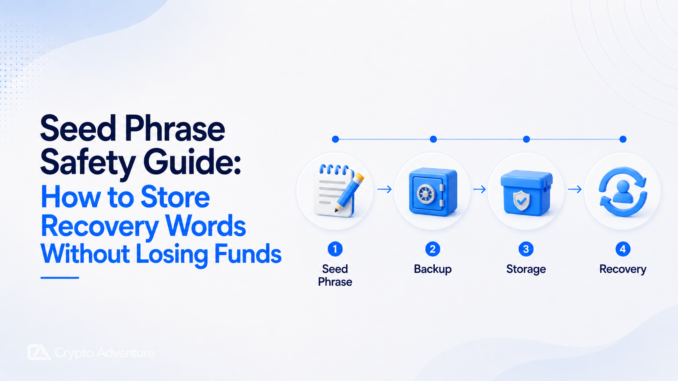
A seed phrase is the recovery backup that can recreate a crypto wallet. In most self-custody wallets, it is the final recovery path if the phone, browser wallet, or hardware device is lost, damaged, reset, or stolen. It is also the fastest way for an attacker to take everything.
That dual role is why seed phrase safety is difficult. The phrase must be available to the rightful owner during a crisis, but unavailable to everyone else at all times. Too much convenience creates theft risk. Too much secrecy creates loss risk. A good backup plan has to survive both.

Anyone with access to the phrase can usually restore the wallet and move the funds. That is why wallet safety starts with a simple rule: the seed phrase is not a password, not a customer support code, not a login recovery link, and not something that belongs in a cloud note. It is key material.
What A Seed Phrase Protects
A seed phrase protects access to private keys. The words are easier for a human to record than raw cryptographic keys, but the practical result is the same. If the wallet device disappears and the phrase is correct, the wallet can be restored on a compatible wallet. If the phrase is lost and the device fails, recovery may be impossible.
This is the core of crypto self-custody. The user controls the keys, but the user also becomes responsible for backup discipline. There is no bank password reset, no exchange support team, and no reversal if the phrase leaks.
Modern wallet recovery models are improving, including passkeys, MPC, and social recovery. Those models reduce some risks for certain users, but seed phrases remain one of the most portable recovery methods when handled correctly.
The Golden Rule: Keep It Offline
The safest default is to create the backup offline, write it down by hand, and store it somewhere private. The phrase should not be photographed, scanned, typed into a phone note, saved in a password manager, sent through chat, stored in email, printed through a connected printer, or uploaded to cloud storage.
Ledger recovery phrase safety is built around the same core principle: never share the phrase and avoid digital copies. Trezor recovery-seed safety follows the same offline-first logic. Uniswap Wallet recovery guidance also treats the recovery phrase as the master access path to a wallet.
Digital storage is tempting because it feels convenient. It is also the most common way users turn a strong self-custody setup into a hot target. Malware, cloud compromise, device theft, screenshots, clipboard access, browser extensions, and phishing can all expose a phrase that should never have been digital.
Paper, Steel, And Shamir Backups
Paper is the simplest backup medium. It is cheap, compatible, and easy to create. It also fails under real-world conditions: water leaks, fire, humidity, ink fade, misplacement, household cleanup, and accidental exposure.
Steel and other metal backups improve physical durability. They are useful for meaningful balances because they can better survive fire, flooding, crushing, and long-term storage. The tradeoff is that a steel backup is still a complete secret if all words are stored in one place. A thief who finds it may not need technical skill.
Shamir backups split recovery into multiple shares, where a threshold number of shares is needed to restore the wallet. This can reduce single-location theft risk and single-location loss risk, but it adds complexity. A user who does not maintain shares properly can still lose access.
The right model depends on the threat profile. A small hot wallet may not need steel. A long-term cold wallet probably should not rely on one paper slip in a drawer. The deeper seed phrase storage comparison is useful because storage choice is not only about durability. It is also about theft, recovery friction, and human error.
Use More Than One Location Carefully
A single backup location can fail. A house fire, flood, burglary, move, or accidental disposal can destroy the only recovery path. Redundancy helps, but it has to be designed carefully.
Two complete copies in two locations reduce loss risk but increase theft surface. A split or Shamir-style structure reduces theft risk but increases operational complexity. A safe deposit box can improve physical security but may create access issues for urgent recovery, inheritance, or jurisdictional problems.
A balanced setup for meaningful funds often uses one durable primary backup and one secondary recovery path in a separate secure location. The storage places should not be obvious, and they should not sit beside the hardware wallet, PIN, device password, or written hints.
Test Recovery Before Large Deposits
A backup is not real until it has been verified. A single misspelled word, wrong word order, poor handwriting, or unsupported wallet format can turn a backup into false confidence.
The safest pattern is to set up the wallet, record the phrase, verify it through the wallet’s backup check or a controlled recovery test, then move a small test amount first. Only after the receive and restore process is understood should meaningful funds move into that wallet.
A recovery test must be done carefully. The phrase should only be entered into a trusted wallet or hardware device during a deliberate restore flow. It should never be entered into a website, pop-up, search-result landing page, fake support screen, or random wallet tool.
Passphrases Can Help Or Hurt
A passphrase can add another layer to a seed phrase setup. In many wallet systems, the passphrase creates a separate wallet derived from the same seed. If an attacker steals only the seed phrase, the passphrase-protected wallet remains hidden or inaccessible.
The tradeoff is permanent loss risk. A forgotten passphrase can lock funds forever. A passphrase stored beside the seed removes much of the protection. A passphrase that is too complex for the owner’s future self or heirs can create recovery failure.
For users who choose this route, the passphrase should be stored separately, tested carefully, and treated as part of the recovery plan. It should not be improvised and then trusted for long-term funds without a restore test.
Phishing Is The Biggest Live Threat
Most seed phrase theft happens through deception, not cryptographic failure. Fake wallet updates, fake airdrops, fake support agents, malicious ads, fake hardware-wallet letters, Discord impersonators, and “security verification” pages all try to make the user type the phrase somewhere unsafe.
The defensive rule is clear: the phrase is only for wallet recovery, not for website verification. No legitimate support agent needs it. No token claim needs it. No exchange needs it. No urgent account warning needs it. If a page asks for the full recovery phrase, the safest assumption is theft.
Inheritance And Emergency Access
Seed phrase safety also has a human-life problem. Funds can be lost if the owner dies, becomes incapacitated, or forgets the recovery structure. A private backup that nobody can find may be safe from thieves and useless to heirs.
A strong plan does not need to expose the phrase during life. It can use sealed instructions, legal planning, multisig, Shamir shares, or a carefully controlled inheritance process. The goal is to let trusted people recover funds under defined conditions without giving them casual access today.
Conclusion
Store the backup away from the wallet device, verify recovery before large deposits, and treat every request for the phrase as hostile. Seed phrase safety is not about hiding words once and forgetting them. It is about building a recovery system that survives real life without giving attackers an easy path in.


Be the first to comment