



Key Takeaways
- On Oct. 8, 2026, the IMF reported tokenized repo daily volume hit $350B, far below the $13T U.S. market.
- Over 50% of trades occur off-hours, but network isolation risks fragmenting tokenized markets further.
- The IMF urged regulators to enact technology-neutral rules as adoption scales toward $300T global markets.
Small Scale, Niche Dominance
Tokenization holds the promise of transforming global capital markets through 24/7 trading, fractional ownership, and compressed transaction times, but key structural hurdles and emerging financial stability risks currently hold it back, according to a report published by the International Monetary Fund.
In a new report, accompanying an analytical chapter of the October 2026 “Global Financial Stability Report,” IMF experts outlined what is required for tokenized financial markets to transition from a niche, fragmented sector into a mainstream financial engine.
According to the experts, tokenization promises to collapse multi-step messaging, clearing and settlement processes into a single unified step. However, they also note that current adoption remains small relative to traditional finance.
To support this assertion, the report points to tokenized activity occurring in repurchase agreements, or repos, averaging between $300 billion and $350 billion in daily transaction volume. Tokenized credit, money market funds, and equities contribute an additional $65 billion in volume.
By contrast, the traditional U.S. repo market alone processes roughly $13 trillion daily, while global capital markets hold more than $300 trillion in total assets. Furthermore, activity is heavily concentrated in the U.S. and select offshore hubs, while trading platforms remain isolated across incompatible networks.
Investor Demand vs. Thin Liquidity
Despite low overall volumes, the report acknowledges that investors are increasingly leaning into features unique to tokenized ledgers, such as round-the-clock trading. Data indicates that more than 50% of trading volume in tokenized markets occurs outside traditional market hours.
Approximately 80% of analyzed tokenized equity trades were executed in amounts smaller than a single full share, indicating that retail investors are embracing tokenization. Meanwhile, overnight returns in tokenized equities are absorbed into traditional equity opening prices shortly after markets open, signaling that tokenized and traditional venues react to the same fundamental information.
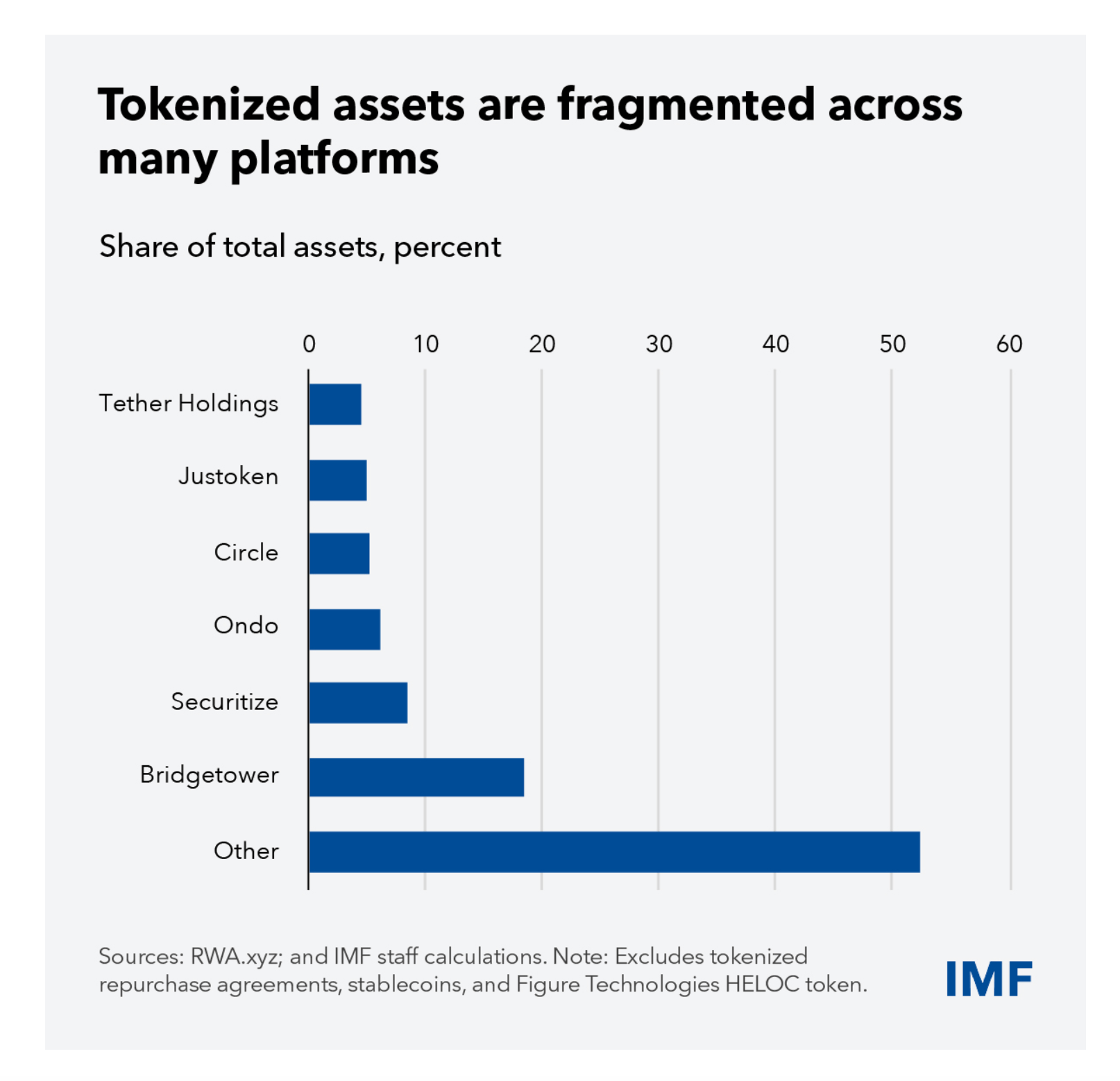
Notwithstanding these advantages, the IMF cautions that tokenized markets currently suffer from thinner liquidity, higher volatility, and price discrepancies caused by fragmented liquidity pools across disparate blockchain networks.
While traditional settlement delays create friction and operational expense, the IMF argued that those same delays historically provided vital time buffers for liquidity management and risk assessment. Moving toward instant settlement on connected ledgers removes those buffers and introduces new risk transmission channels.
As tokenization scales, it could accelerate contagion, leverage risks, fire sales, and liquidity runs across interconnected networks. To enable safe growth without stalling innovation, the IMF recommends a technology-neutral approach.
“Countries should clarify the legal rights linked to tokenized assets, ensure that similar activities are regulated consistently regardless of technology, and support interoperability between tokenized platforms and traditional financial systems,” the IMF explained in the report.
Countries must continuously evaluate vulnerabilities stemming from interconnectedness, leverage, and instant liquidity demands, ensuring safety standards scale alongside market volume.








Be the first to comment