



What to know:
- India crypto raids freeze ₹6 crore after ED searches five Bengaluru payment firms.
- ED alleges firms used USDT and OTC channels for unauthorized cross-border transfers.
- Investigators cite missing FEMA paperwork as India tightens oversight of crypto flows.

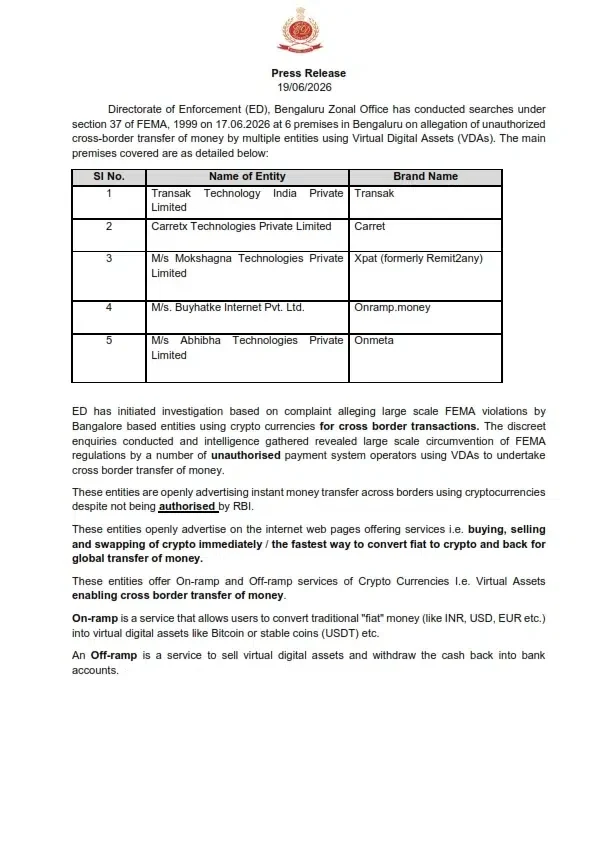
India crypto raids intensified after the Enforcement Directorate searched six premises tied to five Bengaluru crypto payment firms. The agency alleged that the platforms enabled unauthorized cross-border transfers. Investigators froze about ₹6 crore in bank accounts linked to the inquiry.
The Enforcement Directorate’s Bengaluru Zonal Office conducted the searches under Section 37 of the Foreign Exchange Management Act, 1999.
These are Transak Technology India, Carretx Technologies (Carret), Mokshagna Technologies (Xpat), and Abhibha Technologies (Onmeta). The businesses provide products that facilitate the conversion of rupees to digital assets and vice versa.

Also Read: WhiteBIT MiCA Approval in Austria Opens EEA Expansion Path
India Crypto Raids Examine USDT and Cash Payment Routes
India crypto raids targeted companies with fiat on-ramp and off-ramp services. First, the customers transferred rupees into the bank accounts of the companies, the ED said. Those amounts were then converted to the acquisition of virtual digital assets, primarily USDT.
The stablecoins were supposedly sent via crypto platforms and sold over the counter. The agency then paid the recipient in another country in cash, it said. According to the ED, this flow is a conduit outside the typical banking system.

Investigators say the transactions did not have necessary purpose codes or documentation. The agency also pointed out that the transfers lacked the Foreign Inward Remittance Certificates. The platforms circumvented FEMA reporting rules for cross-border payments, it said.
Crypto raids in India also featured accusations of Transak’s transactions with its U.S. affiliate. The ED stated that the company made profits in India in the form of cryptocurrencies before transferring the value to Transak Inc. It claimed the procedure bypassed normal banking channels.
Carret is reported to have facilitated over-the-counter transactions through remittance applications abroad to transfer money to India. In the Mokshagna case, the agency claimed that U.S. customers paid in cash, which was then turned into cryptocurrency. The money was then transferred via Indian exchanges and paid to the payees in India.
ED Expands Crypto Enforcement Actions
The crypto raids in India came after two separate enforcement moves were made for alleged crypto-related frauds. Two days before, the ED had arrested a culprit in the said Ponzi scheme of Korvio Coin, which was valued at ₹500 crore. Authorities said the multilevel marketing operation allegedly targeted more than 248,000 investors.
The agency filed a prosecution complaint on the same day in regard to the Coinbase phishing case. The case involved Indian national Chirag Tomar, who is serving a U.S. prison sentence. Authorities say a fake Coinbase log-in page was used to steal over $20 million.
India crypto raids unfold without a dedicated licensing framework for crypto exchanges or banking-linked crypto applications.
The tax rate on crypto profit in the country is 30%, and the tax deducted at source for crypto trading is 1%. Since 2023, virtual digital asset service providers have been subject to anti-money-laundering rules.
India crypto raids reveal that the regulator is targeting areas where the rupee is coming in or going out of the crypto market. These conversion points are links between the digital asset activity and the banking system. They can supply investigators with transaction information associated with fiat moves.
Also Read: India’s ED Files Charges in $20M Coinbase Crypto Fraud Case



Be the first to comment