

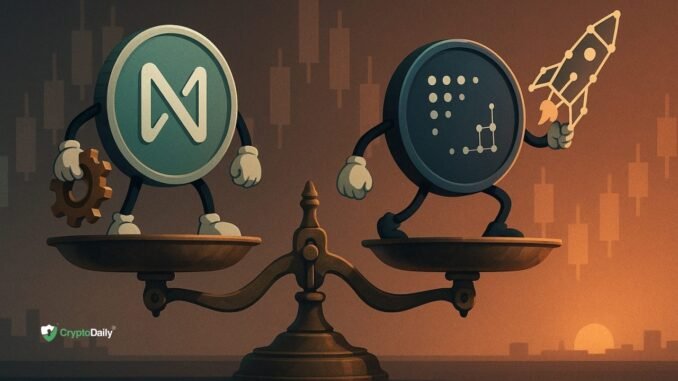

Two headlines, one dilemma: a major Layer-1 rolls out chain abstraction and data availability tools while an AI-first network unveils an agent launchpad. Which narrative moves markets more?
That’s the call traders and builders are weighing as NEAR pushes deeper into infrastructure upgrades and Fetch.ai (FET) doubles down on deployable autonomous agents. Both are ambitious. Only one may deliver nearer-term traction.
Here’s a grounded way to judge which catalyst is stronger for the cycle ahead—without the hype.
The Big Picture
Crypto cycles often orbit two poles: infrastructure and applications. In 2024’s narrative stack, NEAR leans into infrastructure—chain abstraction, better onboarding, and data availability—while Fetch.ai champions application-layer agents and intent-driven workflows. Each appeals to different stakeholders: NEAR to developers who want lower friction and scalability; FET to users and enterprises seeking automation and AI-native coordination.
In practice, catalysts convert when they reduce friction for the next decision-maker in the chain: the developer who ships, the integrator who chooses a stack, or the user who feels a “10x easier” moment.
Understanding how each path lowers friction—and how quickly—helps you gauge which token may capture organic demand sooner.
What NEAR’s Infrastructure Push Actually Changes
NEAR has spent years refining a developer- and user-friendly Layer-1 centered on sharded scaling (Nightshade), human-readable accounts, and predictable fees. Recent and ongoing themes include chain abstraction, easier onboarding, and tooling that lets NEAR serve both as a primary execution layer and as infrastructure for modular stacks.
Chain abstraction and account models
NEAR’s account model supports named accounts and flexible access keys, which makes features like social logins and key rotations more natural. “Chain abstraction” on NEAR aims to hide cross-chain complexity so users interact with apps—while under the hood, smart contracts can coordinate activity across multiple networks. The goal is fewer steps, fewer wallets, and fewer failures in multi-chain flows.
Data availability and rollup support
As modular designs spread, data availability (DA) layers matter. NEAR has positioned components to support rollups seeking low-latency finality and cost efficiency. For app teams, using a DA solution can compress fees and speed confirmations. If NEAR becomes a credible destination for emerging rollups, the network could capture usage from ecosystems that value lower DA costs and quick settlement.
User onboarding: FastAuth and key management
NEAR’s ecosystem has pushed toward passwordless and email-based onboarding flows (often referred to by the community as “FastAuth” approaches) so a user can start transacting in seconds. For non-crypto-native audiences, this removes early drop-off moments like seed-phrase management. If this sticks, it expands the top of the funnel for consumer-facing apps.
What does this change in the short run? Developers can deploy with fewer UX landmines. Integrations—like wallets, bridges, and rollups—gain a clearer surface to plug in. The long run? If DA and abstraction pull new builders in, NEAR could accumulate composable liquidity and steady on-chain activity.
Fetch.ai’s Agent Launchpad: From Idea to Real Workflows
Fetch.ai (FET) focuses on autonomous agents—software entities that can make decisions, negotiate, and transact on behalf of users or organizations. The “agent launchpad” idea bundles tooling, templates, and marketplaces so teams can spin up agents quickly and connect them to data sources, services, and blockchains.
Agent templates and marketplaces
Agent frameworks aim to offer ready-to-use components: identity, wallets, negotiation protocols, and plugin connectors. A marketplace layer can distribute these agents or their skills. If a developer can deploy an expense-reconciliation agent or a logistics-matching agent in hours, not weeks, this lowers the barrier to testing real business workflows.
On-chain economics for agents
Agents need rails: identity registries, service discovery, and payment channels. FET is the native token within Fetch.ai’s economy, intended for staking work, paying fees, or incentivizing services. As agents transact, on-chain demand may emerge—if the workflows actually solve a pain point and move beyond demos to daily use.
What counts as a launch?
“Launchpad” momentum is not just a website going live. The durable signal arrives when third-party developers deploy agents that interact with external systems and settle value on-chain, repeatedly. Watch for credible partnerships, multi-week active usage, and integrations that touch non-crypto software (ERPs, data feeds, or consumer apps). Absent that, a launch risks being a marketing event rather than a usage catalyst.
Context worth noting: over 2023–2024, agent- and AI-linked crypto projects enjoyed strong narratives. Fetch.ai also participated in discussions around broader AI token alliances and migrations. Regardless of branding, the adoption yardstick remains the same: agents that create or capture value in real workflows.
Catalyst Strength: How to Measure It
Both catalysts sound compelling. Turning narratives into comparable metrics helps you avoid purely speculative bets. Here’s a simple framework.
| Metric | Why it matters | NEAR (Infrastructure) | FET (Agent Launchpad) |
|---|---|---|---|
| Time-to-first-success | How quickly a new user/dev gets value | Account creation, first tx, or rollup posting made trivial | Spin up agent, complete external task, settle on-chain |
| Third-party adoption | Independent teams shipping on the stack | New rollups/wallets integrating NEAR components | External developers launching production agents |
| On-chain retention | Repeated usage is sticky value | Growth in daily active signers and contract calls | Recurring agent-to-agent payments and settlements |
| Complementary liquidity | Liquidity follows utility | Bridged assets and stable liquidity pools deepen | Payment rails and stablecoin channels for agents expand |
| Dev velocity | Healthy ecosystem shipping cadence | Tooling, SDK updates, and PR activity | Agent SDK releases, marketplace listings, and updates |
A practical checklist
- Identify the next decision-maker: developer, integrator, or end user.
- Ask what friction the catalyst removes for that person right now.
- Look for verifiable signs: docs, SDKs, code releases, and independent launches.
- Track repeated behavior: weekly active usage beats one-off spikes.
- Map liquidity routes: can value enter, circulate, and exit smoothly?
If a catalyst checks most of these boxes, the narrative has teeth.
Market Structure: Supply, Unlocks, and Liquidity Pathways
Catalysts compete with supply overhang, staking dynamics, and exchange liquidity. Understanding these basics keeps expectations realistic.
Token supply and emissions
NEAR uses protocol-level issuance to reward validators and the ecosystem, while burning a portion of transaction fees. Net issuance depends on network activity and governance parameters. For FET, token supply and any migration plans (for example, alliance or rebrand-related events discussed in 2024) can influence perceived scarcity and near-term flows. Always verify current supply, schedules, and any migration timelines on official channels.
Useful starting points include asset profile pages and documentation hubs like CoinGecko, CoinMarketCap, Messari, and each project’s docs (NEAR, Fetch.ai).
Staking and security budgets
Staking yields and lockups affect circulating supply and validator security. Higher nominal yields can attract stake but may also increase sell pressure if rewards are liquid and emitted quickly. For NEAR, validator set dynamics and delegations influence security and reward distribution. For FET, consider how staking integrates with agent operations—does staking gate service provision, or is it purely economic signaling?
Liquidity concentration
Where do tokens actually trade? Concentrated liquidity on a few venues can magnify volatility around announcements. If you expect a catalyst, check market depth and derivatives open interest to understand how easily price can overshoot and mean revert. For application catalysts (like agent launches), watch whether liquidity forms around the app’s native pairs (e.g., stablecoins needed to pay agents) or stays siloed on exchanges.
Who Benefits and When: Timelines and Feedback Loops
Catalysts land differently across stakeholders. Mapping the sequence helps set expectations.
| Stage | NEAR: Likely first-order impact | FET: Likely first-order impact |
|---|---|---|
| 0–1 months | Docs, SDKs, and tooling updates; dev interest spikes | Agent templates ship; early devs experiment |
| 1–3 months | Pilot integrations (wallets, rollups, DA tests) | Pilot agents run real tasks; first recurring payments |
| 3–6 months | Third-party launches show UX gains; retention metrics improve | Agent marketplaces list verified services; usage stabilizes |
| 6–12 months | Liquidity deepens around successful apps/rollups | Enterprise or consumer integrations expand agent demand |
Feedback loops strengthen when each success reduces the next user’s friction. On NEAR, a polished onboarding flow can make every new app feel easier. On FET, each working agent pattern (e.g., procurement, scheduling) becomes a template others reuse.
Which Catalyst Is Stronger Right Now?
Infrastructure upgrades like NEAR’s tend to be durable: they compound developer convenience and make the ecosystem more attractive over time. Their downside is that they can be invisible to end users, so price discovery often lags until apps showcase the benefits.
Agent launchpads like Fetch.ai’s can create fast, visible wins if they connect to practical workflows—automating tasks with measurable savings or new revenue. Their risk is that “agents” can remain demos without sticky integrations into off-chain systems.
So which is stronger? If you need nearer-term, headline-driven traction, agent launches that demonstrate real tasks and on-chain settlement could move the needle faster. If you prioritize resilience and compounding network effects, infrastructure that lowers UX friction and powers rollups may outlast hype cycles. Many portfolios diversify across both narratives.
Risks & What Could Go Wrong
- Adoption gap: Developers may test but not ship to production if ROI is unclear.
- UX overpromise: Chain abstraction or agent orchestration may break at edge cases.
- Security issues: Smart-contract bugs, key management flaws, or agent exploit paths.
- Token migrations and governance: Rebrands or alliances can confuse holders and delay integrations.
- Liquidity shocks: Thin order books can amplify drawdowns on negative news.
- Regulatory shifts: AI and crypto oversight may evolve, impacting launch timelines or exchange listings.
- Data dependencies: Agents rely on off-chain data; unreliable feeds can corrupt outcomes.
Hype can pull forward expectations, but only repeatable usage sustains value—build your thesis around what users and developers do, not what press releases say.
For ongoing coverage of protocol upgrades, token migrations, and real adoption signals across AI and infrastructure, Crypto Daily tracks announcements and developer milestones in plain English. Visit Crypto Daily for timely briefings and deeper explainers.
Frequently Asked Questions
What does “chain abstraction” on NEAR mean in practice?
It’s an approach to hide multi-chain complexity from end users. Apps can route actions across chains while users interact through a familiar account and onboarding flow. The goal is fewer steps and fewer failures when moving assets or executing cross-chain logic.
How do Fetch.ai agents settle value on-chain?
Agents can use wallets to make or receive payments, post commitments, or trigger smart contracts. The exact design depends on the framework and the target chain. The FET token is intended to facilitate these activities within Fetch.ai’s economy.
Which early signals suggest the agent launchpad is working?
Third-party agents performing repeatable tasks for multiple weeks, on-chain payments increasing over time, integrations with external systems (like ERPs or consumer apps), and credible partners citing concrete savings or speed improvements.
How can I verify current token supply and unlock schedules?
Cross-check official documentation and reputable data platforms such as CoinGecko, CoinMarketCap, and Messari. Avoid decisions based on social media infographics without sources.
Is NEAR’s focus mainly on consumer apps or rollups?
Both. NEAR aims to improve consumer onboarding and also support modular architectures with data availability and interoperability components. The mix you see depends on where developers find the most leverage.
Do I need to be a developer to try agents?
Not necessarily. Launchpads often provide templates and no-code or low-code options. However, complex workflows and enterprise integrations typically require developer input to ensure reliability and security.
Could token migrations impact trading for FET holders?
Yes. Migrations or alliances can involve snapshots, contract swaps, or exchange coordination. Monitor official channels for guidance and be cautious with phishing during transitions.
Disclaimer: This article is provided for informational purposes only. It is not offered or intended to be used as legal, tax, investment, financial, or other advice.






Be the first to comment