



Author
Ahmed Barakat

Author


Share

Fact Checked by
CryptoNews Editorial Team
Author

In the lastest Ethereum news, Fundstrat’s Tom Lee is arguing that Ethereum’s next major move has nothing to do with crypto-native speculation, and everything to do with institutional capital that is already deployed and building.
Writing in Bitmine’s July Chairman’s message, Lee pointed to BlackRock BUIDL, JPMorgan MONY, and Robinhood Chain as concrete evidence that Wall Street has moved from observation to construction on Ethereum’s rails. The ETH price currently sits near $1,880, about 60% below its 2025 peak near $5,000.
The gap between that peak and current levels is the central question Lee addresses. His read is that it reflects a regime change, not a structural ceiling, the first era of ICOs, NFTs, ETFs, and stablecoins has run its course, and the institutions now building on Ethereum represent a fundamentally different demand base with longer time horizons and larger capital pools.
Discover: The Best Token Presales
Ethereum News: BlackRock, JPMorgan, and the Tokenization Build-Out
Lee’s institutional case rests on names that move markets in traditional finance. BlackRock BUIDL, the asset manager’s tokenized Treasury fund, now holds roughly $2.6 billion and has earned Moody’s top money-market rating (Moody’s cited).
JPMorgan MONY extended the bank’s tokenization push that began with Onyx in 2020, adding another institutional-grade vehicle to the Ethereum ecosystem.
Electric Capital data cited by Lee puts nearly 6,000 developers on the EVM stack, ranking Ethereum first among all chains for new builders, a metric that matters more to institutions evaluating long-term platform risk than short-term price momentum.
Wall Street is building on Ethereum, Lee argues in the Chairman’s message, contrasting 2022’s crypto bear-market backdrop with continued institution-led development.
In 2025 and 2026, institutional crypto infrastructure has continued to expand even as ETH price fell sharply from its cycle highs. That divergence between on-chain institutional activity and spot price is the core of his thesis. For more on how BlackRock’s ETF flows are reinforcing this dynamic, see this analysis of BlackRock ETF inflows and their ETH price implications.
Discover: The Best Crypto to Diversify Your Portfolio
Robinhood Chain: ETH as Settlement Money
Robinhood Chain, launched July 1 on Arbitrum, handed Lee one of his more striking data points. Within two weeks of going live, it ranked third among all networks by DEX volume at about $811 million daily, briefly surpassing Ethereum itself according to DefiLlama. Ethereum has since reclaimed that position, and cumulative Robinhood Chain volume has crossed $1 billion.
In the Chairman’s message news, Lee argues that Robinhood Chain’s use of ETH (as described in his discussion of the network’s fees and how it settles) makes it a meaningful Ethereum use case.
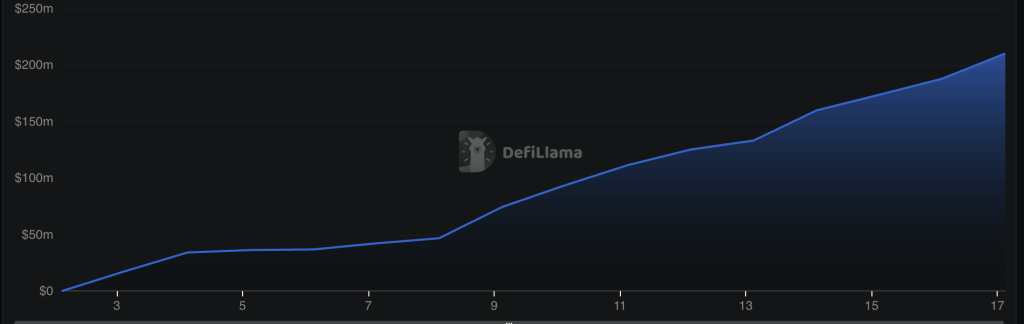
The counterargument is equally straightforward. Artemis CEO Jon Ma has noted that Robinhood Chain’s volume spike is predominantly meme coin-driven, not institutional flows.
And the fee economics cut against Lee’s framing, Robinhood Chain pays Ethereum’s base layer almost nothing in fees. High DEX volume on an Arbitrum-based chain does not translate 1-for-1 into ETH fee burn at the L1 level.
The Amazon Analogy, and the Conflict It Carries
Lee frames the current ETH setup through an Amazon analogy: the stock traded near a split-adjusted $6 for 12 years before climbing to $241 as its total addressable market expanded beyond what early investors could model. He also describes the psychology around sellers at depressed prices.
He also concedes the bearish read directly. ETH has failed twice at the $5,000 level, and skeptics argue that the top of the range could limit upside this cycle.
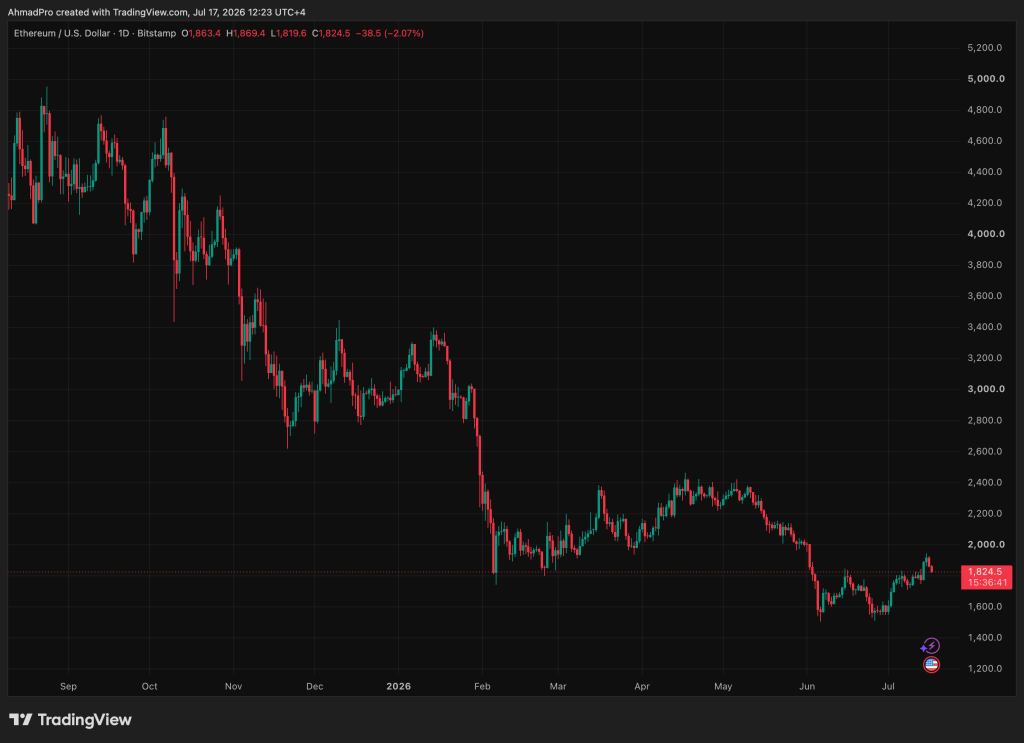
The conflict of interest embedded in Lee’s thesis deserves direct acknowledgment. Bitmine’s latest weekly disclosure shows 5.77 million ETH, about 4.8% of the 120.7 million total supply. Lee is among the biggest beneficiaries if institutional adoption confirms his thesis.
That does not make his argument wrong, but it reframes every price target he issues as coming from a holder with an extraordinary financial stake in the outcome.
The institutional infrastructure Lee cites is real. BlackRock BUIDL’s Moody’s rating, JPMorgan’s MONY fund, and Robinhood Chain’s early volume numbers are all verifiable facts, not projections.
Whether they are sufficient to drive ETH from $1,880 back through $5,000 and beyond depends on whether institutional capital deepens from product launch into sustained secondary market demand, a step that none of these programs has yet demonstrated at scale.
Trades Ethereum, and Don’t Miss Out on Our $1,000 USDT Airdrop on ByBit
Trending News
RecommendedPopular Crypto TopicsPrice Predictions



Be the first to comment