




TLDR
- Iran declared the Strait of Hormuz closed “until further notice” after U.S.-Iran military exchanges
- Brent crude surged 4.4% immediately following the announcement
- European gas prices jumped 3.5–4%, hitting a one-month high
- Eurozone bond yields held near multi-week highs as inflation fears grew
- Europe’s gas storage sits at 47% capacity, below last year’s 56% at this point
Iran’s decision to close the Strait of Hormuz has rattled energy markets, pushing oil and gas prices sharply higher and raising fresh inflation concerns across Europe.
The closure was declared “until further notice” following fresh military exchanges between U.S. forces and Tehran over the weekend. While U.S. Central Command said commercial shipping lanes remain open, the announcement alone was enough to shake global markets.
BREAKING: The US has struck Kharg Island’s western jetty pumping station and multiple pipelines supplying Kharg’s pumping stations, with fires visible on NASA FIRMS satellite imagery.
This is the first US strike specifically targeting oil infrastructure at Kharg, Iran’s primary… pic.twitter.com/lhO9DqGa2Q
— The Hormuz Letter (@HormuzLetter) July 13, 2026
Brent crude jumped 4.4% after the news broke. The Strait of Hormuz is one of the world’s most critical oil shipping routes, and any threat to its operation sends immediate ripples through energy prices worldwide.
Gas Prices Hit One-Month High
European wholesale natural gas prices also climbed sharply on Monday. The Dutch front-month contract rose 3.5% to 50.37 euros per megawatt-hour. The British equivalent rose 4%, moving in step with its continental peer.
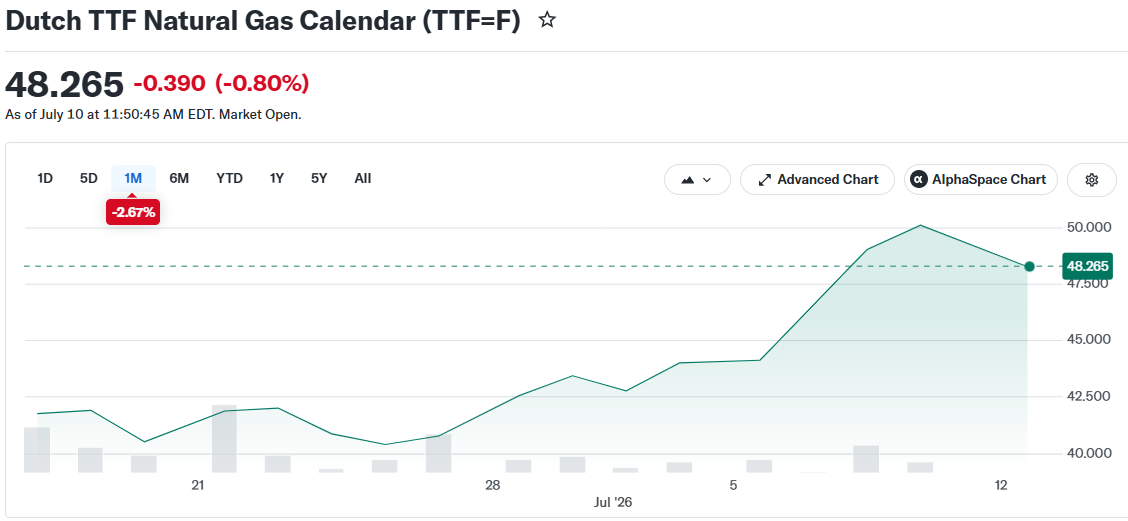
The Strait of Hormuz handles roughly one-fifth of the world’s total liquefied natural gas trade, including the bulk of Qatar’s exports. A prolonged closure could cut off a key supply line to European buyers.
Europe is currently refilling its gas storage facilities ahead of the 2026/2027 winter heating season. Storage is sitting at around 47% capacity, compared to 56% at the same time last year. That gap leaves Europe more exposed to supply shocks than it was twelve months ago.

If Gulf LNG exports are disrupted for an extended period, European buyers would face steeper competition from Asian buyers, pushing prices even higher.
Bond Yields Reflect Inflation Fears
European government bond yields held near their highest levels in over a month on Monday. Germany’s 10-year Bund yield stood at 3.05%, while the 2-year yield was at 2.68%.
Both figures stayed elevated because rising energy prices tend to keep inflation high, which reduces the appeal of fixed-income assets. Last week, German bond yields posted their largest weekly rise in five weeks.
The main concern is that the European Central Bank may have to pause its rate-cutting cycle if energy prices continue to drive inflation higher. Money markets are already pricing in fewer cuts from the ECB than they were just weeks ago.
ECB Executive Board member Isabel Schnabel is due to speak later Monday. Schnabel has been one of the more hawkish voices on the ECB’s Governing Council. Any comments she makes about inflation risks from the Gulf crisis could move markets further.
Diplomatic efforts to ease tensions in the region had shown some progress in recent weeks. Those efforts now appear stalled following the latest military exchanges, leaving energy markets on edge with no clear resolution in sight.
Stop guessing and start investing with confidence. KnockoutStocks gives you the AI insights, market intelligence, and stock research you need to spot opportunities, cut through the noise, and make smarter investment decisions — all in one powerful platform.
Sign up today and get 50% OFF full access to our premium stock picks.
Simply use coupon code SPECIAL50 at checkout to claim your exclusive discount.



Be the first to comment