



No, Bitcoin is not going to $0. It is currently trading near $64,900, down about 49% from its October 2025 all-time high of $126,080, driven by Fed rate uncertainty, ETF outflows, and leveraged liquidations. Its scarcity, global network, and institutional adoption make a total collapse to zero practically implausible.
Key Takeaways
- Bitcoin trades around $64,900 as of mid-August 2026, roughly 49% below its October 2025 peak of $126,080.
- The current bitcoin price fluctuations stem from Fed policy uncertainty, ETF outflow cycles, leveraged liquidations, and macro shocks such as tariffs and geopolitical tensions.
- Bitcoin has fallen 80%+ from its peak on at least three prior occasions and recovered to new highs every time.
- A drop to exactly $0 would require every holder worldwide to sell simultaneously with zero buyers at any price, an outcome most analysts call practically impossible.
- Bitcoin’s value rests on its fixed supply, network effects, and growing institutional and sovereign adoption, not on any single company or government.
Where Does Bitcoin Stand Right Now?
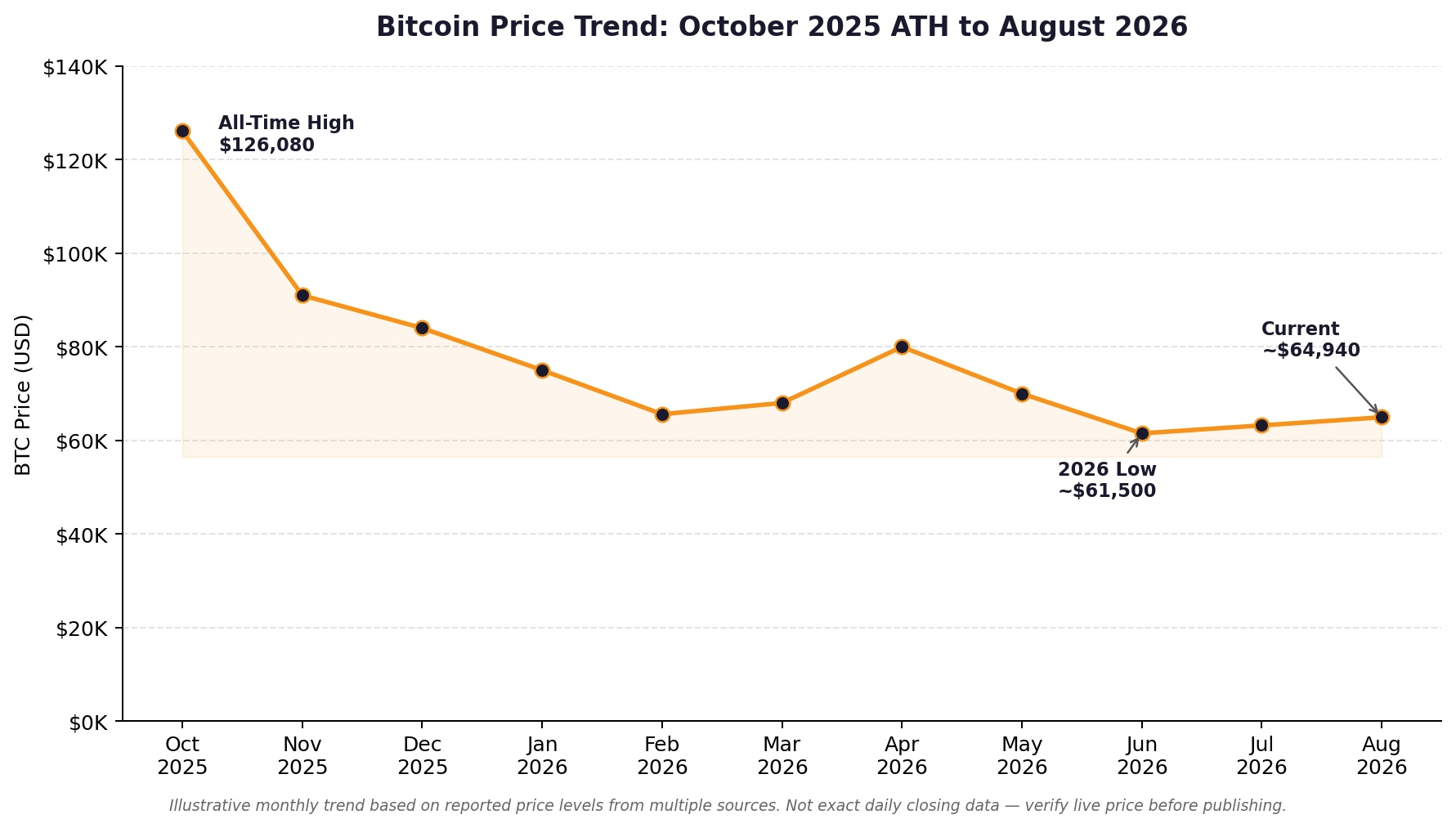
Bitcoin is trading at approximately $64,940 as of August 2026, with a market capitalization of roughly $1.3 trillion. That figure keeps it as the world’s largest crypto and roughly 57% of the entire crypto market. The price has been range-bound between roughly $61,500 and $65,300 through the summer, holding modest weekly gains as traders track upcoming inflation data and Federal Reserve signals.
That current level sits far below Bitcoin’s all-time high. As of August 12, 2026, Bitcoin remains down about 27% since the beginning of 2026 and nearly 49% below its October 2025 all-time high of $126,080. The question of a ‘Bitcoin Crash’ mainly arose after the major price fluctuation in October 2025.

Also Read: Understanding Bitcoin Price Fluctuation in October 2025
Why Is Bitcoin Price Fluctuating So Much?
Bitcoin’s swings since late 2025 trace back to a cluster of overlapping pressures rather than one single cause.
- Federal Reserve policy uncertainty
Bitcoin has moved closely with expectations around US interest rates. The nomination of a known inflation hawk as the next Federal Reserve Chair in January 2026 triggered a broad risk-off sell-off across speculative assets, with Bitcoin leading the decline, since tighter policy historically weighs on risk assets like crypto and growth stocks alike.
- ETF outflows reversing institutional demand
US spot Bitcoin ETFs, which had driven institutional buying through 2024 and the first half of 2025, reversed sharply once sentiment turned. A record 13-day Bitcoin ETF outflow streak totaling $4.4 billion added direct selling pressure on spot prices earlier this year.
- Leveraged liquidations amplifying every move
Crypto markets run on high leverage, which turns ordinary corrections into sharp drops. A single weekend in February 2026, dubbed “Black Sunday II” by traders, produced $2.56 billion in liquidations in one day, and Bitcoin’s entity-adjusted realized loss hit a record of $3.2 billion days later.
- Geopolitical and macro shocks
US-Iran geopolitical tensions and a hawkish inflation reading removed near-term prospects of rate cuts, adding fresh pressure at a moment when the market was already fragile. Tariff announcements and shifting growth expectations have compounded the effect.
- On-chain profit-taking
Long-term holders and large wallets moved meaningful BTC to exchanges after the October 2025 peak, a pattern analysts read as distribution after a strong rally, adding further supply into a weakening market.
Has Bitcoin Crashed This Hard Before?
Sharp drawdowns are not new for Bitcoin. Every previous crash of 50% or more has been followed by a full recovery and a new all-time high, though the timeline has varied significantly.
| Period | Peak | Trough | Decline | Recovery to New High |
| 2011 | $32 | $0.01 | ~99.9%* | ~20 months |
| 2013–2014 | ~$1,150 | ~$150 | ~87% | ~3 years |
| 2017–2018 | ~$19,700 | ~$3,200 | ~84% | ~3 years |
| 2021–2022 | ~$69,000 | ~$15,500 | ~77% | ~2 years |
| 2025–2026 | $126,080 | ~$61,500 | ~51% | Ongoing |
The 2011 collapse was caused by a compromised exchange account triggering a flash crash on Mt. Gox, not a broad market sell-off.
Bitcoin has experienced multiple crashes of 50% or more throughout its history and has recovered from all of them to reach new all-time highs. That track record doesn’t guarantee the current cycle plays out the same way, but it does show that steep drawdowns have historically been part of Bitcoin’s volatility, not evidence of terminal decline.
What Actually Makes Bitcoin Valuable?
Bitcoin’s price swings hard, but its underlying value proposition has stayed consistent since 2009.
- Fixed, verifiable scarcity
Bitcoin’s circulating supply is about 20.07 million coins, out of a fixed maximum of 21 million that will ever exist. No entity, government, or company can inflate that supply, unlike fiat currency or company stock.
- A decentralized network with no single point of failure
Bitcoin runs on a peer-to-peer network of computers rather than a central bank or corporation. That structure lets value move directly between parties, and it means there is no single company whose bankruptcy could take the network down.
- Deepening institutional and sovereign adoption
Spot Bitcoin ETFs have brought traditional financial infrastructure into the asset class, and the US Strategic Bitcoin Reserve holds an estimated 328,372 BTC as of early 2026, making the US the largest known state holder of Bitcoin. Corporate treasuries have followed a similar path, holding BTC as a balance-sheet asset.
- Fifteen years of continuous, unbroken operation
The Bitcoin network has processed transactions without a successful protocol-level attack since its 2009 launch, through multiple 80%+ price crashes, exchange collapses, and regulatory crackdowns.
Also Read: What Is Ethereum Option Trading? Beginner’s Guide
Is Bitcoin Going to $0? What the Debate Actually Says
The “Bitcoin to zero” narrative resurfaces during every steep correction, and 2026 has been no exception. It deserves a fair look at both sides.
The Bear Case
Some prominent critics argue Bitcoin’s value is purely belief-driven. Economist Steve Keen has pointed to Bitcoin’s energy consumption as a long-term regulatory risk, arguing that policymakers focused on climate goals could eventually target crypto mining.
Investor Richard Farr has assigned Bitcoin a long-term value of zero, citing its correlation with equity markets and limited use as an everyday medium of exchange. Peter Schiff has repeated his long-standing view that Bitcoin’s valuation reflects speculation rather than functional utility.
The Bull Case
For Bitcoin’s price to reach exactly $0, every holder worldwide would need to sell simultaneously, with no buyer willing to pay any price for it, at any point, permanently. Given that Bitcoin has millions of holders across more than 190 countries, institutional balance sheets, and sovereign reserves, most analysts consider that scenario a mathematical edge case rather than a realistic outcome.
It is also worth noting that Bitcoin’s most vocal “death call” critics, including Peter Schiff, Steve Hanke, and Warren Buffett, have made such predictions repeatedly for over a decade, through cycles in which Bitcoin’s price has still risen substantially from their original calls.
That said, “not going to zero” is not the same as “cannot fall further.” Bitcoin remains a volatile, high-risk asset, and past recoveries do not guarantee future ones. This piece presents documented positions on both sides; it is not investment advice or a price forecast.
Lessons From Companies Written Off
Steep drawdowns and “this is the end” narratives aren’t unique to Bitcoin. Several companies now considered generational winners faced near-identical skepticism during their own collapses.
| Company | Peak-to-Trough Decline | What Critics Said | What Happened Next |
| Amazon (2000–2001) | ~95% (from ~$107 to ~$6) | Barron’s ran a cover story nicknamed “Amazon.bomb,” predicting the company would run out of cash | Became one of the world’s most valuable companies by market cap |
| Apple (1996–1997) | Stock near record lows, days from insolvency | Widely predicted to be acquired or shut down within a year | Returned to become one of the most valuable companies in history |
| Netflix (2011) | ~75% (Qwikster split-pricing backlash) | Analysts called it a broken business model post-DVD | Became the dominant global streaming platform |
| Bitcoin (2025–2026) | ~51% (from $126,080 to ~$61,500) | “Bitcoin to $0” narrative resurfaced among long-standing critics | Trading has stabilized in the low-to-mid $60,000s as of August 2026 |
The pattern across all three companies is similar: a severe drawdown coincided with a wave of confident predictions that the underlying business was finished. In each case, the companies that survived did so because their core value proposition e-commerce infrastructure, consumer hardware and software ecosystems, and content distribution- remained intact even as the stock price collapsed.
This comparison illustrates a pattern, not a guarantee. Company turnarounds and a decentralized protocol’s price behavior are not identical situations, and past recoveries in either case don’t predict future ones.
Bitcoin Price Prediction 2026
Rather than offering a specific Bitcoin price prediction, it’s more useful to track the signals analysts are actually watching for the rest of 2026:
- Federal Reserve decisions: Rate cuts historically support Bitcoin and other risk assets; hawkish surprises tend to trigger sell-offs.
- US inflation data (CPI): Softer-than-expected inflation reduces pressure on the Fed to hike, which has recently coincided with BTC price recoveries.
- Spot Bitcoin ETF flows: Sustained inflows signal renewed institutional demand; extended outflow streaks have preceded past drawdowns.
- On-chain holder behavior: Large-scale movement of BTC from long-term wallets to exchanges has historically signaled profit-taking pressure.
- Leverage and liquidation levels: Elevated open interest and funding rates raise the risk of another cascading liquidation event.
All of these are live, changing data points. Any specific price target should be treated as a snapshot in time rather than a fixed forecast, and cross-checked against real-time data before being relied upon.
Conclusion
Bitcoin’s current price fluctuation reflects a familiar mix of macro pressure, leverage, and shifting institutional flows, not a breakdown in what makes the asset valuable. History shows steep Bitcoin drawdowns are a recurring feature of its market cycle, and a genuine fall to $0 would require a scenario most analysts consider practically impossible: every holder selling at once, with no buyer anywhere at any price.
Whether you’re new to crypto or tracking the market closely, understanding these cycles matters more than reacting to any single headline. In the grand scheme of things, ZebPay blogs are here to provide you with crypto wisdom. Get started today and join 6 million+ registered users to explore endless features on ZebPay!
FAQs
Is Bitcoin actually going to $0?
A drop to exactly zero would require every Bitcoin holder worldwide to sell simultaneously with no buyer at any price, an outcome most analysts consider a practical impossibility given Bitcoin’s global holder base and institutional adoption.
Will Bitcoin crash further from here?
No one can predict this with certainty. Bitcoin remains a volatile asset, and further declines are possible if Fed policy tightens, ETF outflows resume, or leveraged liquidations accelerate again. Tracking live data is more reliable than relying on any single prediction.
Why is Bitcoin price down so much from its all-time high?
Bitcoin is down roughly 49% from its October 2025 peak of $126,080, driven by a combination of Fed rate uncertainty, spot ETF outflows, leveraged liquidations, geopolitical tensions, and on-chain profit-taking by large holders.
Has Bitcoin recovered from crashes like this before?
Bitcoin has fallen 80% or more from its peak on at least three prior occasions, in 2011, 2013–14, and 2017–18, and recovered to reach new all-time highs each time, though recovery periods have ranged from about 20 months to 3 years.
Disclaimer:
Crypto products and NFTs are unregulated and can be highly risky. There may be no regulatory recourse for any loss from such transactions. Each investor must do his/her own research or seek independent advice if necessary before initiating any transactions in crypto products and NFTs. The views, thoughts, and opinions expressed in the article belong solely to the author, and not to ZebPay or the author’s employer or other groups or individuals. ZebPay shall not be held liable for any acts or omissions, or losses incurred by the investors. ZebPay has not received any compensation in cash or kind for the above article and the article is provided “as is”, with no guarantee of completeness, accuracy, timeliness or of the results obtained from the use of this information.


Be the first to comment