


JPMorgan Asset Management has introduced a 10% annualized return forecast for Bitcoin in its 2027 Long-Term Capital Market Assumptions, placing the cryptocurrency ahead of U.S. large-cap equities, gold and several traditional asset classes over the next 10 to 15 years.
Released on October 19, the 31st edition marks JPMorgan’s first formal inclusion of Bitcoin in its long-term return projections, extending the bank’s institutional investment framework into cryptocurrency.
The 10% base-case assumption exceeds the bank’s 7.5% annual forecast for U.S. large-cap stocks, 8.2% for U.S. real estate investment trusts and 5.5% for gold. However, Bitcoin’s significantly higher volatility prevents its inclusion in the firm’s main strategic portfolio allocation models.
Bitcoin Leads Major Traditional Assets in Long-Term Returns
JPMorgan’s outlook places Bitcoin among the highest-returning assets in its investment framework, although the projected performance carries substantially greater uncertainty than conventional securities.
The bank assigns Bitcoin an annualized volatility assumption of approximately 55%, compared with considerably lower risk estimates for equities, bonds and gold. Its analysis treats Bitcoin separately from traditional portfolio assets because historical relationships between cryptocurrency prices and other financial markets have remained unstable.
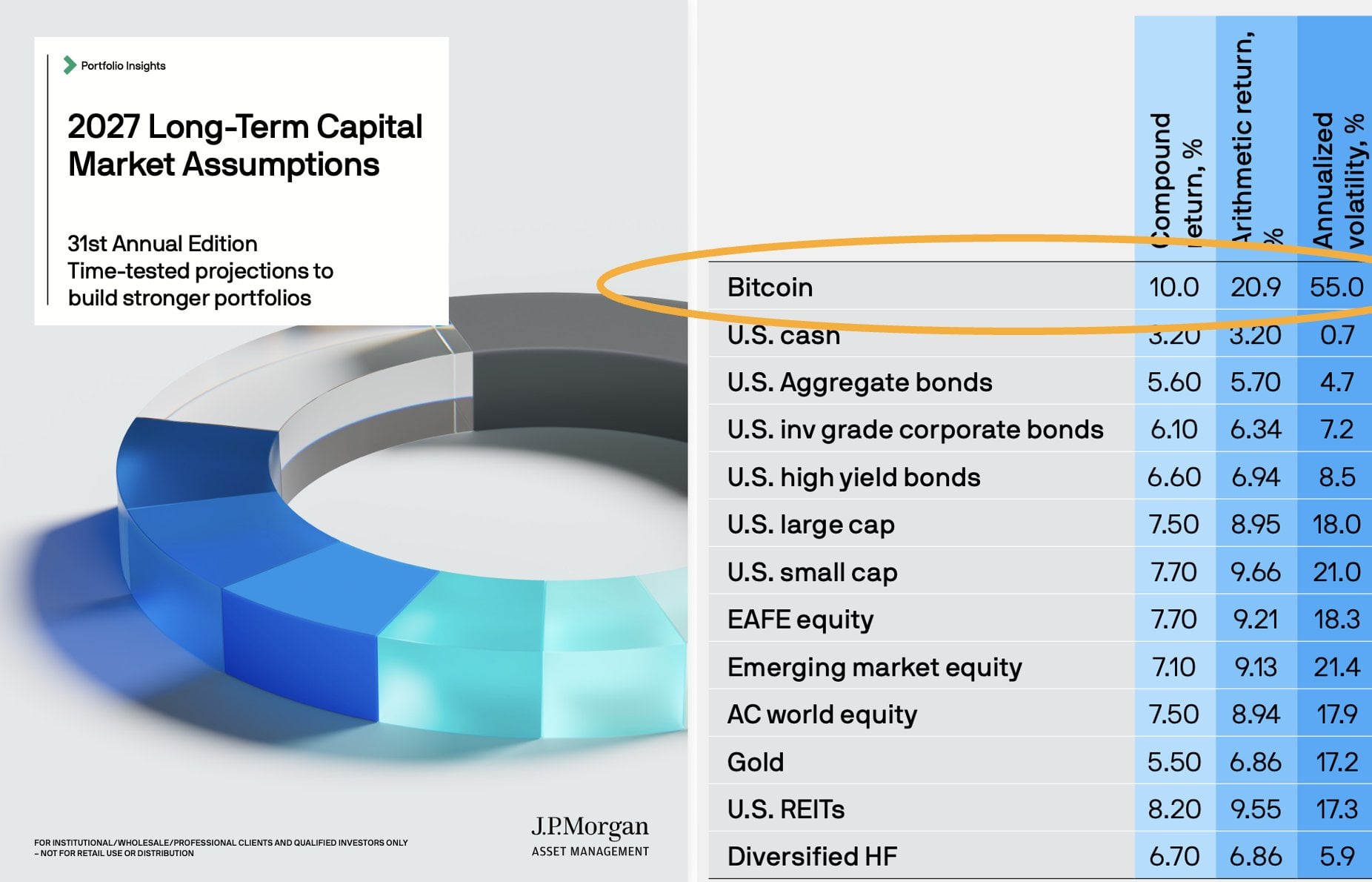
The projections represent compound annual returns over a 10- to 15-year investment horizon, rather than expected gains for 2027 alone. Actual returns may differ substantially from the modeled assumptions.
Bitcoin’s inclusion follows growing institutional use of cryptocurrency investment products, with Sygnum Bank previously identifying institutional Bitcoin adoption as a structural shift in traditional portfolio construction.
High Volatility Keeps Bitcoin Outside Core Portfolio Models
JPMorgan has introduced Bitcoin return expectations without incorporating the asset into its primary covariance matrices, which institutional investors use to evaluate portfolio risk and diversification.
Instead, the firm provides a smaller, separate matrix comparing Bitcoin with selected traditional assets. Its unstable correlations make it difficult to establish a reliable strategic allocation alongside equities, fixed income and alternatives.
The bank’s caution contrasts with its comparatively constructive return outlook. Bitcoin’s projected performance exceeds that of several traditional assets, but a higher expected return does not necessarily produce stronger risk-adjusted results.
The relationship between Bitcoin and gold remains particularly relevant. Earlier research on Bitcoin and gold examined how changing macroeconomic conditions redirected investor demand between cryptocurrency and precious metals as markets reassessed inflation, liquidity and financial risks.
JPMorgan’s new framework also arrives after its analysts described Strategy’s expanding dollar reserves as a positive development for Bitcoin, reducing concerns that corporate treasury financing obligations could trigger forced BTC sales.
JPMorgan Raises Broader Investment Return Forecasts for 2027
Bitcoin’s introduction forms part of a wider upgrade to JPMorgan’s long-term capital market expectations.
U.S. large-cap equity return forecasts increased by 80 basis points from the previous year’s assumptions, supported by resilient corporate profit margins and anticipated productivity gains from artificial intelligence.
Global equity returns are projected at 7.5%, while global aggregate bonds are expected to deliver 5.3% annually, their strongest projected returns in approximately two decades.
A traditional portfolio consisting of 60% equities and 40% bonds is expected to generate a 7% compound annual return, rising to 7.5% when diversified alternatives account for 30% of the portfolio.
The forecasts incorporate more than 200 asset classes across over 20 base currencies, with assumptions calculated as of September 30, 2026. Bitcoin remains outside the core strategic allocation model despite receiving its first dedicated long-term return forecast.


Be the first to comment