



- KLV is the native coin of the Klever Blockchain.
- Use: It is used to pay for network fees, staking, app interactions, P2P transfers, and payments.
- Why it is important: The coin builds a comprehensive ecosystem that users, developers, merchants, and validators can employ in day-to-day practical use.
- Business side: Merchants can receive KLV payments using NOWPayments, thus giving it a real-world use case for potential adoption in commerce.
KLV is the native coin of the Klever blockchain and is used as the foundational layer 1 coin, but it actually goes much beyond that in day-to-day transactions. This will also benefit investors and validators as well as businesses that want to use a stable cryptocurrency for payments.
In this article, we’ll first clarify KLV’s function in the ecosystem and then its real-world application with NOWPayments, which is widely used by merchants. The goal is to show how a blockchain asset can bridge the gap between network infrastructure and commercial practice.
Everything You Need to Know About KLV
The evolution and the native coin. Klever began as a collection of crypto products, notably a wallet and an exchange, but it soon outgrew the constraints of operating on external networks. That progression led to the creation of its own Layer 1 blockchain. KLV was introduced as the native coin that now anchors every operation within that chain, from transaction fees to staking and application logic.
The vision and the ecosystem. Klever’s goal has always been to simplify and bring blockchain technology within reach for developers and ordinary people. For that purpose, the network provides and integrates a set of tools and interconnected products to make the process as smooth as possible, minimizing complexity and reducing the technical entry barrier. Now, there are a few things that work in the ecosystem: each one has a different purpose.

- Klever Blockchain: the whole network is run by the Layer 1 protocol and every transaction is processed at this level.
- Klever Wallet is a simple and secure mobile wallet for managing your digital assets on-the-go.
- Klever Extension is a web browser extension that lets you open dApps in your browser without requiring any third-party applications.
- KleverSafe is the hardware wallet solution for cold storage and increased security of your cryptocurrency.
- KleverScan: a network explorer where you can see and verify the transactions and the blockchain of the network.
- Developer infrastructure: APIs, SDKs, and smart contract infrastructure for building on the network.
How Klever Coin Works
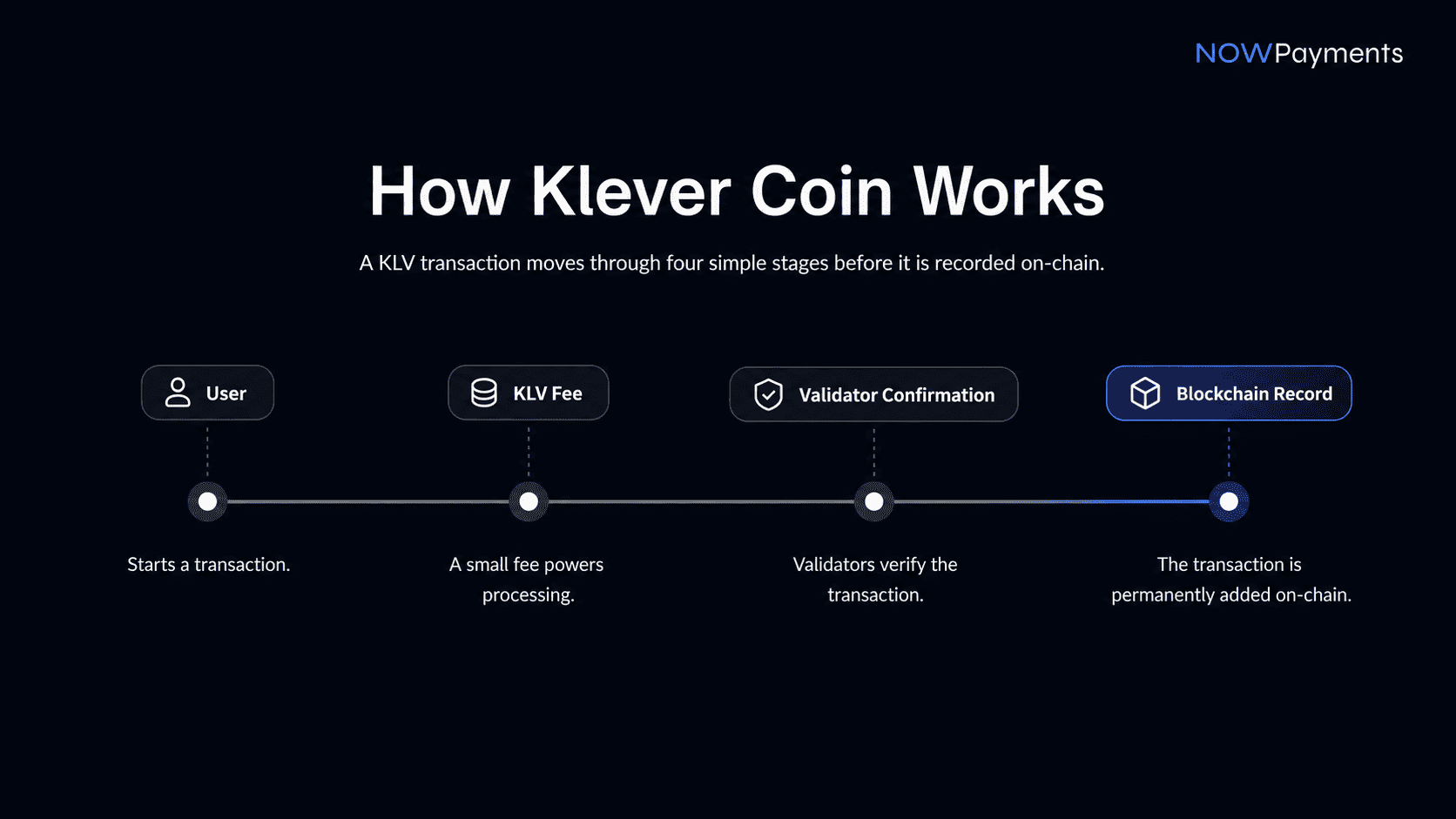
KLV is the native token of the Klever Blockchain, and it will be used to pay all transaction fees, staking, and all on-chain activities. Validators validate transactions and delegators delegate to validators and stake KLV. The network uses a delegated proof-of-stake model rather than running their own nodes. This keeps the network secure and open.
Transaction flow
- A user performs a transfer, a contract call, or an application action.
- The network determines the amount of the fee in KLV.
- Validators execute and verify the transaction.
- The transaction is written to the blockchain.
- Delegators pledging to validators also can obtain rewards.
KLV operates exclusively on the Klever Blockchain. If you send it to wallets or exchanges that do not support this network, it will be lost forever. Always double-check the network before sending.
KLV Tokenomics
KLV is the native Layer 1 coin of the Klever Blockchain. It has a ticker KLV and runs on a delegated proof of stake. Coinbase and KuCoin state that the total supply is limited to 10 billion tokens, with a circulating supply of about 8.88 billion KLV as of July 2026. People mainly use it for fees, staking, applications, transfers, and payments.
| Metric | Value |
| Ticker | KLV |
| Network | Klever Blockchain |
| Asset type | Native Layer 1 coin |
| Consensus | DPoS |
| Max supply | 10 billion |
| Utility | Fees, staking, apps, transfers, payments |
On the supply side, Klever employs a verified burn mechanism: quarterly buybacks and burns funded by wallet swap fees, plus additional burns from yearly product revenues. Over 379 million KLV were burned from 2020 earnings, and 317 million from 2021 earnings. As with any token, these supply metrics are dynamic and should not be read as performance guarantees.
What Makes KLV Unique?
KLV has unique points in both technical and development aspects and has business power to back it, which makes its strength in an all-round game.
- Native ecosystem utility. KLV is the native utility token of Klever Blockchain that powers transaction fees, staking, transfers, and applications within the ecosystem.
- Native blockchain features. Creating assets, staking logic, permission management, and deploying NFTs are all native functions, and developers don’t have to be forced to use third-party smart contract templates.
- Delegated Proof of Stake. Token holders can participate simply by delegating, meaning they can earn rewards as a potential income and help secure the network without the hassle of running their own nodes.
- Infrastructure for financial DeFi. Projects can issue tokens, NFTs, and other blockchain assets natively on the Klever Blockchain with KLV as the base layer token without reinventing the wheel every time they want to leverage KLV.
- Dedicated wallets. You can use KLV on all these products: mobile wallet, browser extension, and hardware solution, enabling seamless management of your funds anywhere.
- Merchant usability. Now you can spend your KLV coins at merchants that accept cryptocurrency via NOWPayments, thus making KLV a real checkout option in real-world shopping.
What makes KLV different isn’t any one of these things but all of these things, from infrastructure and developer toolsets to consumer wallets and merchant payments and, now, staking, all native to one, single Layer 1 chain.
What Is KLV Used For?
The utility of KLV can best be comprehended by observing its users and use cases as the coin performs very different functions relative to the audience.
| Audience | Primary uses |
| Users | Transfers, wallet payments, staking, delegation |
| Developers | Application deployment, smart contracts, asset creation (tokens, NFTs) |
| Businesses | Merchant checkout (via NOWPayments), digital services, Web3 products, network fees |
For everyday users, KLV is used for transfers, wallet payments, staking for potential rewards, and delegation to validators without having to run a node. Developers use KLV to build apps, run smart contracts, and mint tokens or NFTs, with every single on-chain action devouring a tiny fraction of the coin. Now, companies can get paid in KLV for their goods and services via the merchant checkout (NOWPayments) and they can also pay for the network fees their blockchain needs to incur.
KLV’s multi-functional nature enables it to never be pigeon-holed into a single duty. Its value derives from meeting the needs of all three segments at once.
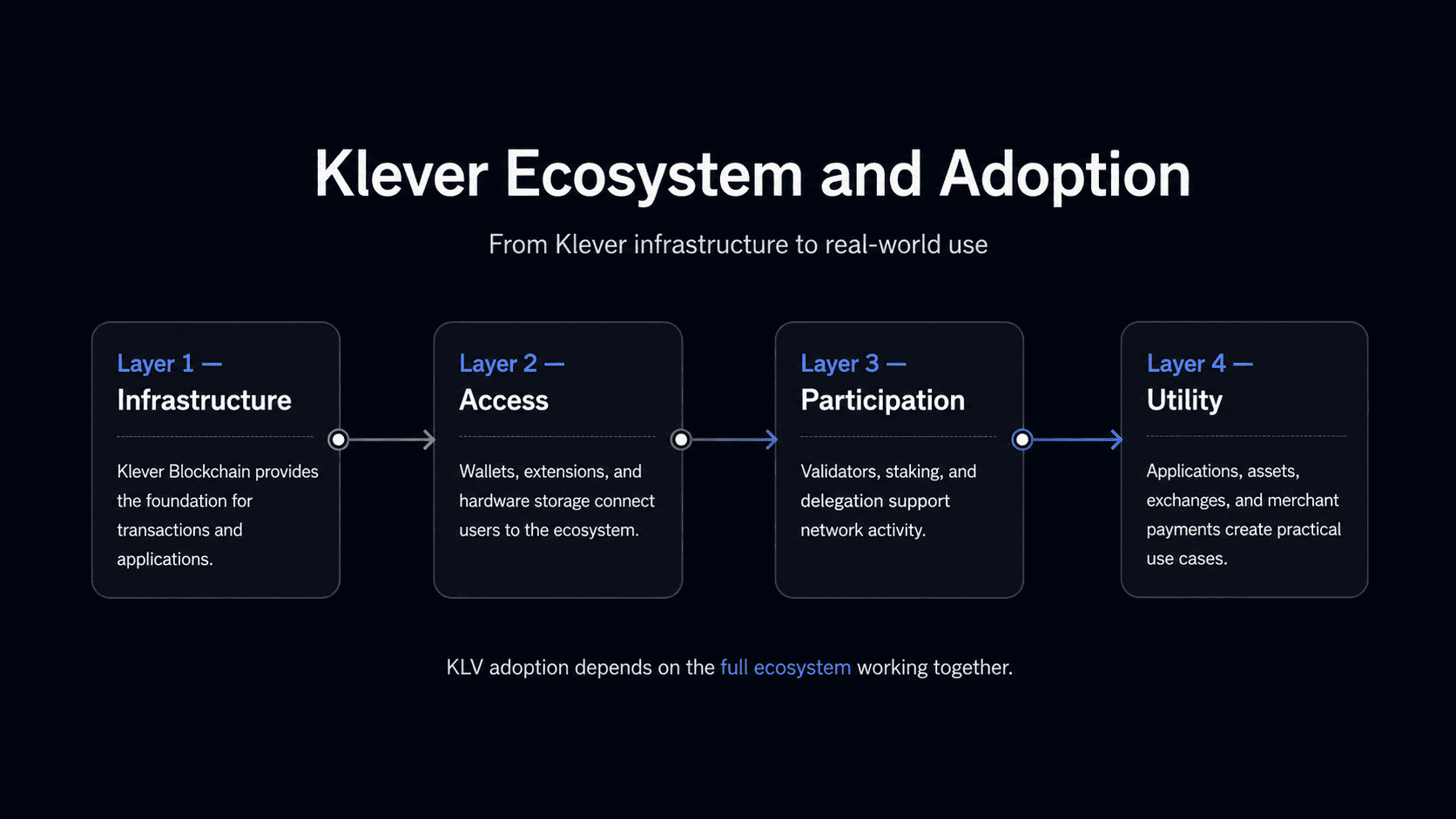
Klever Ecosystem and Adoption
Non-developers are able to securely manage their KLV via their preferred mobile wallet, browser extension, or hardware storage option.
- Developers have APIs, SDKs, smart contract tools, and documentation to build apps and issue their own tokens.
- The network runs on staking and delegation, where validators are the ones processing transactions and delegators are backing them up without having to run nodes themselves.
- KLV is listed on exchanges for liquidity and NOWPayments allows merchants to accept it at checkout.
All of this together makes a complete ecosystem, but it’s only truly adopted when people are actually using it, transactions are flowing, and developers are still active.
How to Accept KLV with NOWPayments
Integrating KLV payments with NOWPayments is quick and simple. Follow these steps to start accepting payments:
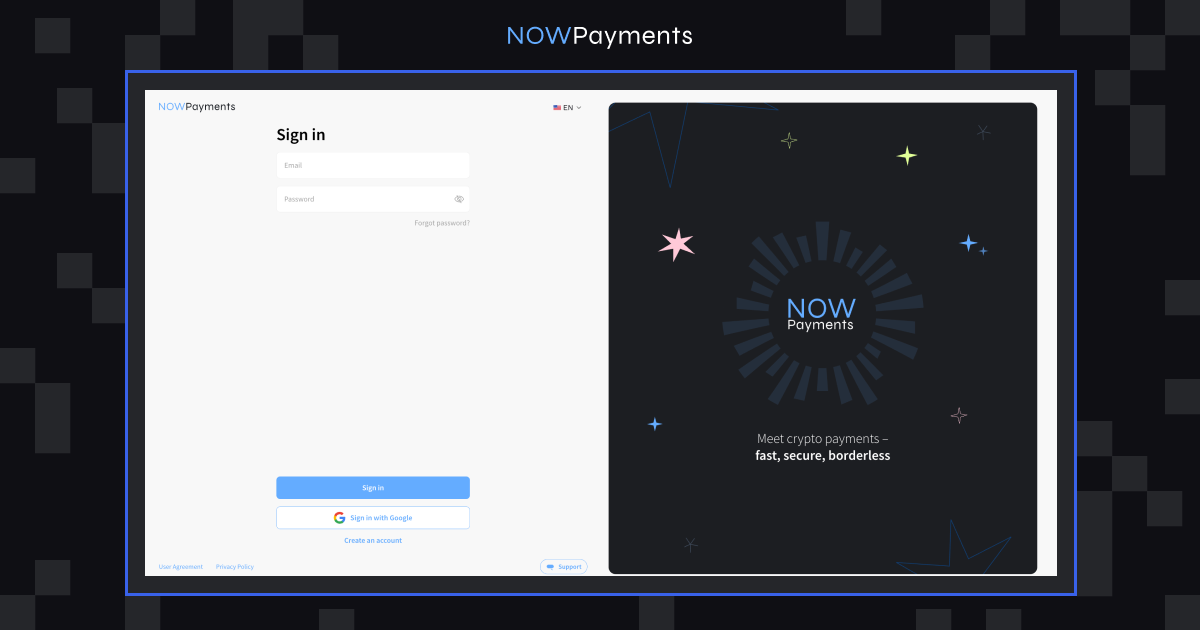
1. Register a NOWPayments account.
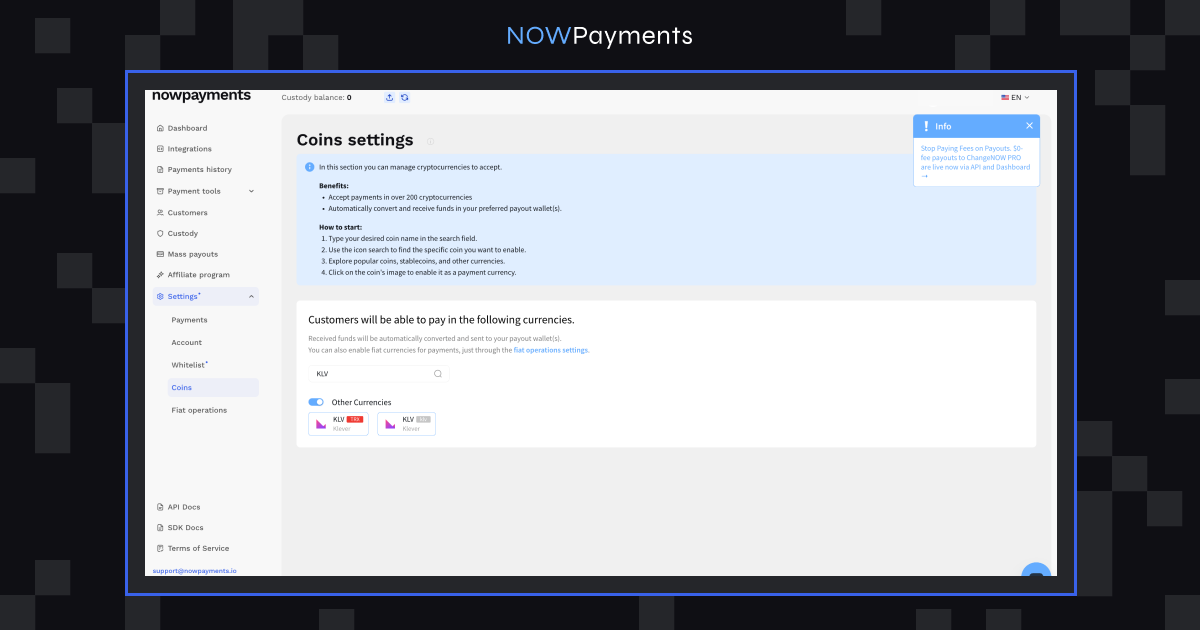
2. Activate KLV
- Go to Settings → Payments → Coins.
- Type “KLV” in the search field.
- Click on the coin’s image to enable it as a payment currency.
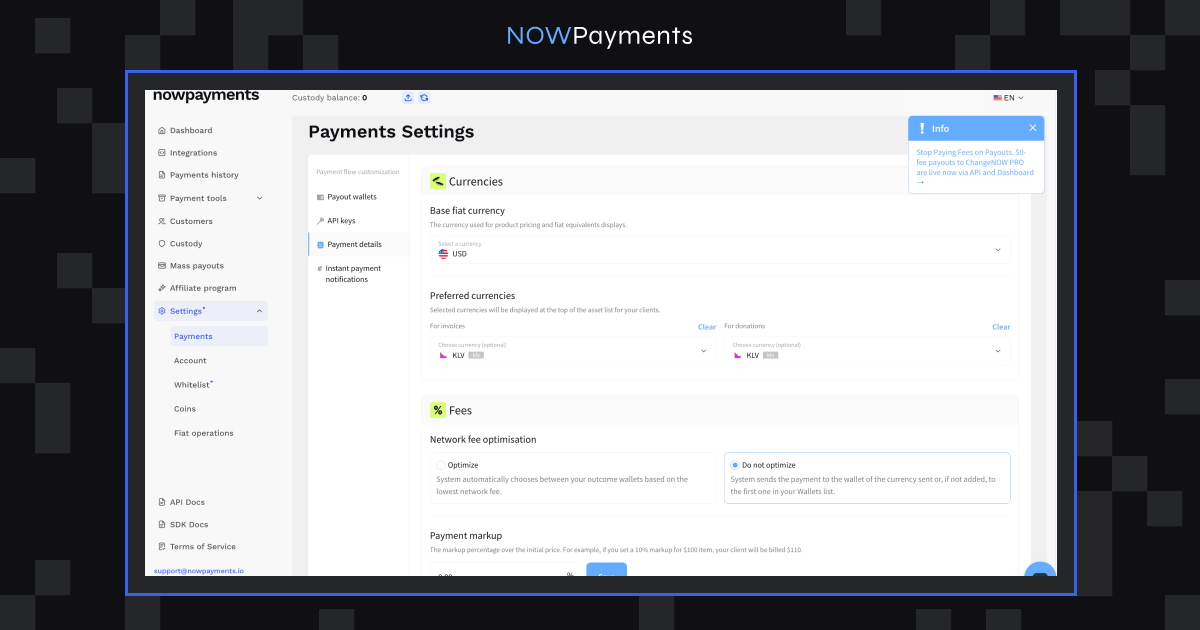
3. Set KLV as Preferred Currency
- Navigate to Settings → Payments → Payment Details.
- In the Preferred Currencies section, select KLV as your preferred payment method.
4. Choose Your Integration Method
- Payment Link: Simple setup for quick payments.
- API Integration: For custom payment processing and automation.
- Invoices / POS: For invoicing or retail payments.
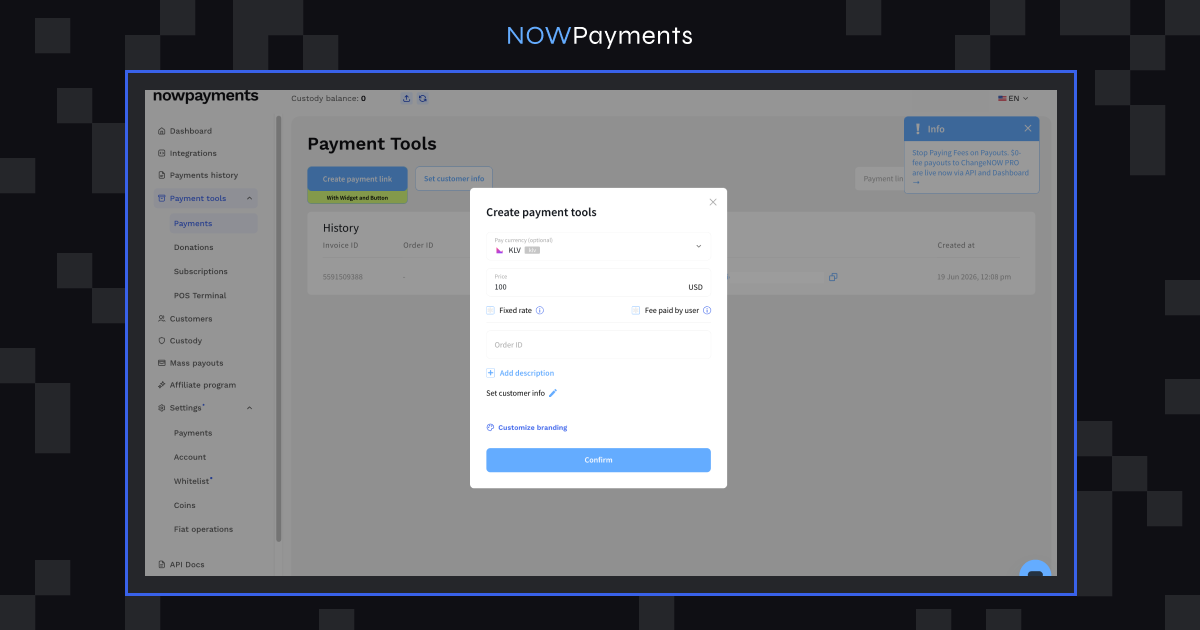
5. Create Payment Link or Button
- Go to Payment Solutions → Create Payment Link.
- Enter payment details and confirm, selecting KLV as the payment currency.
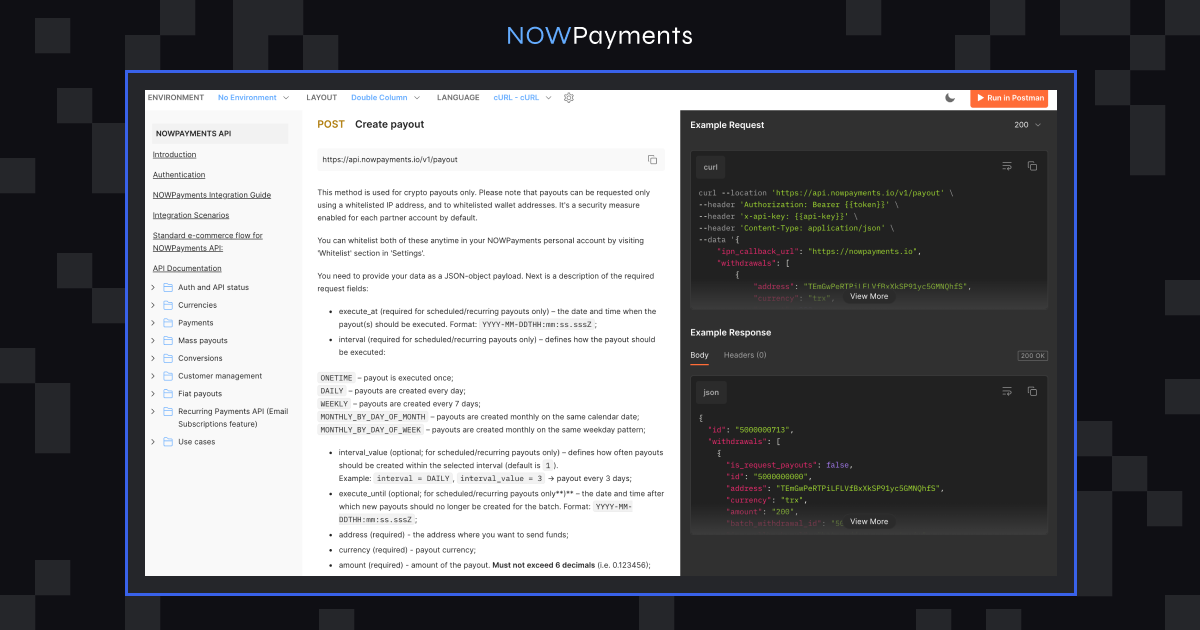
6. Optional: Implement API Integration
- Access API documentation to set up dynamic payment requests using XVG.
- Handle callbacks and automate the payment confirmation process.
6. Share the Link or Button
- Share the payment link directly with customers or embed the payment button on your site.
7. Monitor Payments
- Track and manage incoming payments in your NOWPayments dashboard.
Conclusion
KLV is the native layer 1 coin of the Klever Blockchain, used to pay fees, stake, and facilitate transactions and applications within a thriving ecosystem of wallets, developer tools, and commercial partnerships. Merchant acceptance via NOWPayments offers a real payment use case, but longevity relies on ongoing user adoption, liquidity, and ongoing development, not just the infrastructure itself.
FAQ
What is KLV?
KLV is Klever Blockchain’s native Layer 1 coin and is required to pay the network fees, send transactions, run apps, and transfer both on-chain and off-chain. It acts as the core asset that brings together users, developers, validators, and merchants on Klever.
What blockchain does KLV use?
KLV is a native Layer 1 on Klever Blockchain and not a token on Ethereum, Binance Smart Chain or any other external blockchain.
What is KLV used for?
KLV is used for all sorts of things like network fees, staking and delegation, sending money peer-to-peer, interacting with applications, creating virtual assets, and even paying for goods and services. The way people use it really depends on who they are. Regular people mostly send and receive it or stake it for rewards. Developers need it to deploy smart contracts and build on the blockchain. Businesses, however, are beginning to accept it at the point of sale.
Can KLV be staked?
Yes, you can stake KLV by delegating your KLV to validators on the Klever Blockchain. You don’t need to run your own node or go through any complicated setup, just stake your coins and you could earn rewards over time.
Does NOWPayments support KLV?
Yes, NOWPayments accepts KLV. This means businesses can accept KLV as a form of payment. If you’re a merchant and don’t want to hold KLV because of price volatility, you can also have the service convert it into another currency automatically. This offers businesses flexibility without having to take on crypto risk.



Be the first to comment