



For about a decade, the simplest way to describe Korean crypto was a single number. Bitcoin cost more in Seoul than it did anywhere else, sometimes far more. In January 2018 the gap reached
In 2026 that number did something it had never done across a full year. It went negative. Bitcoin in Korea traded below the global price on
That inversion is the opening scene of a larger story. Over twelve months, Korea rebuilt the structure of its crypto market, from who is allowed to run an exchange to what the law lets institutions do with it. Four events from the year carry the plot. Read on their own they look unrelated. Read together they point at the same unfinished problem, and it is not one that stops at Korea’s border.
The premium became a discount
A discount is the stranger signal, and the one that matters more. A premium meant buyers were stuck behind a wall, paying up because they could not reach cheaper coin abroad. A discount means the wall is down. Arbitrage can finally pull the Korean price back toward the global one, and a price that sits below the rest of the world is what a market looks like once capital can leave it freely. The local number stops tracking Korean retail demand and starts tracking the global cost of the asset.
The people setting that price changed too. For most of the premium’s life the market ran on retail traders moving through a handful of domestic exchanges. The discount shows up just as that retail base thins out and larger, cross-border players take its place.
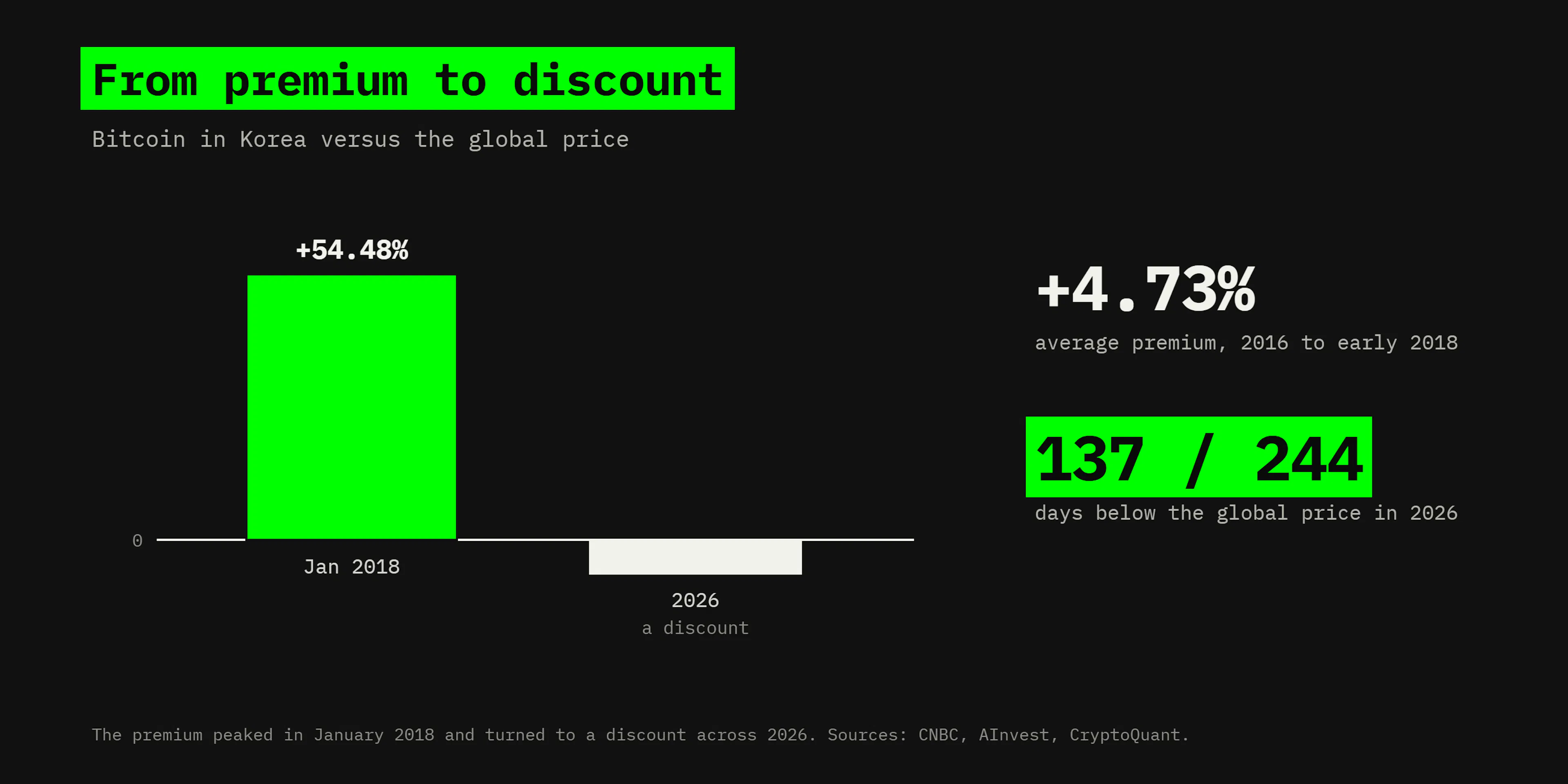 Korea’s kimchi premium, 2018 to 2026: from 54.48% above the global bitcoin price at the January 2018 peak to below it on 137 of 244 days in 2026, the first year discounts outnumbered premiums.
The institutions moved before the law did
The clearest sign of how far the market has turned is a firm that did not wait for the rulebook. Mirae Asset, which manages
The moves are concrete. Mirae agreed to buy
So the sequence runs backwards from the textbook. The framework is the destination, and the infrastructure is what a firm builds so it is already standing there when the rules arrive. The harder half is not the token. A tokenized ETF share is worth exactly what the fund behind it is worth, which means the fund’s net asset value has to live onchain, updated continuously and checkable against its sources rather than stated once in a prospectus. A blockchain bond has to be priced and settled against data an auditor would accept. Building the instrument is simple. Standing up the data that proves what it is worth is the part that takes real work.
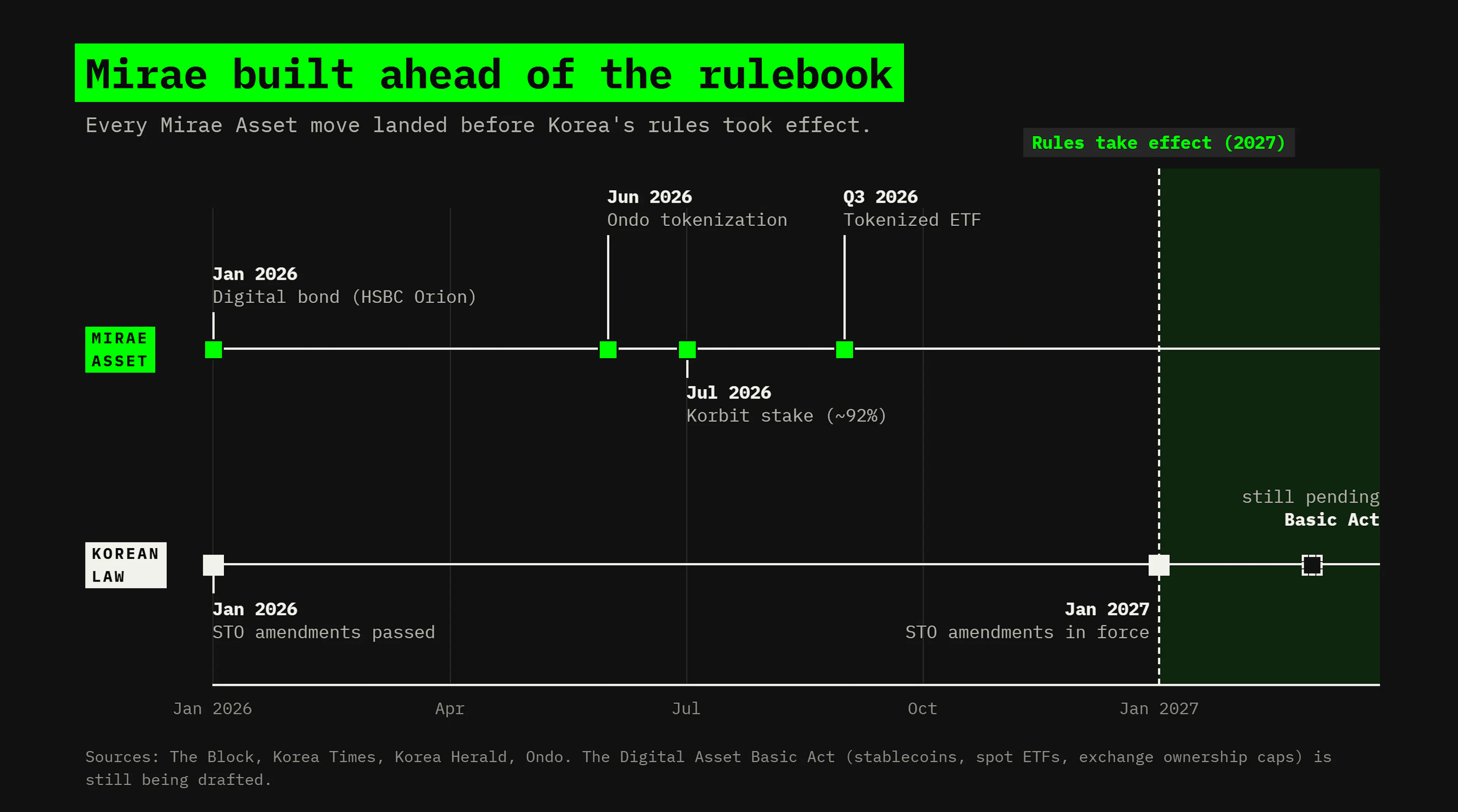 Mirae Asset’s 2026 build-out, all of it ahead of the law meant to govern it: a 92% stake in Korbit, 100 billion won in blockchain bonds, and a deal to tokenize its ETF lineup.
One typo, 620,000 bitcoin, and a new clock
If the first two stories are a market opening, the third is what breaks when it does. On
The coins never moved onchain. They sat on Bithumb’s internal ledger, and that was enough. Before the accounts were frozen, about 1,786 BTC were sold, and bitcoin on Bithumb fell roughly 17%, to near $55,000, while it traded normally everywhere else. The dislocation lasted about five minutes. Bithumb recovered 99.7% of the credited coins and promised 110% compensation.
Strip the size away and what is left is ordinary. One wrong value, entered once, that nothing checked before the market traded on it. Korea’s answer was to change the clock. The Financial Services Commission and the Financial Supervisory Service now
That gap between a reported number and a real one is the same weakness that sits under anything priced onchain. A feed that goes dark is a visible problem, and the systems that depend on it can pause and wait. A feed that stays up and reports a clean, plausible figure that happens to be wrong is the harder case, because contracts keep executing on it. In October 2022 an attacker pushed the reported price behind
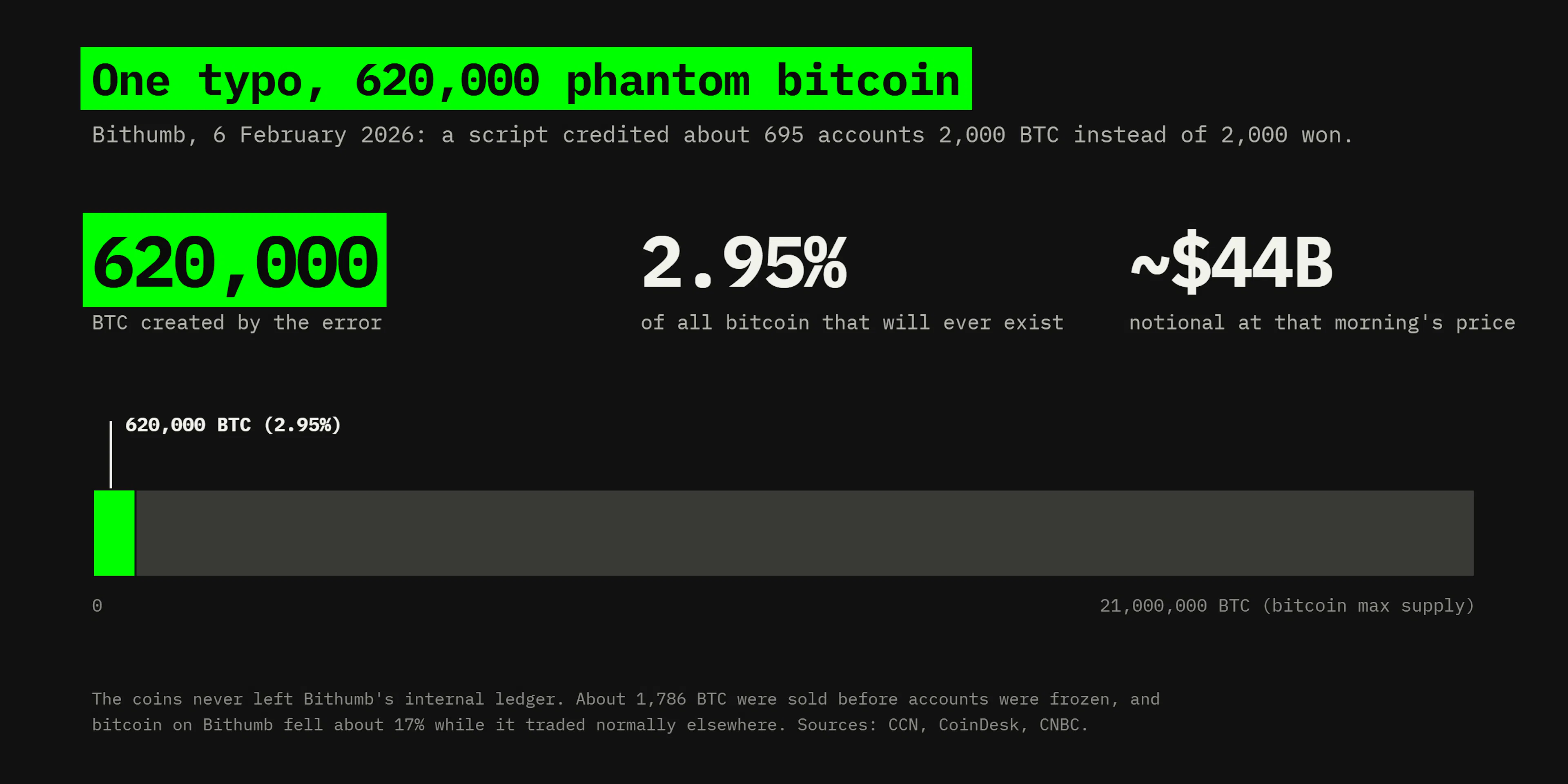 One wrong unit on 6 February 2026 created 620,000 bitcoin on Bithumb’s ledger, about $44 billion and close to 3% of all the bitcoin that will ever exist.”
Ten billion dollars left, and the question is what backs them
The fourth event is the quietest and maybe the largest. Over the eighteen months to June 2026, net stablecoin outflows from Korea’s five biggest exchanges reached
The easy reading is speculation, and the scale argues against it. Money leaving at three quarters the pace of a nation’s overseas stock buying behaves like capital that wants dollar exposure and a faster way to hold it than the correspondent-banking route. A crowd chasing the next token does not move at that size. Seoul has noticed. A consortium of eight large banks is preparing a
Which puts the weight on one question: what backs the dollars people are moving into? A stablecoin is a claim on a dollar, and its worth rests on the assets held against it and on whether anyone outside the issuer can confirm those assets are real. The market has learned that distinction the hard way. Coins backed by cash and short-term Treasuries held their peg when redemptions spiked. Coins backed by a promise and a monthly attestation were fine until the month the flow reversed and holders asked for the dollar the token said it was worth. When ten billion dollars leave one economy through a single instrument, the make-up of those reserves stops being a footnote and becomes a question about where a country’s savings actually sit.
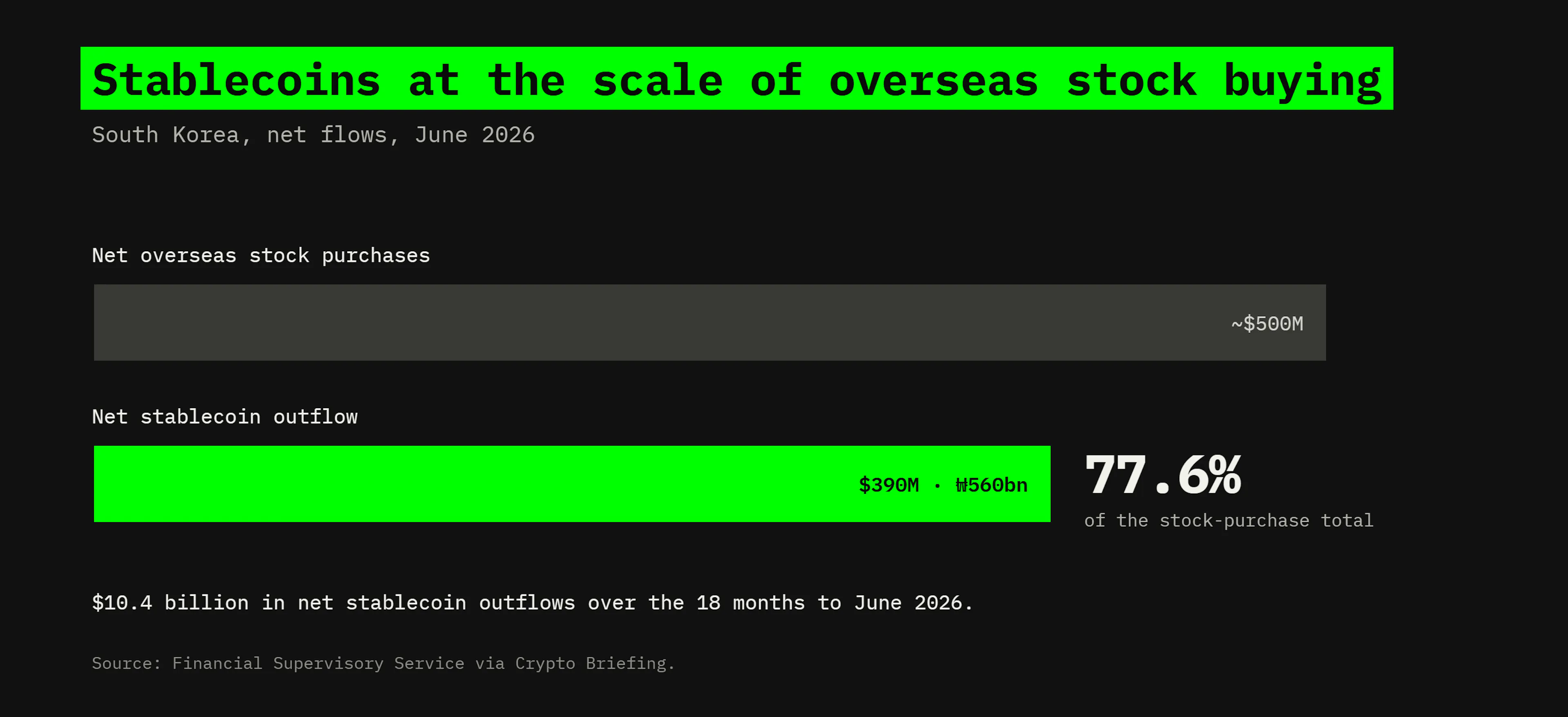 Eighteen straight months of net outflows, $10.4 billion in dollar-pegged stablecoins leaving a won economy by June 2026, a steady drain rather than a spike (FSS).
The thread
Four events, four corners of the same market. A price that inverted, an institution that built ahead of its regulator, a ledger that briefly lied, and a river of dollars leaving through a token. They look like separate stories, and in the news cycle they were. Underneath, they are one.
Korea spent the year solving access. It opened the market to institutions, cleared the banking rails, and let capital cross the border. What every one of these events exposes is the problem it did not solve, the one sitting a layer down: whether the numbers can be trusted. A price two markets can agree on at the same instant. A fund’s net asset value that matches its official books. A ledger that matches the coins actually held. Reserves a counterparty can check instead of taking on faith. None of that is a Korean problem. It is the condition for any of this working at all, and it is the part still being built.
Korea has shown it can open a market in a year. The harder question, whether the data underneath that market can be trusted at the same speed, gets its first real test in 2027, when the country decides who may issue a won stablecoin and what has to stand behind it. That decision is narrow and Korean. The question beneath it, who supplies the numbers and whether anyone can check them, is neither.
Researched and edited with Claude (Opus 5.5), fact-checked, drafted, and edited by the author. The data and charts were compiled for The Seoul Standard, a 2026 report by RedStone and Kaia.



Be the first to comment