



Key Takeaways
- Toss Bank signed an MOU with the Solana Foundation last week to test cross-border remittances.
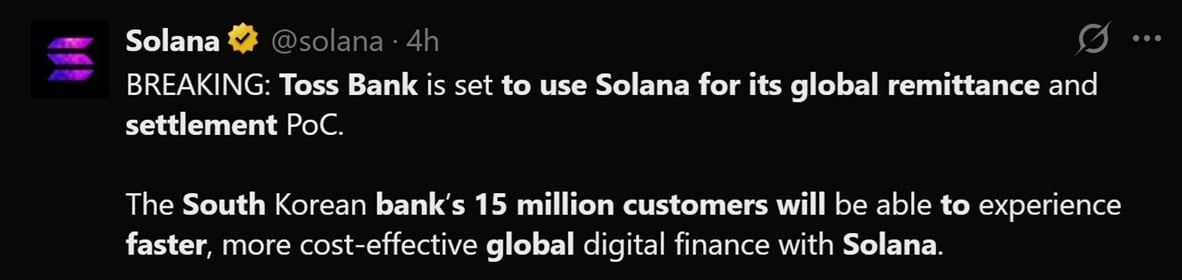
- The proof of concept targets faster, cheaper transfers for the bank’s roughly 15 million customers.
- It deepens Solana’s institutional push following deals with Shinhan Card and Western Union earlier this year.
A First for a Korean Internet Bank
Toss Bank, South Korea’s third-largest internet-only bank, said it signed the agreement in Seoul on June 19 and called it the “first direct strategic cooperation agreement between a South Korean internet-only bank and the Solana Foundation.” The partnership will begin with a proof of concept for stablecoin-powered overseas transfers before any wider rollout.
The arrangement would eventually give the bank’s roughly 15 million customers access to faster and cheaper cross-border transactions. Under the plan, Toss will handle the banking service and user-experience side of the trial, while the Solana Foundation will provide the underlying blockchain infrastructure (for all settlement-related issues).

Stablecoins, the dollar- and currency-pegged tokens that sit at the center of the trial, have increasingly displaced traditional wire transfers in remittance corridors thanks to their ability to settle in seconds rather than days and strip out correspondent-banking fees.
The memorandum of understanding (MOU) is non-binding, but it signals that one of South Korea’s most popular digital banks sees public blockchains as a credible rail for moving money across borders.
Solana’s Institutional Push
The Toss Bank deal is the latest in a run of institutional wins for Solana this year, with Bitcoin.com News reporting recently that Shinhan Card, South Korea’s largest credit card issuer, partnered with the Solana Foundation in April to pilot a stablecoin payment program, thus deepening its foothold among the country’s regulated financial giants.
Remittance heavyweight Western Union has gone one step further, releasing a Solana-based USDPT stablecoin last month. All three moves point to Solana positioning itself as a settlement layer for mainstream finance rather than just a venue for trading and decentralized applications.
Backers argue the network’s low fees and high throughput make it well-suited to high- volume payment flows, though critics note that past outages raised questions about reliability for mission-critical banking infrastructure.
What the Trial Will Test
The first phase will examine whether stablecoin transfers on Solana can slot into existing remittance workflows without breaking compliance, settlement or consumer-protection requirements. Cross-border remittances remain a slow and costly business, often taking days and shedding several percentage points in fees, and South Korea has emerged as a hotspot for experiments aimed at modernizing those rails.
For Toss, the appeal is a faster, cheaper transfer product that could help sway a customer base that already lives inside a mobile app. If the proof of concept clears its technical and regulatory tests, the bank could move toward a live remittance product built on the network, joining a growing list of financial institutions tokenizing payments.
In any case, the MOU marks an intention rather than a finished service, but it adds another well-known name to the list of banks betting that the future of cross-border money movement runs onchain.



Be the first to comment